
I’m currently writing a series of articles on the sacraments for the cathedral website. They are being posted here in case anyone wants to comment or ask any further questions.
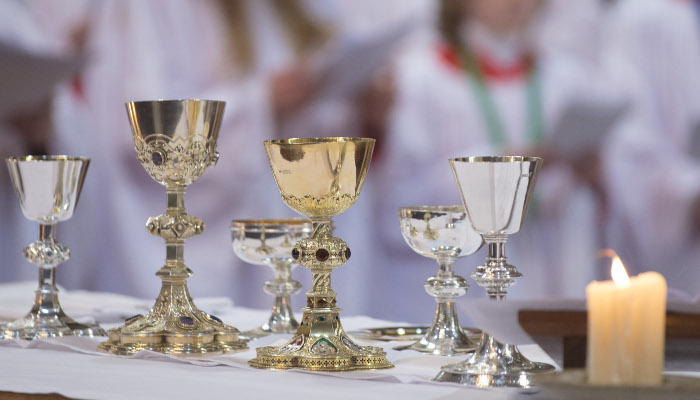
This article from the Provost will form part of a series on the sacraments.
Lots of different churches have different names for the meal of bread and wine that is central to the lives of almost all Christian traditions. Holy Communion, Mass, the Lord’s Supper, Eucharist are all names which refer to Christians eating bread together and drinking wine as Jesus did with his disciples the night before he died.
Here at St Mary’s the word we most often use is Eucharist. This comes from the Greek word that simply means Thanksgiving.
In the Anglican/Episcopal tradition which we are a part of, the service of communion is celebrated by members of the clergy who have been ordained to the priesthood and must always take place in the context of a congregation, even if there is just a congregation of one person. A priest can’t celebrate communion on their own. There is something about sharing that is an intrinsic part of what communion is about.
At St Mary’s Cathedral, everyone is welcome to receive communion. This includes young children who learn about the reverence and joy that are bound together in the sharing of the meal in the context of receiving the sacrament along with those who bring them to church. We believe that no-one should be able to remember being refused communion and that we learn what it all means by a lifelong engagement with God. Anyone who believes that they think they know exactly what communion means probably hasn’t realised that God has more to teach them yet.
Christians speak of the bread that is shared as the Body of Christ and the wine that is drunk as the Blood of Christ. The simple bread and wine become in the course of the service powerful symbols that connect us with the life and death of Jesus Christ. As a sacrament it is an outward sign of inward grace. That means that the rich symbolism of communion speaks of something that is happening to our souls when we receive the bread and wine. The ritual or liturgy by which we receive the body and blood of Christ itself forms us and shapes our lives. By participating in this meal we come close to God. At St Mary’s we share communion every Sunday of the year and also on the major feast days – days on which we remember something special that happened to Jesus or the major saints who have witnessed to Christian life since Jesus was on earth.
One of the ways to develop as a Christian is to take on the discipline of receiving communion at least once a week.
The sharing of communion is a mysterious thing. It happens in our current time and place but connects us with Christians through the centuries and all around the world in our own time who are sharing the same meal.
People often ask what actually happens to the bread and wine in the course of communion. People who come to St Mary’s from a Roman Catholic background sometimes want to know whether we believe in transubstantiation. There would be many ways that people in the congregation describe what happens at communion but probably the way of describing what happens that would unite most people would be to say that we believe in the real presence of Christ in the sacrament.
At the moment in the service when the priest asks the Holy Spirit to come upon the bread and wine and upon the people (another Greek word: epiclesis – calling down the Holy Spirit from on high) many members of the congregation make the sign of the cross. This connects us as individuals with what is happening at the table and is a powerful reminder that this is all being done in the context of the love of God which took Jesus to the cross and that each of us are changed by God by our participation.
One special use of communion in our tradition is that we sometimes share communion at funerals. This is a fitting and very beautiful way to give thanks for the live of someone who was themselves a communicant member of the church. We also have an annual service on or about All Souls Day – 2 November each year at which we remember those who have died in the context of a communion service. A communion service which has the intention of remember the dead is called a requiem.
Communion is the central act of worship in a church like St Mary’s. The building is primarily designed for the celebration and sharing in this meal.
We believe that God is present when we share bread and wine at the altar. This leads us to believe that God is present at every table everywhere and that when God’s people share food they are saying something about the way we believe that the world should be – a way of life which we sometimes refer to as the Kingdom of God and which we believe is close at hand.
Frequently Asked Questions about Communion
I can only eat gluten free bread – does that mean I can’t receive communion?
No – gluten free wafers are available in St Mary’s. They are square rather than round so we know them from regular wafers. Please tell one of the stewards when you come in that you need a gluten free wafer and tell the priest at the altar if they are unaware that you need one.
I can’t drink alcohol – does that mean I can’t have communion?
No – if you receive just the bread (sometimes called receiving in ‘one kind’) then you have fully received communion. If you wish to acknowledge the chalice then you may wish to touch it or kiss it rather than take a sip of wine.
I’m squeamish about drinking from a common cup – can I dip my wafer in the wine?
Don’t be squeamish – we use fortified wine which kills off germs. If you have something infectious yourself, please don’t receive the wine but receive in one kind. Please don’t take your wafer in your hand and dip it in the chalice (sometimes called intinction) as it spreads more germs than simply taking a sip from the cup which is wiped after each person has received.
Do you believe in transubstantiation?
We believe in the real presence of Christ in the sacrament.
But do you really believe in transubstantiation?
We believe in the real presence of Christ in the sacrament.
You don’t believe in transubstantiation do you?
We believe in the real presence of Christ in the sacrament.
What happens to the bread and wine that are not used up after communion?
We reserve bread and wine in church in a tabernacle on the High Altar. They can be taken from there to those who are too sick to come to church.
The bread and wine that are reserved remind us that Christ is here. Some people like to acknowledge the presence of Christ in the church in this way when they come into the building or approach the high altar by going down on one knee (called genuflecting) or bowing. The sacrament is not reserved between Maundy Thursday and Easter Day, a time when sacraments are not celebrated and so we don’t bow or genuflect at that time.
Can I receive the wafer on my tongue?
Yes – but most people receive the wafer in their hand and then eat it. There is nothing holier or more virtuous about receiving it directly on the tongue and it is much easier for the person giving communion to put it in your hand.
I don’t want to receive communion – is it compulsory at St Mary’s?
If you are at a communion service in St Mary’s and don’t want to receive communion you are welcome to approach the altar with everyone else carrying a service sheet in your hand. That will indicate to whoever is distributing communion that you’d prefer to receive a blessing than to receive the bread and wine.
Do you really mean it when you say that everyone is welcome to receive communion.
Yes. Unless the Scottish Episcopal Church has explicitly forbidden you to receive communion (very, very rare indeed) then you are welcome to receive communion here whoever you are and wherever you are from whether you have been here many times or whether this is your first time in the building.
Any more comments or questions?

Leave a Reply