
• Every Eucharist is a Virtual Eucharist

    Heaven

    Every Eucharist is a virtual Eucharist. Of course it is.

    We know this.

    We experience this.

    We forget this.

    Christianity – at least the bits of Christianity that are worth taking seriously – takes time and space so seriously that it knows that the particular cannot ever express the ultimate. Indeed, time and space are playthings in the hands of the religiously inspired.

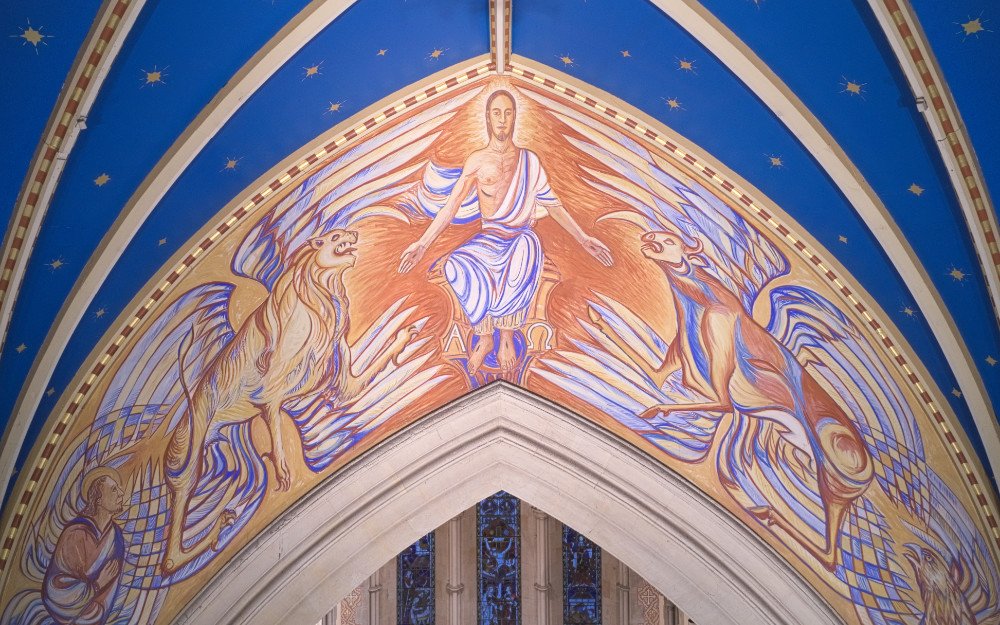
    Over the last few months it hasn’t been possible for my congregation to celebrate the Eucharist together in one space. But when we used to do that, we were never entirely in one space anyway. The very building itself is designed to transport people from the knowledge that they are a few yards from a busy thoroughfare in the Second City of Empire. Taking a few steps inside we find that we are in another place altogether. And in another empire, where the Emperor is servant of all and love is the essense of the law. The conceit that going into church takes you into a divine, heavenly realm is not an idea exclusive to the East. Coming into St Mary’s you are supposed to feel that you are stepping into heaven. It has been built to make you feel that. It has been decorated to make you feel that.  It does make people feel that.

    Whenever I take people into church I almost always hear them express a sense of wonder. We have the wow factor. It has been created by human skill to make you feel that the reality that you experience as you stand in the street is not the only reality that you can experience. It is a space that conveys that love, joy and peace might be possible and it does that without words. It is done with beauty and it takes people a few steps up the stairway to heaven.

    And it is the church playing with reality.

    That experience of going into a holy space and feeling part of something bigger is something common to religions that are divided on all kinds of doctrinal matters. It points to things that are best expressed through virtual reality and religious people are so used to virtual reality that they sometimes forget that it is all around them.

    When people come to the Eucharist in St Mary’s they are at once in Glasgow and simultaneously elsewhere. And elsewhere isn’t even singular either. At the Eucharist in Glasgow we are at one and the same time in an Upper Room in Jerusalem rather a long time ago and at the Wedding Feast of the Lamb at the ultimate consumation of all that is. The Last Supper and the Breakfast at the End of the Universe happen at the same table. At the same time.

    And as we gather at our table, we gather at every table and eat in communion with those who share in the same meal. Our fellowship with them isn’t prevented by circumstance. Our Eucharistic fellowship has never been prevented by circumstance or lack of physical proximity.

    We couldn’t keep the Triduum in Holy Week without virtual reality.

    Without virtual reality it would just be a way of making feet smell less.

    Without virtual reality it would just be a bonfire that would die.

    Christ is the celebrant at every Eucharist no matter which particular celebrant is standing there. Virtual reality becomes interwoven with the reality of the lives that we bring to the table and we are formed and changed and made new. It is how God’s love is expressed.

    This is virtual reality. Every Eucharist is a Virtual Eucharist. Cyberspace is one of the most powerful metaphors for prayer that human beings may ever develop.

    Our bodies are bound by physics.

    God’s love in this world isn’t.

    This is why religious buildings are important. It is also why they are not important.

    Every Eucharist is a Virtual Eucharist.

    Every Eucharist always was a Virtual Eucharist.

    Of course it was.

9 responses to “Faith and Order Board Business – the Anglican Covenant process”

  1. kelvin Avatar

    Tim Daplyn – says that the Indaba process is not a normative process but something which means many things to many people. We have no rules of procedure. Asks if the feedback from Indaba will be incorporated into synod. is is canonical. Indaba was designed for African situation not our own.

  2. kelvin Avatar

    Chris Mayo – history is replete with turning points. We are at a turning point. Covenant process is laiden with emotion. People making up their minds at an early stage. Some see it as taking away our identity. Others see it as essential in a chaning environment. Question today is about moving on the journey. Thinks it would be abbrogation of responsibility to turn down this motion. We have a voice the punches far above our weight to communion.

    1. kelvin Avatar

      I speak and ask for material for dioceses to consider which puts a different position to that put by the Anglican Comminion Office.

  3. kelvin Avatar

    Grant Swain speaks in favour of the covenant and says that we would be left out in the cold by refusing to sign. Says that we must be there. But, our strength lies in being undecided. He supports the motion and says that we must sign the Covenant so we can mediate between extremists both in and outside our church. Talk is needed. But we need to be

  4. kelvin Avatar

    Lawrie Scrimgeour – asks since Independence is on the agenda, in this motion we are talking about Independence. Has the faith and order board considered a referendum on the question of the Covenant.

  5. kelvin Avatar

    Anne Pankhurst – notes that the Faith and Order Board say that there could be other processes. She says that we could end up with a Canon which was very difficult to change. She asks for further enlightenment.

  6. kelvin Avatar

    Bishop of Glasgow (Acting Convener) responds: Synod does seem to have the capacity to decide to adopt the process outlined. Responds to my suggestion by saying that he will take those views back to Faith and Order Board. He says that the Process itself takes no view on the Covenant. Synod is the only legally competent body to decided it. A referendum has not been considered and he believes it would not be canonical. Faith and Order Board has considered the posibility of remaining undecided.

  7. kelvin Avatar

    Bishop of Argyll says that Indaba process is a way of giving everyone a voice in a transparent way. We are trying to talk this year and explore the issues in depth. Next year a canonical process. Everyone will see everything that has been said in the Indaba process. The process is no in camera or in committee but a way of giving everyone a voice.

    1. kelvin Avatar

      Motion is carried – I think about 12 – 15 people voted against and 1 or 2 abstentions. So, we have a process for considering the Covenant.

Leave a Reply

Your email address will not be published. Required fields are marked *

Previous Posts

  • Generous Episcopacy: The Rt Rev Michael Hare Duke RIP

    I gather from a twitter correspondent that the Rt Rev Michael Hare Duke has died. Bishop Michael was the bishop with whom I first tested my vocation. Having been a bishop since 1969, he saw and influenced the entire modern story of the Scottish Episcopal Church. Where to begin with memories? The time I sat…

  • The Peace and Unity and Order of the Church

    One of the things that I’ve occasionally raised in blog posts is the question of whose responsibility it is to promote the unity of the church. I think this was focused for me particularly at the consecration of the Bishop of St Andrews, Dunkeld and Dunblane just over 9 years ago when the preacher preached…

  • New Statement from College of Bishops

    There’s a new statement from the College of Bishops today about same-sex marriage. It can, and should, be read in full – see here: College of Bishops Guidance re Marriage 2014 I’m appalled by its contents and in particular appalled at the way the Bishops of the Scottish Episcopal Church are treating gay clergy and…