
 So, here’s the thing. You’re sitting in your rectory in the Wolds of Nether Essex and turning the wireless dial at the end of a long day in June. Through the crackle and fizz of the static you finally find the Home Service and a plummy voice says with just the tiniest hint of surprise: “The Scottish Episcopal Church agreed overwhelmingly today at its General Synod in Edinburgh to allow gay couples to get married in its churches, becoming the first Anglican church in the UK to do so”. And you are suddenly agog. Could it be, you wonder, that there is another way of being a priest in these islands which might suit you down to the ground? Could it be that you should shake the dust of Basildon and Billericay from your feet and move to Banff or Buchan where the rainbow flag of freedom surely waves proudly in the sky? Your mind starts to imagine swapping Clacton-on-Sea for the true liberty of living in Clackmannanshire. “Harlow Nae Mair!” you cry as you imagine yourself marching with the kilt-clad masses at Helensburgh’s famous Pride March.
Before you know where you are, you are reaching for the back pages of the Church Times and applying for anything north of the border and wondering where you buy Episcopal plaid because the Holy Spirit in her infinite wisdom has revealed to you a sudden and previously unexplored call to the Scottish Episcopal Church that simply can’t be argued with.
Well, if you do seek to live out the Scottish Option, what will you find? We’ll get to the sex bits further down the post but there’s quite a lot to talk about before we get there.
The truth is, there’s quite a lot of comings and goings between the Scottish Episcopal Church and other provinces of the Anglican Communion. One of the things that matters about the Anglican Communion is that it is relatively easy for those working in one part of the world to move to another part of the world. If you are priest (for example) in one place, then you are regarded as a priest in all places of the Communion. That’s kind of the big idea.
We see quite of lot of trade between the provinces of Scotland and England. The idea of full communion allows people from the Scottish Episcopal Church to work in the Church of England and vice versa. Well, that’s the theory though in reality some people are in fuller communion than others – I would struggle to work in Englandshire as I can’t affirm things that they’ve added to the Creed as essential such as the Five Guiding Principle of the Church of England guaranteeing the flourishing of those opposed to the ordination of women and I could never agree that I would only have a relationship with another man if I was prepared to lie about it to my bishop. But anyway, there’s full communion for some people and come and go they do.
There is quite a lot that is very attractive to people from the C of E coming north. However, one of the most difficult things about making that journey is that from a distance things look the same when in fact they are completely different.
Here’s a few things that are very different that people thinking of hitching their wagons and travelling north need to think about.
Well, the first thing that you need to think about when it comes to moving to Scotland is that you are going to have a relationship with your bishop. More so than you’ve probably had before. Not only that, but the bishop may well have a relationship with members of your congregation in a way entirely unlike any relationship that you’ve witnessed in the Church of England. I would expect a bishop in a Scottish Episcopal diocese to know all the clergy by name and that they would also know key individuals in the congregation too. We are a much smaller church and that means that we relate completely differently. You are almost always relating to people whom you know rather than nameless officials. There’s an upside to that but there’s a downside to it too that you’ve probably not thought about. To put it bluntly, there’s no-where to hide.
Not only do I know my bishop but I also expect to know all the bishops of the church. I get to deal with them in the course of provincial business (we’ll come to that in a bit) and I would expect that if I had any cause to pick up the phone, I’d get through to any of them quickly and they would know who I am. (And I expected that when I worked in Bridge of Allan too, it isn’t simply because I work in a relatively high profile place).
When it comes to dioceses, don’t forget that there might be no-one in the diocesan office except the bishop, an administrator and maybe a Diocesan Secretary and or Treasurer who themselves may be very part time. Here in Glasgow the diocesan operation consists of a bishop, a canon missioner (currently on maternity leave), three part time people in the diocesan office doing administrative roles and the Diocesan Secretary and the Diocesan Treasurer who work part time and receive a small honorarium rather than a salary. There are no departments. There are hardly any experts. There’s no professionals. There’s just a few people holding things together who are supported by clergy and lay people from around the diocese volunteering to run various small programmes, some of which are almost invisible. It looks hand-knitted. It is hand-knitted.
The kind of clergy who tend to enjoy working in Scotland tend to be Jacks or Jills of all trades – generalists who can throw their hand to anything that their congregation throws at them whilst also join in running some Committee or Board either provincially or in the diocese.
See that word province – that’s how we talk about the Scottish Episcopal Church. It is a province of the Anglican Communion. Coming from England, you’ve probably never really thought of the Church of England as being a province of anything. (And here we’re talking about something quite different to the Provinces of York and Canterbury). You probably think a province is some kind of colonial outpost. Work in Scotland for 2 minutes and you’ll suddenly discover things about Anglicanism that you’ve never thought about in your life before. You’ve probably never realised that most Anglicans are non-conformists, people who worship in churches that are completely separate from the state and which receive no state funding. Here in Scotland you’ll find that you’re not in the most populous church nor even the second most populous church. The Church of Scotland and the Roman Catholic Church are each about 10 times the size of the Scottish Episcopal Church. As an Anglican, you’re very much in a minority. As most Anglicans in the world are.
“Oh, you elect your bishops” you cry quaintly. Yes. That’s what Anglicans generally do. Never forget how odd the idea is that Anglican bishops are appointed rather than elected nor how curious the idea of them being appointed in the name of the head of state.
Don’t forget – the Queen is a Presbyterian.
Don’t forget – the Archbishop of Canterbury has no jurisdiction in this realm of Scotland.
Don’t forget – the Church of Scotland is not something you belong to and if you ever refer, even by accident, to the Scottish Episcopal Church as the Church of Scotland you might as well wear a large garish sign around your neck bearing the words “foreign ignoramus – do not take me seriously”.
When it comes to the Church of Scotland you may not understand the fury that the Columba Agreement unleashed until you’ve been here for some time but don’t underestimate it before coming to work in Scotland. Remember that many if not most priests in the Scottish Episcopal Church don’t really think that ministers of the Church of Scotland are or should be interchangable with priests ordained in our own church. Remember too that most Scottish Episcopalians going to a communion service in the Church of Scotland will happily join in and receive the bread and whatever it is in the cup and think loving thoughts about Jesus but may still feel that something was missing that didn’t make it feel quite the full bhuna. The statement in the Columba Agreement that Holy Communion is rightly administered in the Church of Scotland felt like a very foreign statement. The blunt reality is that lots of Episcopalians don’t feel that way about it.
But wait – before you get uppity on someone else’s behalf, don’t forget that we tend to feel the same way about worship in the Church of England. Take us down to Englandshire and we’ll try to be well behaved but inside we are still rolling our eyes at the Eucharistic prayer (if we can spot it) and on coming home we’ll readily say that there seemed to be something missing somehow.
That’s hard to understand. But look up epiclesis and realise that it isn’t just a word or an nice prayer – it is something that we think a reality.
There’s a lot of other politics to get your head around – both ecclesiastical politics and actual political politics. It is made more difficult because it isn’t all entirely settled and individuals may not entirely seem to be making sense.
Take me for example – I’m in favour of the United Kingdom because I care about the poor child in Carlisle as much as I care about the poor child in Carstairs. For that reason, notwithstanding the fact that I have no truck with the current UK government, I reject Scottish Independence. However, when it comes to religion, I’m the very opposite – hastily defending the independence of the Scottish Episcopal Church. Should the Archbishop of Canterbury put a toe over the border (something which does happen from time to time) you’ll find me suddenly taking on the role of William Wallace, picking up my two edged sword of destiny and whirling it around my Saltire be-painted head to defend the true religion from interlopers. Well, I do this using twitter, but you get the idea. Does this entirely make sense? No. Is it entirely real? Yes.
And it isn’t just me. You’ll find all kinds of things that don’t at first appear to make any sense should you move up to a charge here.
What’s that, you ask, a charge? What’s one of those?
Well, a charge is what we sometimes call a congregation or group of congregations. What else would you call a congregation without a parish?
Yes – learn this and learn it good before you even pick up a pencil to encircle a Scottish advert in the Church Times – there are no Anglican parishes in Scotland. Not one. Zilch. Nada.
Come to Scotland to work and you’ll not be working in a parish. No parish funerals. No parish weddings. No parish schools. Nothing like that at all.
You’ll be working for the people who appoint you and pay you – your congregation. Yes, that’s right, they actually pay you with money that comes from their giving. It isn’t the diocese who pays (though the diocese may appoint a paying officer to gather the money and run a payroll system). It isn’t the province. It isn’t the Queen. It isn’t the Church Commissioners. (Church who?) It is the actual people you will be preaching to on a Sunday who have to dig in their pockets and find your stipend. That’s a fundamentally different situation to that which you’ve experienced before if you’ve worked in English parishes. Make sure you understand what that will feel like. Think of it more like being a chaplain to people who happen to like worshipping this way. People are often rather derogatory when they refer to working in “chaplaincy mode” to keep a congregation going. They forget that chaplaincy models are mission models wherever they are found – just ask a chaplain.
With regards to worship, most but not all of our congregations are liberal catholic to one degree or another. Vestments are usually worn. The sacrament is usually reserved. The liturgy that we use is one that we are rather proud of.
Being a priest in Scotland is about gathering a congregation. It isn’t particularly about offering the ministrations of religion to everyone in your local territory. Someone has that responsibility and it isn’t you. And no matter how important you think ecumenism is, you’ll realise very quickly that you are not running the show.
Talking of ecumenism, ever wondered how it feels if you are not the top dog church? No, you haven’t. Of course you haven’t. You’ve never even thought of the question. But start wondering, particularly if you want to work well with others here.
I happen to love the Scottish Episcopal Church – love it more than is good for me some would say. I think that being a priest in the Scottish Episcopal Church is one of the most rewarding things anyone can be called to do. I also think we’ve got stuff for sharing as we attempt to make Jesus known in the world. Stuff to be shared in Scotland and stuff to be shared beyond Scotland. This is a great part of the vineyard in which to work. However, it is only a good part of the vineyard in which to work if you’ve really thought through how different it is from where you’re coming from.
Don’t assume you understand anything about moving into ministry if you are coming from England.
By the way, we’re as friendly as we’re feisty. We think the two things go together. Odd, isn’t it?
Now before I sign off, and you go to buy your kilt for your interview, what about the sex bits.
Firstly, if you’ve heard about the Scottish Episcopal Church’s recent decision about opening marriage to same-sex couples and think you can come up here because anything goes – please forget this and see a qualified therapist. The truth is, gay couples in the SEC are going to get the opportunity to be married because generally speaking their relationships look to those around them like a stable sacramental way of life that they already recognise. If you want a life of flighty gay fancy, you are probably looking in the wrong direction by looking north.
However, it is the case that I suspect that there will be people who look at the decision that we’ve made and the way that we’ve made it and think that they would quite like to be part of a church that behaves as we have done. I don’t think that will be limited to gay folk either. The truth is, we’ve worked hard at that decision and gone about it in as grown up a way as any church I know. There’s plenty of room for clergy who want to live and work in a church like that and who think that there a chance that God is calling them to help congregations in Scotland to grow a bit.
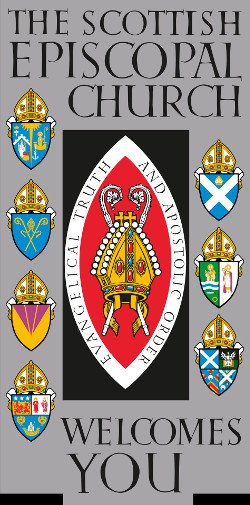
If that’s you, we need you. Not only that, we’ll love you and we’ll welcome you.
It says so on the sign by the door.
PS – We don’t have flying bishops. I hadn’t thought of mentioning this because, well why would anyone ever come up with the idea of flying bishops and think it was a good idea? However a friend contacted me and suggested I make it crystal clear as those coming from the south might wonder.
All our bishops ordain men and women. We don’t have any resolutions suggesting that some priests are not really priests.
In a sane church you wouldn’t, would you?
PPS – for what it is worth, I think that it is a very difficult thing to move successfully into Episcopal ministry (ie being elected bishop) in another province of the Anglican Communion to the one you are working in. It might work but there are plenty of examples of people who just didn’t know what they were letting themselves in for. I’d say that I’ve seen more examples of people trying to do that who have ended up miserable than I would have liked to see. It shouldn’t be surprising that it isn’t an easy transition to make. However, I’ve known several who just didn’t bank on how different it all is. See above.


Leave a Reply