
• 10 Thoughts on the Blessing of Asparagus

    It seems that Worcester Cathedral recently had a service for the blessing of asparagus.

    As this is a matter that might be seen to have consequences for the wider Anglican Communion, I thought I’d offer a few thoughts.

    1. There can be no justification for blessing asparagus as asparagus is never mentioned positively in the bible. There is simply no biblical case for blessing asparagus. None at all. If God had wanted asparagus to be blessed, then surely Jesus would have blessed asparagus at the last supper. (1 Corinthians 15:3)
    2. In fact, we know that asparagus should not be blessed because Genesis says so. “In the course of time Cain brought to the Lord an offering of the fruit of the ground, [asparagus] and Abel for his part brought of the firstlings of his flock, their fat portions. And the Lord had regard for Abel and his offering, but for Cain and his offering he had no regard.”  (Genesis 4: 3-4). You can’t pick and choose what the bible says. God’s holy word is clear and lasts forever.
    3. The blessing of asparagus promotes and validates the asparagus lifestyle. How will the church as a whole be able to maintain moral standards in one part of the world if asparagus is blessed in another? (Matthew 5:48)
    4. If we start blessing asparagus then it automatically follows that people will demand blessings for other kinds of vegetables. Although one might not personally object to the blessing of asparagus, one must take into account where this might lead. God will not be faithful to those who bless asparagus. (Amos 5:14)
    5. It would be entirely acceptable to offer a Thanksgiving for the Picking of Asparagus provided there are no rings used to hold the asparagus and any blessing must be upon the asparagus pickers and not the asparagus itself. (Ezekiel 44:30). The blessing of asparagus itself is sinful.
    6. The Archbishops have issued the following statement: “No asparagus is a problem, or an issue. Asparagus is made in the image of God. All of the asparagus, without exception, is loved and called in Christ. There are no ‘problems’, there is simply asparagus. (Romans 8:28) However, in order to maintain the unity of the church, it remains the case that asparagus blessings fall outside of that which is permitted for clergy of the Church of England following the last agreed Lambeth Conference statement on the matter. Clergy should continue to explore the maximum freedom possible when encountering asparagus whilst remaining within current guidelines. (Philippians 4:5)
    7. It remains the case that we all strive towards good disagreement (Philippians 4:2) about asparagus blessings whilst forbidding entirely the actual blessing of asparagus
    8. You cannot serve God and asparagus. The love of asparagus is the root of all evil. Do not associate with other eaters of asparagus. (1 Corinthians 15:33)
    9. There is an additional argument against the blessing of asparagus which stems from tradition. There should be no blessings of asparagus until the major churches who have the apostolic succession make an agreed statement on asparagus. This might be achieved in the form of an Ecumenical Asparagus Council of the Church however there remains some disagreement about who has the authority to call such a Council. (1 Corinthians 11:2)
    10. Always remember that God loves asparagus and that there have been some fine and courageous examples of self-giving asparagus throughout history. Many people are able to testify that some of their best friends have even eaten [unblessed] asparagus. So long as the church exercises gracious restraint in blessing asparagus, it will be possible for people to hear about the unique gifts that asparagus brings to the world. It may even be that God has a purpose for asparagus. (Exodus 9:16)
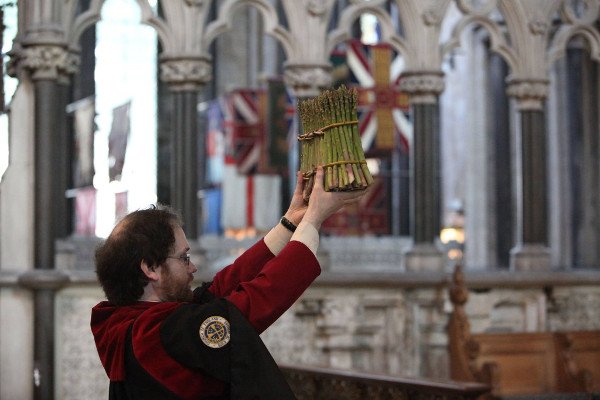
    the offering of the asparagus

    Save

    Save

    Save

    Save

52 responses to “Inclusive Language – again”

  1. ryan Avatar
    ryan

    Kelvin – that cracked me almost as much as your last tweet on the left of your blog ;-)!

  2. Jimmy Avatar

    Ryan, although you address your comment to Kelvin like I am not there. I assume you are referring to my poem, I can assure you that it does not crack me up watching you making any opinion you may have untenable.

    1. kelvin Avatar

      No Jimmy – I think Ryan was indeed referring to my last comment, above.

  3. Jimmy Avatar

    Thank you Kelvin and Sorry Ryan.

  4. ryan Avatar
    ryan

    No worries! Was indeed referring to the v.amusing coming out day tweets at the side.

    I’m not sure there’s ever existed anyone, anywhere,at any time, of whom it could be said that *all* their opinions are ‘untenable’, so such rhetoric is dehumanising at best. Apropos nothing, I was moved to google the poetic stylings of the great David Brent. Who needs Auden? 😉
    http://murfinsandburglars.com/2009/04/14/bad-poetry-for-tuesday-david-brent-edition/

  5. Peter Avatar
    Peter

    Kelvin; no, I think it distracts. It simp;ly reminds us that this is how your mind works: you make connections and delight in that sort of word-play. However, to sharpen up my point. Thank you for helping me to realise that, for some, ‘family’ is not a positive word in the way in which I experience it. For my part, this willl mean that I will be more careful about its use when others might feel excluded (and therefore hurt). Mutatis mutandi can you accept that I feel offended by what seems to be merely a casual linking between family and the f word? These are sensitive areas, but sensibilities are by no means confined to those who find family a painful or unhelpful concept.

  6. Simon Avatar
    Simon

    I am slightly nervous aboaut the alternatives to the 1982 Liturgy, not because I don’t share the inclusive sentiments expressed above (I do). I fear that, as so often in the history of the church, the steps we take to avoid one kind of mistake in the way we talk about God can lead us into another. The avoidance of pronouns as a measure to achieve inclusivity produces inelegant, strained and stilted English. How would it be if one were to use it in day-to-day speech? ‘I saw John this morning. I asked John’s how John’s health was. John said that John was over his flu, and hoped to be back at work on Monday’. This may not in itself seem to be a problem. But in fact, what very quickly happens when we adopt this idiom in addressing/expressing God, is that the very idea of a personal God begins to recede. My basic instinct is that the church’s language of pulbic prayer is properly anchored in that of the scriptures. There are dangers in departing from this. The perceived problem (rightly perceived) is perhaps better tackled by good teaching about the nature of God, than by linguistic contortions that produce stilted prayers, and possibly a less real and vivid idea of God.

  7. Melissa Avatar
    Melissa

    About the family imagery – another reason to drop it in church is for the sake ones who, like me, do actually have the signifying family relationships.

    There is too much pressure on day to day life with children when that life is forced to serve as some kind of example or testimony or witness to the world – or more likely one’s church friends – about the nature of God.

    I think it sours love because in that kind of scheme loving children is more fundamentally a means to an end.

Leave a Reply

Your email address will not be published. Required fields are marked *

Previous Posts

  • All may, none must, some should.

    The title of this post indicates the teaching that many Anglicans/Episcopalians would give to people when asked what Anglican teaching about the sacrament of confession is. It isn’t defined anywhere I don’t think though the practise of the church and canon law back it up. Ash Wednesday seems to me to be an appropriate day…

  • The 10 Commandments of Using Images on Church Websites

    1 – Thou shalt remember that a burning candle is not the only image of all that is holy and all that is true. 2 – Thou shalt not put the vulnerable at risk by revealing their identity and location. 3 – Thou shalt remember when using pictures of people that the Lord thy God…

  • Pancakes a-coming

    My most successful blog post of all time is just about to get its annual boost. Always gets readers in the week running up to pancake day. Yes – it is the Provost’s Famous Pancake Recipe. Full instructions here: http://thurible.net/20040224/pancake_receipt/

  • From Criminality to Equality

    I think this is one of the moments in the debates on marriage where there’s more wisdom to be heard in one speech made well than in acres of newsprint trying to analyse the vote in the House of Commons last night. Here’s David Lammy giving it his all. Let me speak frankly. “Separate but…