
• Fake Pope Quote Posts

    One of the more bizarre developments in social media has been the rise in fake quotes from popes appearing online.

    One might think that Roman Catholics would be particularly at the forefront of this kind of activity, but that’s not necessarily the case. Anglicans seem to love a good fake pope quote. I’ve seen them posted by an incredible number of people including several senior clerics.

    I am bewildered as to why people post things and in doing so say something like “Isn’t it amazing that we’ve got a pope who said…?” and don’t pause for a moment to ask whether it might be the case that someone has just made it up. Incredulity might well be a pathway to common sense.

    The sad thing is that there’s plenty of profound things that popes do say that are worth repeating. It seems a terrible shame that Pope Francis might be remembered not for his genius in addressing the Climate Crisis in Laudato Si’ but for a series of invented platitudes about hospital walls.

    Particularly puzzling are those, and again, I have senior clerics in my mind, who post these things and then when told that they are not by the pope in question respond by saying that they are going to leave the post up on social media because it sounds like something the pope might have said or that they agree with the sentiments anyway.

    I can’t think of a clearer example of bearing false witness than leaving something published that you have claimed to be written by someone when you know that in fact it was not.

    But anyway, I have a more entertaining response to this from today than just outraged spluttering on other people’s facebook posts, which is to suggest to anyone desperate for a fake pope quote to post online that they ask ChatGPT to come up with a new one rather than recycling someone else’s.

    Here’s how it goes. You open up ChatGPT and you give it this kind of prompt:

    write a fake quote from Pope Leo XIV that is about 450 words long. Make it sound vaguely plausible but the message is the everyone is welcome in the church, even those who think they are not. Use the kind of language of the self-help and empowerment movement to suggest that the pope wants to change the church and that he alone has a vision to do this.

    And bless it, ChatGPT churns it out beautifully.

    There are many who believe the Church is not for them. They whisper to themselves, ‘Surely not me—not with my past, not with my doubts, not with my wounds.’ But I say to you today: the doors of the Church are not narrow—they are wide. They are not guarded by perfection—they are held open by grace.
    We must move beyond the old habit of exclusion cloaked in the language of tradition. We must stop drawing lines where Christ drew none. The Church is not a sanctuary for the flawless; it is a refuge for the broken, the confused, the seekers, the scarred. If you feel lost, unsure, uncertain of your worth—you are precisely who Christ called. You belong here.
    This is not a time for silence or shadows. It is a time for awakening. Too long have we accepted a Church that feels distant, judgmental, fearful of difference. But the Gospel was never about fear. It was always about radical welcome. About the love that does not check credentials at the door.
    I envision a Church reborn—not in doctrine, but in posture. A Church that speaks less about rules and more about renewal. A Church where questions are not threats but invitations. A Church where you do not have to hide who you are to be loved as you are.
    This vision is not shared by all. Some will say it is too soft, too open, too modern. But I say it is simply faithful—to the Jesus who touched the unclean, who ate with sinners, who forgave before they asked, and who never once said, ‘Come to me, but only if you’ve already cleaned yourself up.’
    I do not seek to dismantle the Church—I seek to return it to its heart. That heart is mercy. That heart is hospitality. That heart is Christ.
    If you are gay, divorced, disillusioned, poor, angry, unsure if you even believe anymore—come. If you have been hurt by the Church, forgotten by the Church, judged by the Church—come. If you are full of joy or full of rage—come.
    You will not find a perfect community. But you will find a people trying—trying to be more like Christ, one small, stumbling step at a time. That is all any of us can do.
    The future of the Church is not behind us in stone and ritual. It is ahead of us—in compassion, in courage, and in the willingness to welcome those who thought there was no place left for them. I have seen this future. And I believe it begins now.”
     
    Isn’t that genius? “Not a time for silence or shadows” – completely meaningless and yet exactly the kind of thing that people love posting. I just love “The future of the Church is not behind us in stone and ritual…”. No pope would ever say that. Priests do tend to like a bit of ritual after all and if any pope got near saying that then I’m sure that they could count on those that surround them to prevent them making a fool of themselves and alienating all their clergy.
     
    “I envision a Church reborn—not in doctrine, but in posture.” Can you imagine anyone other than perhaps a C of E bishop commenting on the latest draft of Prayers of Love and Faith ever saying anything so absurd? Yet I’ve seen plenty of even sillier fake pope quotes purporting to be the real deal.
     
    People do love this kind of thing. And that’s exactly the kind of post that I’ve seen posted and liked and reposted dozens of times in the last few weeks.
     
    Might I suggest that we put a stop to it? For as the medieval pope Kelvinius the First said in 1524…
     
    Let not thine idle hands inscribe falsehoods in the name of the Holy See, for to speak a lie in the voice of Peter is to forge chains for thine own soul. Be on guard for the truth. For the truth shall set you ChatGPTFree.
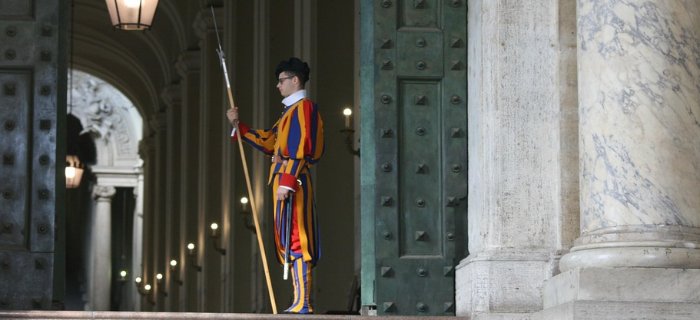
     
     
    Picture of a Swiss Guard on guard.

9 responses to “RSA Animations”

  1. annie t Avatar
    annie t

    Fascinating stuff; like watching a (very) animated Paulo Freire! Loved the insight ‘collaboration is the stuff of growth’. Interesting implications for a congregational paradigm for theological education. Thanks Kelvin.

  2. kelvin Avatar

    Yes – I was also reminded of my synod question about TISEC, which I still don’t think I’ve received an adequate answer to, which was something like this: “Is learning through TISEC driven by normalised marking or learning outcomes?”

  3. Kimberly Avatar

    presumably neither, but by the grace of God?

    (‘normal’, ‘outcomes’, and ‘TISEC’ all in the same sentence could lead to much fun. But I suspect I’d head down the via negativa again.)

    1. kelvin Avatar

      The answer that I got was “both” though I’ve never believed that can be possible. I do believe that TISEC at one time or another took on the trappings of each of those learning models, but that is not the same thing at all.

  4. Rosemary Hannah Avatar
    Rosemary Hannah

    Can I gently suggest that the Tisec you love to hate has over the years changes significantly?

  5. kelvin Avatar

    TISEC has always claimed to be changing – in that way it always is the same.

    I do accept that things have changed but have no way of knowing whether they have changed for the better. I still know people whom it appears to suit and I still know people who get distressed by what is done to them within it. In that respect at least, again, it remains the same.

    I’ve said before now that one of the reasons that TISEC is something that still presents unresolved issues for some of us who went through it is that there was never any public accountability within the church over what was done to us. No-one was ever held responsible and even though TISEC itself went through several reviews, the reasons for those reviews being carried out were never transparent.

    I’d still be happy to receive a coherent answer to the question. Incidentally, when I was in TISEC, the answer was clear – it was driven by learning goals and outcomes.

    I was at the General Synod where we voted for TISEC to cease to be a teaching institution. That was a pretty strong decision and one which was enthusiastically celebrated by some. (I went to the celebratory lunch afterwards and some folk came up from England for it). That does make it hard to understand what has happened subsequently.

  6. Rosemary Hannah Avatar
    Rosemary Hannah

    More than it would be appropriate for me as a staff member to answer to, and more than I am the most appropriate person to answer to, educational theory not being my speciality. However, FWIW I can answer to the fact that normalised marking is firmly in place, and that our external examiner is more than happy with the standards our students achieve. Beyond doubt all those who get a diploma from us have achieved the educational equivalent of the first two years of University education.

  7. kelvin Avatar

    Well, this isn’t comparing like with like as the current external examiner acts for an institution (albeit one which may have a financial interest) that had nothing to do with TISEC when I was in it, however, I can say that the external reports on TISEC were always astonishingly good.

    All the more astonishing for those of us who were in TISEC at the time I was, actually.

    It would be interesting to compare the quantifiable academic achievements of Scottish ordinands over time. I’ve a notion that two years of university study falls short of the standards for ordinands which the General Synod was hoping for when it last voted on a report about TISEC.

  8. Rosemary Hannah Avatar
    Rosemary Hannah

    The current external examiner is, it is true, employed; however he is not a member of the qualifying institution. He is a member of another independent academic institution, thereby bringing to his examination direct knowledge of at least three bodies (theirs, ours and his as it were). The work of our students is scrutinised by two markers at Tisec, and each piece of work scrutinised by the external examiner who checks it is achieving the same standards as YSJ. The over-all standard of YSJ is likewise scrutinised to ensure it too is achieving work of the same standard for the same level as other Universities.

    The question of whether standards nationally have risen or fallen is a different question, and harder to ascertain. We may indeed have our own different opinions. But I think it beyond doubt that the general level of the work of Tisec students is the same as the level (qualification for qualification) as the standard of students nation wide. So very much work goes into ensuring this.

    Personally, I would not be prepared to grant a degree in anything involving Biblical studies without knowledge of the Biblical languages. However it is a fact that the Universities now often do this – and indeed even forty years ago it was possible to obtain a M. Theol at St Andrews with only Greek. However regrettable this is, insisting on a full degree will not restore this.

    For those who study for a qualification with Tisec while working, as indeed for those who study with other bodies while working, to achieve two years of degree level study while in a full time job is a considerable achievement. To reach degree standard would take another 18 months I suppose – and that is a decision for the church to take.

    While I would be very sympathetic to the idea of encouraging more students to undertake a full time degree at a University, the funding of such things is a decision for the denomination, not Tisec. To ensure this in the present economic climate would be expensive, and for students who already have personal commitments, not always possible. This is why most English dioceses offer part-time training. The brief for Tisec is to offer a course that those NOT taking a full-time a course can follow, together with specifically vocational study which the Universities do not provide.

Leave a Reply

Your email address will not be published. Required fields are marked *

Previous Posts

  • The English Heresy

    A long time ago and in a land far away, by which I mean Fife, I was a theological student. It was a good time in my life. By and large I was in the company of clever people, learning clever things from clever people. Theological education can be exciting and that was an exciting…

  • Turning Up and Being Counted

    I’m currently going through a strange time. I’m away from my congregation on sabbatical. It is a good thing to do and I’m having a great time, meeting fantastic people and learning a thing or two by stopping for a while to breathe. There’s always things that you miss when you are away from the…

  • 12 Things I’ve Learned About Preaching

    At the moment, I’m on sabbatical and am not preaching regularly. However, I recently had the opportunity to preach to a congregation largely made up of apprentice preachers – those who are training for ordained and lay ministries in the church in the future. A number of them have asked me to share some wisdom…

  • It was 30 years ago today…

    It seems extraordinary to me that it is thirty years since I stood with others in Deans Yard in London outside the meeting of the General Synod of the Church of England waiting for news. It was a long day and one that many had worked towards tirelessly, for many years. It was the day…