
• Fake Pope Quote Posts

    One of the more bizarre developments in social media has been the rise in fake quotes from popes appearing online.

    One might think that Roman Catholics would be particularly at the forefront of this kind of activity, but that’s not necessarily the case. Anglicans seem to love a good fake pope quote. I’ve seen them posted by an incredible number of people including several senior clerics.

    I am bewildered as to why people post things and in doing so say something like “Isn’t it amazing that we’ve got a pope who said…?” and don’t pause for a moment to ask whether it might be the case that someone has just made it up. Incredulity might well be a pathway to common sense.

    The sad thing is that there’s plenty of profound things that popes do say that are worth repeating. It seems a terrible shame that Pope Francis might be remembered not for his genius in addressing the Climate Crisis in Laudato Si’ but for a series of invented platitudes about hospital walls.

    Particularly puzzling are those, and again, I have senior clerics in my mind, who post these things and then when told that they are not by the pope in question respond by saying that they are going to leave the post up on social media because it sounds like something the pope might have said or that they agree with the sentiments anyway.

    I can’t think of a clearer example of bearing false witness than leaving something published that you have claimed to be written by someone when you know that in fact it was not.

    But anyway, I have a more entertaining response to this from today than just outraged spluttering on other people’s facebook posts, which is to suggest to anyone desperate for a fake pope quote to post online that they ask ChatGPT to come up with a new one rather than recycling someone else’s.

    Here’s how it goes. You open up ChatGPT and you give it this kind of prompt:

    write a fake quote from Pope Leo XIV that is about 450 words long. Make it sound vaguely plausible but the message is the everyone is welcome in the church, even those who think they are not. Use the kind of language of the self-help and empowerment movement to suggest that the pope wants to change the church and that he alone has a vision to do this.

    And bless it, ChatGPT churns it out beautifully.

    There are many who believe the Church is not for them. They whisper to themselves, ‘Surely not me—not with my past, not with my doubts, not with my wounds.’ But I say to you today: the doors of the Church are not narrow—they are wide. They are not guarded by perfection—they are held open by grace.
    We must move beyond the old habit of exclusion cloaked in the language of tradition. We must stop drawing lines where Christ drew none. The Church is not a sanctuary for the flawless; it is a refuge for the broken, the confused, the seekers, the scarred. If you feel lost, unsure, uncertain of your worth—you are precisely who Christ called. You belong here.
    This is not a time for silence or shadows. It is a time for awakening. Too long have we accepted a Church that feels distant, judgmental, fearful of difference. But the Gospel was never about fear. It was always about radical welcome. About the love that does not check credentials at the door.
    I envision a Church reborn—not in doctrine, but in posture. A Church that speaks less about rules and more about renewal. A Church where questions are not threats but invitations. A Church where you do not have to hide who you are to be loved as you are.
    This vision is not shared by all. Some will say it is too soft, too open, too modern. But I say it is simply faithful—to the Jesus who touched the unclean, who ate with sinners, who forgave before they asked, and who never once said, ‘Come to me, but only if you’ve already cleaned yourself up.’
    I do not seek to dismantle the Church—I seek to return it to its heart. That heart is mercy. That heart is hospitality. That heart is Christ.
    If you are gay, divorced, disillusioned, poor, angry, unsure if you even believe anymore—come. If you have been hurt by the Church, forgotten by the Church, judged by the Church—come. If you are full of joy or full of rage—come.
    You will not find a perfect community. But you will find a people trying—trying to be more like Christ, one small, stumbling step at a time. That is all any of us can do.
    The future of the Church is not behind us in stone and ritual. It is ahead of us—in compassion, in courage, and in the willingness to welcome those who thought there was no place left for them. I have seen this future. And I believe it begins now.”
     
    Isn’t that genius? “Not a time for silence or shadows” – completely meaningless and yet exactly the kind of thing that people love posting. I just love “The future of the Church is not behind us in stone and ritual…”. No pope would ever say that. Priests do tend to like a bit of ritual after all and if any pope got near saying that then I’m sure that they could count on those that surround them to prevent them making a fool of themselves and alienating all their clergy.
     
    “I envision a Church reborn—not in doctrine, but in posture.” Can you imagine anyone other than perhaps a C of E bishop commenting on the latest draft of Prayers of Love and Faith ever saying anything so absurd? Yet I’ve seen plenty of even sillier fake pope quotes purporting to be the real deal.
     
    People do love this kind of thing. And that’s exactly the kind of post that I’ve seen posted and liked and reposted dozens of times in the last few weeks.
     
    Might I suggest that we put a stop to it? For as the medieval pope Kelvinius the First said in 1524…
     
    Let not thine idle hands inscribe falsehoods in the name of the Holy See, for to speak a lie in the voice of Peter is to forge chains for thine own soul. Be on guard for the truth. For the truth shall set you ChatGPTFree.
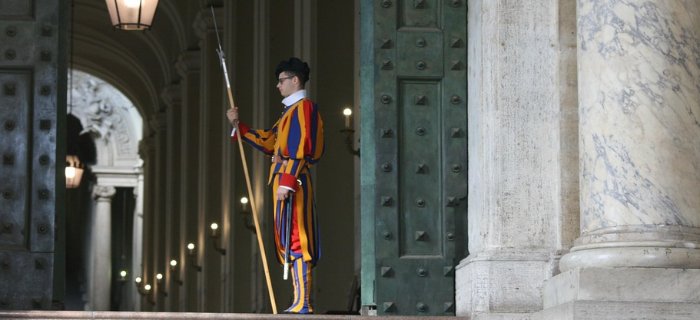
     
     
    Picture of a Swiss Guard on guard.

7 responses to “Whither the Kirk?”

  1. Pausing Place Avatar

    I missed last night’s programme, but I thought your comments were interesting.

    In a sense, perhaps it’s unsurprising if the SEC is inwardly more positive about itself than the CofS. My take is that in the recent past, at least, the SEC started from a lower common denominator, not being the “local” church in the same way as the Kirk, and so it doesn’t have to contend with others saying of it “look how the mighty have fallen” in quite the same way.

    As to the health of the Kirk (and the SEC for that matter), I think we need to reflect on our self-perception and to consider carefully the points and places in which a dying church (congregation or denomination) should be allowed to die gracefully, and the ways in which we might see new life emerge from the rubble.

    As a young(ish!), relatively new Christian I have seen examples of (both urban and rural) SEC and Kirk congregations where there are few signs of new growth, little to draw in younger (under 50 year olds, to pick a random-ish number) new folk, and much to sustain negative preconceptions of church as boring, irrelevant and so forth.

    We as a faith community need to get much better at stepping up to the mark in our creativity and engagement with our society. The sad truth is that most young adults do not know and have not heard about Jesus Christ, and unless we engage with them in ways culturally relevant to them, and which do not presuppose previous knowledge (too often taken for granted) they never will.

    It troubles me, but I do think it’s true to say that in the SEC and in the Kirk we have a church sustained by the traditions and cultural reference points taught to a previous generation. Culture has shifted radically, with the result that the same will not be able to be said in 20 years time.

    Our challenge is clear. Whether the Kirk and the SEC can step up to the mark to address what it means to live out the Great Commission in the 21st century is less so.

  2. Cal Avatar
    Cal

    I didn’t really understand who this programme was aimed at, or even what its aim was.

    Yes, numbers have fallen, but perhaps the small number of people who remain are there because they actually want to be, not because it’s the done thing on a Sunday morning.

    And personally, I rather like the idea of a church “sustained by traditions”. Clearly the church has to be relevant to modern society, but in abandoning the traditions of worship then you lose the centre of why the church exists in the first place.

    There was something very Presbyterian about the programme with its “we’re doomed” mentality. I find the SEC generally more positive in outlook.

  3. John Avatar
    John

    The only book the presenter seemed to have used in his research was ‘The Death of Christian Britain: Understanding Secularisation 1800-2000’ By Callum G Brown – indeed Callum Brown was one of the speakers. The thesis of this well argued sociological study is that “quite suddenly in 1963 something very profound ruptured the character of the nation and its people sending organised Christianity on a downward spiral to the margins of social significance”. That something he identifies as new media, new gender roles and a moral revolution which has dramatically ended people’s conception that they lived Christian lives.” It could be said to have happened as “sex began” between the end of the Chatterly ban and the Beatles first LP as the poet Philip Larkin so famously put it.”
    To balance this statistical decline the programme flagged up some of the “church without walls ” iniatives in a lame sort of way. All in all a most unsatisfactory programme that only told half the story.

  4. Kenny Avatar

    Good crit Kelvin. My reflection at the end of the programme was, “Lord, we visited this stuff over 30 years ago, and have come out of it stronger and better Church in the SEC.” Hopefully, we stopped longing for ‘the good old days’ a long time ago!

  5. MartinRitchie Avatar
    MartinRitchie

    I thinking “Pausing Place” makes a good point about needing to creatively engage with society. From my own experience of working with a CofS congregation, this creative engagement is a weak spot for many.

    As a counterpoint to the programme, interesting to note in the latest “Life and Work” a very positive article about a growing CofS congregation in Stornoway – and I mean really growing! So not all doom and gloom, and I’m sure there are many more examples of bright spots, just as there are in the SEC!

  6. Graham Vahey Avatar
    Graham Vahey

    If the C of S disappeared completely we would be at a loss. During the dark and bleak years of Thatcher’s reign she refused to visit Scotland for 5 years. When she did she expressed shock that we had Royal Regalia and ordered it to be removed immediately for safe-keeping to England. Her ‘Sermon on the Mound’ is now historical for its condescension to the Scots. She was none too pleased to be handed two reports on poverty in Scotland by the powerful Church and Nation Committee. Indeed, it was to this Committee that the population turned to for a moral lead during Thatcherism. When James VI (‘Jamie the Saxt’) became James I in England, the population turned to senior Scottish earls for a moral lead. Unfortunately, the Piskie Church does not give a moral lead in Scotland, apart from the work of the Scottish Constitutional Convention in the recent past. The RC Church does pronounce on moral issues. Could it not be conceivable that all the major Churches could unite in a Committee to pronounce for Scotland on moral issues as the Church & Nation Committee once did?

  7. Aldous N. Gaiters Avatar
    Aldous N. Gaiters

    Speaking as a Nonjuror myself I am sure the SEC has a right to a moral voice in Scotland. Taking the US daughter church of the SEC as a model you could see where the fissures would appear. There is room for a modern liberal Christian voice, but even I an old Liberal myself, would have to fear that such a voice might appeal to only a select few.

Leave a Reply

Your email address will not be published. Required fields are marked *

Previous Posts

  • The English Heresy

    A long time ago and in a land far away, by which I mean Fife, I was a theological student. It was a good time in my life. By and large I was in the company of clever people, learning clever things from clever people. Theological education can be exciting and that was an exciting…

  • Turning Up and Being Counted

    I’m currently going through a strange time. I’m away from my congregation on sabbatical. It is a good thing to do and I’m having a great time, meeting fantastic people and learning a thing or two by stopping for a while to breathe. There’s always things that you miss when you are away from the…

  • 12 Things I’ve Learned About Preaching

    At the moment, I’m on sabbatical and am not preaching regularly. However, I recently had the opportunity to preach to a congregation largely made up of apprentice preachers – those who are training for ordained and lay ministries in the church in the future. A number of them have asked me to share some wisdom…

  • It was 30 years ago today…

    It seems extraordinary to me that it is thirty years since I stood with others in Deans Yard in London outside the meeting of the General Synod of the Church of England waiting for news. It was a long day and one that many had worked towards tirelessly, for many years. It was the day…