
There are doubtless parts of the world where someone in my position would not need the skills that I have. If one were the Dean of a Swedish Cathedral or one of the glories of the Church of England, perhaps it would be the case that you could just hire Someone To Do It For You. However, I’ve found that I’ve had to learn a lot by myself. Here are 10 key skills that I’ve tried to teach myself.
Working as a priest in Scotland in a part of Christendom which is, shall we say, financially challenged, I find these skills to be essential for building a congregation and helping it to grow.
None of them are things which I was taught during my formation for ministry by the church.
1 – Being able to resize pictures and put text on them
Oh, I know you were expecting me to say that the number one skill that a priest needs is to be able to parse a Hebrew sentence or to be able to recite the reasons that the Council of Nicaea was called but no, there are other things that you need in order to be able to attract folk to the lovely mysteries these days and being able to manipulate pictures is right up there.
The truth is, we are becoming an ever visual culture and being the mistress of how and where your message appears visually is a fundamental skill.
I could teach you this in an afternoon.
I use gimp to manipulate images. It is free as in beer, speech and salvation.
This is what I’m talking about:
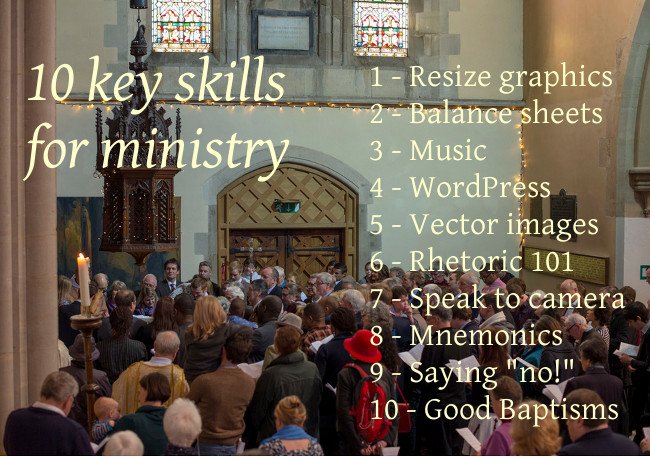
See how your eye shot to that on the page?
2 – Being able to read a balance sheet
Yes, lots of people are frightened of numbers. I’m in the lucky position of having a maths and computer degree and that gives me a head start. However, the maths I learned didn’t tell me much about how to deal with financial information. That experience does give me a head start in trying to get my head around annual statistics, but money is something else.
I don’t think I’m particularly skilled in this area, but I know the basics. Enough anyway to have requested a copy of the church accounts when I was interviewing for this post and enough to have asked the bishop at the time whether he knew that the cathedral basically had no money. And I know enough to be able to read the diocesan accounts now and realise that St Mary’s is contributing more than the poorest 30 or so congregations in the diocese. (And I note that each congregation having one vote at Diocesan Synod feels like a very expensive delight from where I’m standing).
3 – Being able to read music and sing
It is impossible to underestimate how much it can improve matters in any congregation if the priest has some musical common sense and a few basic skills. I think that one of the basics about growing a congregation is that you can’t make any progress unless the congregation like singing what they are invited to sing. The theology doesn’t matter that much. (Trust me on this one, there are strong musical traditions with astonishingly bonkers theologies that have helped very different churches to expand). The musical style doesn’t seem to matter that much. If your congregation enjoy belting something out, your congregation is more likely to grow than if they feel uncertain, grumpy or sad when they sing. Almost no-one talks about this. I don’t know why.
Everyone can sing a bit better than they do. Everyone should try to do so.
For the kingdom.
4 – Being able to set up a WordPress blog
Think what Gutenberg managed to do for the Christian faith by making ideas available to those who were desperate to receive them.
Now think what you could do with power that Gutenberg could not have imagined.
We are all publishing outfits these days.
Go on, go the extra mile and learn enough about search engine optimisation to make sure your stuff appears high up in google when people are searching for things. Go on, go on, go on.
Basic skills mean basic growth. Of anything.
5 – Basic Vector Image manipulation
Yes, I know there’s a lot of technical stuff about images going on here. I took two days away from regular work a couple of years ago in order to improve my vector image skills and it has paid off hugely. The badge ministry at St Mary’s is a direct consequence of this, establishing ethos for the congregation, proclaiming our values to those coming into the building and raising no small amount of money and fun.
Vector image skills means being able to do very basic design work like centering things, putting circles around things, tiling things, using fonts appropriately in larger images.
By the way, you do know that when everyone in Christendom uses an appropriate font for the task in hand then God’s reign of Justice and Joy will be at hand, don’t you?
Become a fontamentalist.
Here in St Mary’s we use heavenly Gentium and we spurn the way of Comic Sans, which leads to the nether parts of hell.
I use inkscape for my vector image work. It is free. Have a go.
6 – Rhetoric 101
There’s no-one in the priestly game who doesn’t need to get up on their hind legs from time to time and persuade people of something. That means either having a natural gift of the gab or working at it to get better. Actually, those who have a natural gift probably work that bit harder because they know it matters.
Speaking clearly is one thing. Knowing when to apply an appropriate bit of assonance, alliteration and anticip———-ation doesn’t just ease the pain for you of speaking in public but it makes life much easier on your audience.
By the by, you might be interested to know that I had 35 minutes of teaching about how to preach a sermon during all of my training. It wasn’t a 35 minutes that was a particularly good 35 minutes either.
7 – Speaking to camera
I think everyone in ministry these days needs to be able to speak to camera about something that matters without hesitation, repetition or deviation. Video killed the radio star but video is the future of the pulpit hopeful.
And whilst we are at it, learn a few video editing skills too.
Not for your sake but for all for Jesus.
He’s worth it.
8 – Learn some mnemonic tricks
Everyone forgets names. Everyone can get better at learning how to remember them.
Rehearse names you need to remember. Write down names you need to remember. Ask people whose names you have forgotten how they think you should remember them. Use your most outrageous visual imagination in order to trick your mind into remembering people. It is one of the reasons God gave you an ability to imagine the absurd.
9 – Cultivating the ability to say “no” nicely.
I’m quite good at saying “no” but we can all learn to try saying so a bit more nicely. For all of us in ministry need to know when to say no. It is a basic skill to be able to decline The Latest Mission Plan (We call them LMPs in the trade), Unwelcome Ecumenical Initiatives (UEIs, obviously), Invitations to Raise Money From Charities who are certain that you need to work for three months to alleviate the plight of Abandoned Gay Puppies in South America etc (sadpuppycamp.com). They all distract from the matter at hand.
So… No. No. No.
Nicely if you can. But no anyway.
10 – Liturgical Skills: Good Baptisms
There’s no greater liturgical skill than baptising someone without making them wail. My top tip here is don’t turn them upside down and make sure they can still see someone they like.


Leave a Reply