
• Every Eucharist is a Virtual Eucharist

    Heaven

    Every Eucharist is a virtual Eucharist. Of course it is.

    We know this.

    We experience this.

    We forget this.

    Christianity – at least the bits of Christianity that are worth taking seriously – takes time and space so seriously that it knows that the particular cannot ever express the ultimate. Indeed, time and space are playthings in the hands of the religiously inspired.

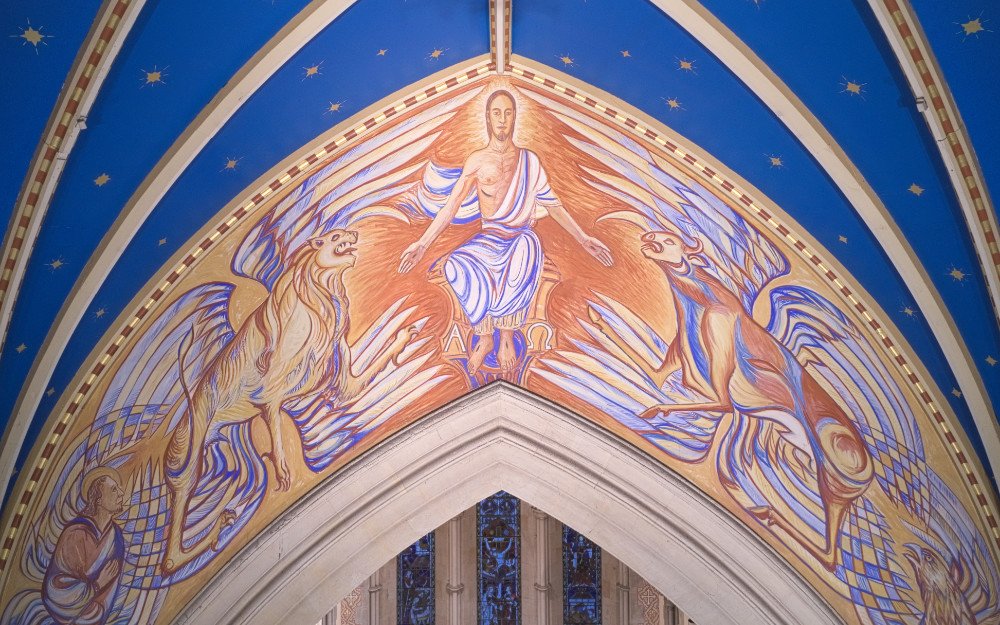
    Over the last few months it hasn’t been possible for my congregation to celebrate the Eucharist together in one space. But when we used to do that, we were never entirely in one space anyway. The very building itself is designed to transport people from the knowledge that they are a few yards from a busy thoroughfare in the Second City of Empire. Taking a few steps inside we find that we are in another place altogether. And in another empire, where the Emperor is servant of all and love is the essense of the law. The conceit that going into church takes you into a divine, heavenly realm is not an idea exclusive to the East. Coming into St Mary’s you are supposed to feel that you are stepping into heaven. It has been built to make you feel that. It has been decorated to make you feel that.  It does make people feel that.

    Whenever I take people into church I almost always hear them express a sense of wonder. We have the wow factor. It has been created by human skill to make you feel that the reality that you experience as you stand in the street is not the only reality that you can experience. It is a space that conveys that love, joy and peace might be possible and it does that without words. It is done with beauty and it takes people a few steps up the stairway to heaven.

    And it is the church playing with reality.

    That experience of going into a holy space and feeling part of something bigger is something common to religions that are divided on all kinds of doctrinal matters. It points to things that are best expressed through virtual reality and religious people are so used to virtual reality that they sometimes forget that it is all around them.

    When people come to the Eucharist in St Mary’s they are at once in Glasgow and simultaneously elsewhere. And elsewhere isn’t even singular either. At the Eucharist in Glasgow we are at one and the same time in an Upper Room in Jerusalem rather a long time ago and at the Wedding Feast of the Lamb at the ultimate consumation of all that is. The Last Supper and the Breakfast at the End of the Universe happen at the same table. At the same time.

    And as we gather at our table, we gather at every table and eat in communion with those who share in the same meal. Our fellowship with them isn’t prevented by circumstance. Our Eucharistic fellowship has never been prevented by circumstance or lack of physical proximity.

    We couldn’t keep the Triduum in Holy Week without virtual reality.

    Without virtual reality it would just be a way of making feet smell less.

    Without virtual reality it would just be a bonfire that would die.

    Christ is the celebrant at every Eucharist no matter which particular celebrant is standing there. Virtual reality becomes interwoven with the reality of the lives that we bring to the table and we are formed and changed and made new. It is how God’s love is expressed.

    This is virtual reality. Every Eucharist is a Virtual Eucharist. Cyberspace is one of the most powerful metaphors for prayer that human beings may ever develop.

    Our bodies are bound by physics.

    God’s love in this world isn’t.

    This is why religious buildings are important. It is also why they are not important.

    Every Eucharist is a Virtual Eucharist.

    Every Eucharist always was a Virtual Eucharist.

    Of course it was.

9 responses to “The Episcopal Way of Death”

  1. Rosemary Hannah Avatar
    Rosemary Hannah

    The greatest privilege I have ever had in the service of the people of the church was to be the person who received the coffin the night before the funeral and led Compline then. The church was on an island, and the coffins those of people I loved and honoured. It was deeply moving for everybody there. I hope one day that will be done for me and mine.

  2. Sr Alison Joy Avatar
    Sr Alison Joy

    I have prayed washed and dressed Sisters who have died and it helped me to see that death is not scary. I have lined a number of Sisters graves with flowers around the inner edge from the inside, also helpful. The body was received at Vespers in Chapel the day before, Solemn Requiem was the next day complete with asperges and incense. We returned from the graveside and when in Chapel sung a very joyful favorite hymn for the Sister we had just buried. It was always a sad, happy, remembering occasion I hope that I will be able to have most of this too.

  3. Sarah Lawton Avatar
    Sarah Lawton

    This is beautifully said.

    When my parents died in a car crash, we knew our Episcopal church would be too small to accommodate all the mourners; but the local Roman Catholic congregation saw our need and graciously offered the use of their space for our Episcopal funeral (including Eucharist led by two Episcopal bishops). They also offered their pall for the second coffin as we had only one. All the churches and the synagogue in town offered choir members and/or food for the feast after the service. An ecumenical, indeed, interfaith foretaste of heaven!

    We placed the two bodies in closed coffins in our Episcopal church the night before; we prayed Evensong and Compline, and received a long line of visitors; and then parishioners kept vigil with the bodies all night. In the morning we prayed over the bodies before beginning the procession to the larger RC church where the (Episcopal) funeral was to be held. In this sad, glorious service sang many, many Easter hymns, and I learned that it’s possible to sing and sing even through tears. I’m told that people reconciled that day who had not spoken in years – I’ve heard it from both parties (one now a bishop).

    All of which is to say: our Episcopal Way of Death can be a profound grace if we let it. It can be profound too when it’s a simple, small, quiet service for a person who has lived a long life and died of old age (unlike my parents). It’s the same words, the same truth of loss – all of us pass through this life but for a moment – the same mystery, the same words of affirmation and hope at the grave: alleluia, alleluia, alleluia.

    1. Kelvin Avatar

      Thank you for posting that – bearing witness to exactly what I was trying to say.

    2. Michael Povey Avatar
      Michael Povey

      Thanks Sarah. (Other readers, Sarah is a friend. I was at the Funeral and heard her offer the most profound Gospel Centred and Honest Grief eulogy I have ever heard)

      1. Sarah Lawton Avatar
        Sarah Lawton

        Dear Michael, thank you for saying that. Your presence that day was a blessing to our family. That gathering, for all the shock and sadness, really did feel like a foretaste of heaven, didn’t it? A great cloud of witnesses singing with us.

  4. Ronnie Smith Avatar

    Having attended a few funerals in our parish recently – one of them for our Vicar, who died on Easter Eve – and being nearer to the grave myself (at 85 and still active as a priest) I appreciate, Father Kelvin, the care you take over this special subject. The Church can be so close to families at this special time – giving them a taste of ‘The great love of God as revealed in the Son’ – precious at this time.

  5. Tony Whatmough Avatar
    Tony Whatmough

    There are sometimes good reasons for having the cremation first, as there was for my brother yesterday especially with people traveling and wanting to be able to bury the ashes on the same day. They key is to talk with the family about what they are looking for and how it can be done.

    1. Kelvin Avatar

      Dear Tony, I’m sorry to hear that you’ve lost your brother. May be rest in peace and rise in glory.

      There are always reasons why people want to have a cremation first and people always believe that they are good reasons. Every single time there are reasons. My contention is that I’m unpersuaded that any of them justify changing what we believe. (What we do and what we believe being utterly bound up with one another in such circumstances).

      My point about funerals is very precisely that the wishes of the family are important but that no tradition will survive if we simply abandon what we believe for reasons of convenience.

Leave a Reply

Your email address will not be published. Required fields are marked *

Previous Posts

  • Generous Episcopacy: The Rt Rev Michael Hare Duke RIP

    I gather from a twitter correspondent that the Rt Rev Michael Hare Duke has died. Bishop Michael was the bishop with whom I first tested my vocation. Having been a bishop since 1969, he saw and influenced the entire modern story of the Scottish Episcopal Church. Where to begin with memories? The time I sat…

  • The Peace and Unity and Order of the Church

    One of the things that I’ve occasionally raised in blog posts is the question of whose responsibility it is to promote the unity of the church. I think this was focused for me particularly at the consecration of the Bishop of St Andrews, Dunkeld and Dunblane just over 9 years ago when the preacher preached…

  • New Statement from College of Bishops

    There’s a new statement from the College of Bishops today about same-sex marriage. It can, and should, be read in full – see here: College of Bishops Guidance re Marriage 2014 I’m appalled by its contents and in particular appalled at the way the Bishops of the Scottish Episcopal Church are treating gay clergy and…