
• Review: Nixon in China – Scottish Opera – ****

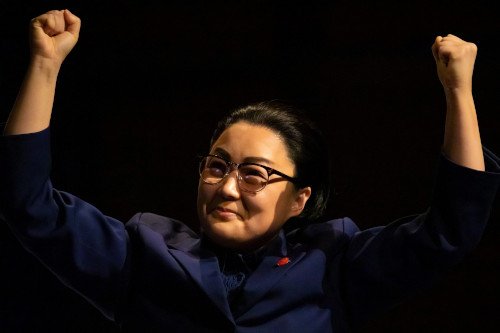
    Madame Mao
    Hye-Youn Lee as Madame Mao. Photograph: James Glossop

    Do we make history or does it make us?

    Scottish Opera’s co-production of Nixon in China is a timely and intelligent piece that asks questions about things that many in the audience will remember yet provides no easy answers. This is not a simple morality tale, nor a love story, nor a tragedy. It is an opportunity for every audience member to reflect on the swirling currents of modern political life. It is a piece that is at once about how strange the past seems to be and how even stranger, the present.

    The dominant theme in John Fulljames’s production is looking back. The whole story is told as a retrospective study of documents within an archive storage facility. Everything is either memory or historical record.

    This is an innovative staging making clever use of video throughout. Some of this is simply projected pictures. More interestingly though, much is seen in the form of layers of documents laid down under a digital vizualiser on a desk on the stage.

    The bold scoring of the arrival of the plane in China (Landing of the Spirit of ’76) is matched with a particularly fabulous kaleidoscope of projected images on stage.

    Joana Caneiro’s conducting shows some restraint throughout the evening. Both orchestra and singers seem a little underpowered. There was no trouble with balance between the pit and the stage but as the action and the theatre heated up, the sound of the fans on the large digital projector in the auditorium were more of a distraction than they should have been.

    None of this took away from the sheer excitement of the score. This is a phenomenal musical work. The retrospective mood on the stage perfectly matches the retrospective mood of much of the music, referencing, Wagner, Stravinsky, dance tunes and so forth. This is a production which also emphasises that though radical in some ways, the piece is fundamentally rooted in an operatic tradition. The various set pieces between the six characters, the three female secretaries singing in a semi-chorus, the quotes from other musical works and librettist Alice Goodman’s teasing playfulness with rhyming couplets all emphasise that this is a piece that refreshes a tradition that we already know well.

    The singing honours have to be awarded to the two female principals. The arrival of Hye-Youn Lee as Madame Mao in the second act was brilliantly exciting. The role demands an agile coloratura soprano and Hye-Youn Lee did not disappoint. Julia Sporsén’s portrayal of Pat Nixon was also astonishing and she completely dominated Act II. Indeed, there was the creeping realisation that there’s an ambiguity in the title of the work. Which Nixon are we celebrating coming to China – Richard or Pat? John Fulljames missed a trick in not bringing Ms Sporsén on last to receive the audience’s appreciation at the end of the evening to make the point that the piece is largely about Pat Nixon rather than her tricky husband. This was particularly seen throughout the revolutionary ballet when the action was entirely focused on Pat. Throughout everything her voice and hair were coiffed to perfection. She looked and sounded impeccable.

    Amongst the men, Eric Greene’s Richard Nixon was interesting and even vulnerable and Nicholas Lester’s final valediction as Chou En-lai the Premier of China moving, elegiac and world-weary.

    As the final archive box was put away with its characters in it, one felt thankful that this work had been brought out of storage by those intelligent enough to make it compelling and interesting. In a world still functionally unable to make sense of the relationship between power and the people this was a production that seemed necessary. I came out at the end of the evening feeling that I understood the world better than I did before. I also came out feeling that the world was also more perplexing than it seemed earlier in the evening.

    Both things can be true.


    Rating: ★★★★☆

    This review was published first by Scene Alba.

8 responses to “Why Billy Graham’s legacy is complex”

  1. Catherine Mooney Avatar
    Catherine Mooney

    We went to see Billy Graham the last time he came to Glasgow. The bank manager gave us tickets! It was my first time at Parkhead. Never had I seen so many Burberry raincoats. It was a hugely choreographed occasion. The intensity of the occasion passed me by, I had never been any where with so many people before. However his effect was clear, people were very moved. r

  2. Meg Rosenfeld Avatar
    Meg Rosenfeld

    Kelvin, I take my hat off to you (or, as a dear, sadly departed Portuguese friend of mine used to say, “I take my head off to you”) for being able to sort out 1) your deep respect for Billy Graham the man, and 2) your wholly justified condemnation of some of his beliefs and their unfortunate consequences, and to come up with your conclusion (which I share) that he is awaking in glory–to some surprises!

  3. ukviewer Avatar

    I never heard of Billy Graham, until I became an Anglican. I was raised as a Catholic and when I was young, only who the Pope was, and perhaps saw Arch Bishop Fisher on TV and being told that he was a Non-Catholic and I shouldn’t watch him or read about him.

    When I became an Anglican, I met some Evangelicals who t raced their history back to his Crusades and extolled his virtues. When I did research for Essays that I was writing for my training, I read about the darker side of his ministry, particularly those you ably describe. I revised my opinion of him, to one of someone who was given a Gift to proclaim the good news, but somewhere mixed it up with bad theology and missed the bit about us all being Children of God, who loves each and every one of us, not a select few.

    I’ve seen the headlines and eulogies for him and have say, that with due respect that his ministry was misused and misdirected down a tangent that has had consequences for many who are victimized daily as a result.

  4. Christina Mackay Avatar
    Christina Mackay

    Hi Kelvin,

    I’m a producer on BBC Radio Scotland’s Good Morning Scotland programme on Saturday. We are planning to do an item about Billy Graham and were interested in what you said in your blog and wondered if you’re around to come on the programme. Could you give me a call on 0141 422 7711. Many thanks.

  5. p hall-ropberts Avatar
    p hall-ropberts

    I think billy was a great preachr but he did not accept that god made gay people as well as straight & I couldn’t accept that

  6. Rebecca van Pelt Avatar
    Rebecca van Pelt

    Billy Graham refused to conduct his meetings in stadiums that were segregated. He understood that we all stood equal before God. He sought crusade support across denominational lines. He ministered to our presidents, regardless of political ties or denominational ties. His sole text book was the Bible. He sole message was the salvation of the individual man through faith in Jesus Christ.

    1. Kelvin Avatar

      Well, Rebecca, I think Billy Graham’s life leaves a very complex legacy.

      Here’s what Malcolm X thought of him: http://religiondispatches.org/billy-graham-and-the-gospel-of-american-nationalistic-christianity/

      On the other hand, here’s what Mel White thought about him: https://www.melwhite.org/remembering-billy-graham/

      Here’s a CNN piece which quotes Billy Graham criticising Martin Luther King’s “I have a dream” speech: https://edition.cnn.com/2018/02/22/us/billy-graham-mlk-civil-rights/index.html

      “Only when Christ comes again will the little white children of Alabama walk hand in hand with little black children.”

      I’m prepared to stand by my assessment that I benefited from Billy Graham’s ministry and also that there are some things about his ministry which have caused harm, to me and to others. Life really is as complex as that.

  7. Dalton Mackenzie Avatar

    For me, Billy was exceptional. He lived a life to please no man but his creator

Leave a Reply

Your email address will not be published. Required fields are marked *

Previous Posts

  • Prayers for Remembrance

    Last Sunday evening we had an extraordinary Choral Evensong. The idea was simple – to mark the start of the First World War by singing some of the music that the cathedral choir was singing 100 years ago. The idea came from Pam Barrowman, one of the members of the choir whose historical research includes…

  • Jericho, Berlin and what wall next?

    I remember going on a school trip to Germany when I was a young teenager. I don’t remember that much about the visit to be honest, but I do remember the wall. We were not in Berlin but we were staying near enough to the border between East Germany and West Germany to warrant a…

  • Somewhere over the rainbow

    I’ve just heard that I’ve been included in the Independent on Sunday’s Rainbow List. This is the new name for the Pink List – a list of gay, lesbian, bi and trans people whom the newspaper wants to celebrate as people who have made a difference in the past year. To be honest I’m surprised…

  • Becoming a Welcoming Cathedral

    Someone who is visiting Glasgow at the moment and who has been to St Mary’s a couple of times, said to me this week, “Well, whatever you are telling those people about Welcome, they are actually doing it.” It reminded me of someone in the congregation who said early on in my ministry here, “You…