
• Eugene Onegin – Scottish Opera – Review – ****


    Scottish opera reach the end of their rather thin main stage season with a well sung Eugene Onegin which brings with it a lot of surprises.

    The action begins, not with the overture but with silence. An older woman – Tatyana herself in old age, we are to discover, stumbles into the wreck of an old country house. A sense of melancholy pervades the scene even before she flings open tall window-shutters and lets in light and mist and music.

    The older Tatyana remains on stage throughout the evening and clearly we are seeing things through her memory. This doesn’t particularly get in the way though it is all rather reminiscent of the end of last year’s Scottish Opera season which saw La Boheme through the unlikely eyes of an older reminiscing Mimi.

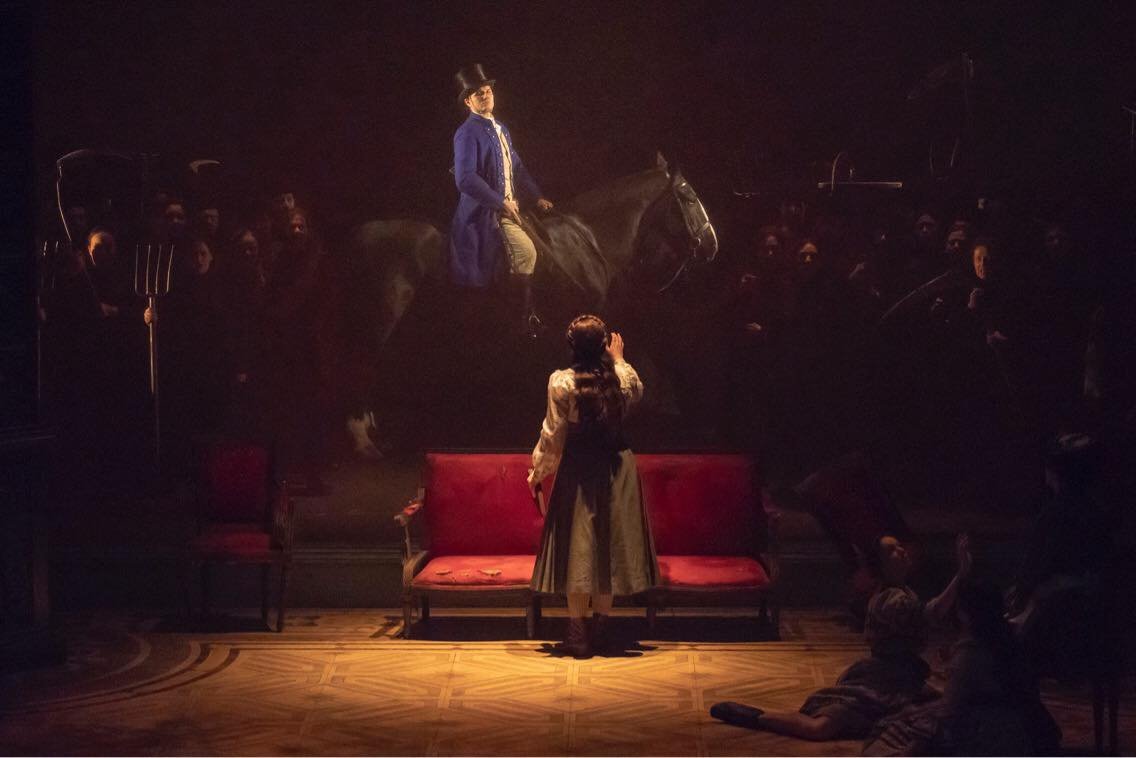
    Director OIiver Mears keeps quite a lot of the action off stage – including everything to do with the chorus. When they are peasants, their singing can be heard through the tall windows and when they are at the ball later on they are kept behind a gauze at the back of the stage which, thanks to Fabiano Piccioli’s lighting design is sometimes the back wall of the room in the country house where we seem to be and sometimes dissolves to show a scene behind it. This sits rather well with an opera which never attempts to tell the whole story. Tchaikovsky picks and chooses individual scenes from Pushkin’s story of Onegin and so a lot of the action is happening off-stage anyway.

    In terms of the singing, there are great riches on offer. Onegin himself is played rather cool and aloof by Samuel Dale Johnson. His passions come to life at the end of the piece when he realises that he made a huge mistake in spurning the love of Tatyana. Why anyone should spurn Tatyana when she is played by Natalya Romaniw escapes me. Her singing was one glorious scene of passion after another. She seemed to completely inhabit the besotted Tatyana and it felt as though there was nothing that she wouldn’t do to get her man. Onegin’s friend Lensky was also well served, being sung superbly by Peter Auty.

    There was quite a lot to compete with the singing however, and certainly in the first act, the music was quite upstaged by some complex stage business. At one point the peasant chorus could be seen in dull light behind the gauze at the back of the stage. They parted in the manner of Moses parting the Red Sea to reveal the dim figure of Onegin sitting astride a horse. It took a few moments to realise that this was in fact a living and breathing real live horse.

    Indeed, although the horse was scarcely visible for more than 25 seconds of the production, it made the strongest impression possible, for it next appeared bounding onto the stage though one of the tall windows, still with Onegin on its back.

    Alas, for the singers, the horse also turned out to be a disgruntled opera critic and was soon followed by a Russian looking ostler with an all too necessary bucket and shovel.

    Sadly the horse did not receive the dignity of a namecheck in the programme.

    However, the musicians carried on regardless through all this and through other more successful pieces of stage business including the members of the chorus striking ball silhouettes, the sudden and rather unexpected appearance of Onegin standing naked in his bath and a group of figures who appeared around a table.

    Some of these scenes were seen through the back-wall gauze and were very effective. It worked well though one had to remember that for some of these scenes we seemed to be seeing what was in the head of a character who was comprised of the memories of another character, which takes quite a suspension of disbelief. Sadly too, there’s a price to pay for putting the chorus at the back of the stage and effectively behind a curtain and this left the second act which should be overwhelming feeling a little underpowered.

    There are a couple of rather odd historical oddities. Presumably the gloopy bubble-gum dripping off Onegin’s boot wasn’t meant to be there but it wasn’t at all clear how Tatyana managed to write with a fountain pen in the 1830s.

    Tatyana’s Pen was in fact sponsored by 19 donors, most of whom were named in the programme so clearly it wasn’t a last minute thought.

    Stuart Sutherland’s musical direction was assured and confident. Indeed, it was difficult to believe that this was the same orchestra who sounded so shambolic just weeks ago for Ariadne Auf Naxos.

    Tchaikovsky was clearly on the run from his own sexuality when he composed this piece. In Scottish Opera’s hands, the experience of unrequited and then impossible love and rejection never sounded so good.

    Do say – “that was a stunning end to Scottish Opera’s season”.

    Don’t say – “how do they train a horse to defecate in time to Tchaikovsky?”

    Rating: ★★★★☆

    This review appeared first in Scene Alba.

9 responses to “The Lament Question”

  1. kimberly Avatar

    ask it in the singular, and the answer is: because you’re a four.

    you’ll have me playing the funeral ikos next.

  2. kimberly Avatar

    the other answer is about possibility being revealed in limits.

  3. kelvin Avatar

    Its not just me though, and not just fours.

  4. Aaron Orear Avatar

    I think because sorrow touches the core of the human condition – we are mortal but can perceive immortality. “He has made everything suitable for its time; moreover he has put a sense of past and future into their minds, yet they cannot find out what God has done from the beginning to the end.” (Eccl. 3:11)

  5. Erp Avatar
    Erp

    I understand Aristotle talks about catharsis and various philosophers have followed up on that idea.

    Perhaps it arouses sadness both from the art itself but also from our own sources festering within and allows us to let go. We feel better for the letting go, the lessening of our own internal sadness, and so perceive the art as beautiful.

  6. RosemaryHannah Avatar
    RosemaryHannah

    Kimberly was there before me. However, even I, a nine, can sometimes see the beauty in sad things. For me they do two things (may be more but two are most obvious). The first is the catharsis thing. The second is to make me less lonely. Look, here am I weeping, but all around me people sit in the same sorrow. It is not just my sorrow – I am not alone.

    I have long thought there is another answer, one I do not properly understand but I have (I think – and who am I to think it). Deep in God there is a huge well of sorrow. Unless we experience sorrow we cannot understand God. When we sorrow we tap into that well, and become closer to him.

    And being a nice cheerful nine, I will now add that I live in hope that having sorrowed with him, we will share also and even more fully in the joy which swallows the sorrow. Delete this last paragraph from your mind on reading, it will only spoil the joy of the sorrow.

  7. Elizabeth Avatar
    Elizabeth

    Edgar Allan Poe said the most beautiful thing in the world is a beautiful, dead woman. Nice, eh?

  8. Ritualist Robert Avatar
    Ritualist Robert

    Surely it’s because the concept of beauty is independent from concepts such as ‘sadness’ and ‘happiness’ – just as a G major chord might be loud or soft, but that volume has no effect on its G major-ness.

  9. Steve Avatar
    Steve

    I remember Augustine saying (don’t ask me where) that for a picture to be beautiful it requires dark colours as well as bright.

    There is also a hint of an answer in this poem by Edwin Muir:

    Yet still from Eden springs the root
    As clean as on the starting day.
    Time takes the foliage and the fruit
    And burns the archetypal leaf
    To shapes of terror and of grief
    Scattered along the winter way.
    But famished field and blackened tree
    Bear flowers in Eden never known.

    Blossoms of grief and charity
    Bloom in these darkened fields alone.
    What had Eden ever to say
    Of hope and faith and pity and love
    Until was buried all its day
    And memory found its treasure trove?
    Strange blessings never in Paradise
    Fall from these beclouded skies.

Leave a Reply

Your email address will not be published. Required fields are marked *

Previous Posts

  • Sermon preached on 1 September 2013

    Quite often, Jesus talks about things that I don’t know much about. A man may have gone out to sow – but I know precious little about agriculture. A father may have said goodbye to a prodigal son but I know nothing about having a jealous brother. A young man may have been told not…

  • Atonement theory and the Naughty Step

    One of the parents in the congregation recently was saying how hard it is to answer good questions from children about why Jesus came and had resorted to trying to explain it in terms of the Naughty Step. I thought it might be helpful to lay out some of the main theories of the Atonement…

  • Intervention in Syria – does not meet criteria for a just war

    I am not a pacifist. If I was, then I would simply argue against intervention in Syria because armed intervention was always wrong. Instead, I think that there are circumstances where it is right (not by any means good) for armed force to be used. Christians have a fairly well developed tradition of thinking about…

  • Dido and Aeneas & Bluebeard’s Castle – Oper Frankfurt

    This review should appear in due course on Opera Britannia. Dido and Aeneas & Bluebeard’s Castle – Oper Frankfurt, Edinburgh International Festival Festival Theatre – 25 August 2013 Rating: “Please note, ” said the notice on the way into the Festival Theatre, Edinburgh, “this performance contains smoke, water-based haze, fog and nudity.” What they didn’t…