
• Husbands and Wifes

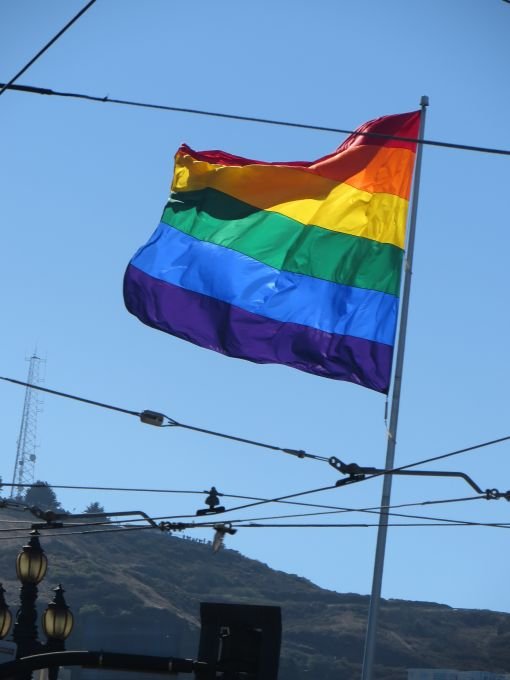
    flag over castro

    Yesterday I heard the news that the House of Lords has given a third reading to the new legislation which will allow gay couples to get married in England and Wales. It should get the nod from the House of Commons today and then go to the Queen for Royal Assent by the end of the week. The first marriages under this legislation will take place sometime next year once registrars have been re-trained and new forms printed.

    I expect we will have a period where all kinds of other institutions will have to re-write their forms and policies too. One can imagine married same-sex couples getting grumpy when they try to fill in an insurance form or try to join a social network and they are offered wife or husband when they want to be offered a box to tick for the opposite.

    It is only fairly recently that I’ve heard same-sex couples who were married speaking freely of their husband or wife. We have one same-sex couple connected to St Mary’s who are married, having been hitched in South Africa. When I was in Canada and the USA I was hearing the use of husband by some married gay men and wife by some of the lesbian couples I met. It was by no means universal but it was becoming common and rather ordinary though no doubt that takes a little time.

    Part of me remembers that I once was against same-sex marriage and that it was partly because I thought that gender-neutrality had something to offer. Were gay couples not leading the world by insisting on having partners rather than the somewhat possessive alternative nouns?

    I think I was wrong about that. What was needed was equality and some people need to use just such possessive language to describe their relationships in the same way that straight married couples sometimes reject it and use the partner language.

    Inevitably there is now going to be a period of reflection and consultation whilst the government tries to decide whether to open Civil Partnership up to straight couples. I expect that will happen though I’m not that keen. It seems to me that the right way forward was simply to incorporate Civil Partnership with Civil Marriage. However, I suspect that though I’ve been on the winning side of most arguments about changes in marriage law, that is not one that I’m likely to win now.

    Very many churches have proclaimed themselves to be against same-sex marriage as it will somehow undermine and threaten the institution of marriage itself.

    I don’t think that is true. I do think that retaining Civil Partnership and opening it up to straight couples does undermine the institution of marriage though. Had the churches engaged in these arguments in more constructive ways than most of them did then they might have had an influence which strengthened marriage. Instead, I suspect that in the long term they will have weakened it.

    Still, we’ll not worry about that today. We will simply fly a rainbow flag in celebration for all those soon to be married couples in England and Wales. And recognise that the last battles still have to be won in Scotland.

    Alleluia for England!

    And once more unto the breach.

9 responses to “The Lament Question”

  1. kimberly Avatar

    ask it in the singular, and the answer is: because you’re a four.

    you’ll have me playing the funeral ikos next.

  2. kimberly Avatar

    the other answer is about possibility being revealed in limits.

  3. kelvin Avatar

    Its not just me though, and not just fours.

  4. Aaron Orear Avatar

    I think because sorrow touches the core of the human condition – we are mortal but can perceive immortality. “He has made everything suitable for its time; moreover he has put a sense of past and future into their minds, yet they cannot find out what God has done from the beginning to the end.” (Eccl. 3:11)

  5. Erp Avatar
    Erp

    I understand Aristotle talks about catharsis and various philosophers have followed up on that idea.

    Perhaps it arouses sadness both from the art itself but also from our own sources festering within and allows us to let go. We feel better for the letting go, the lessening of our own internal sadness, and so perceive the art as beautiful.

  6. RosemaryHannah Avatar
    RosemaryHannah

    Kimberly was there before me. However, even I, a nine, can sometimes see the beauty in sad things. For me they do two things (may be more but two are most obvious). The first is the catharsis thing. The second is to make me less lonely. Look, here am I weeping, but all around me people sit in the same sorrow. It is not just my sorrow – I am not alone.

    I have long thought there is another answer, one I do not properly understand but I have (I think – and who am I to think it). Deep in God there is a huge well of sorrow. Unless we experience sorrow we cannot understand God. When we sorrow we tap into that well, and become closer to him.

    And being a nice cheerful nine, I will now add that I live in hope that having sorrowed with him, we will share also and even more fully in the joy which swallows the sorrow. Delete this last paragraph from your mind on reading, it will only spoil the joy of the sorrow.

  7. Elizabeth Avatar
    Elizabeth

    Edgar Allan Poe said the most beautiful thing in the world is a beautiful, dead woman. Nice, eh?

  8. Ritualist Robert Avatar
    Ritualist Robert

    Surely it’s because the concept of beauty is independent from concepts such as ‘sadness’ and ‘happiness’ – just as a G major chord might be loud or soft, but that volume has no effect on its G major-ness.

  9. Steve Avatar
    Steve

    I remember Augustine saying (don’t ask me where) that for a picture to be beautiful it requires dark colours as well as bright.

    There is also a hint of an answer in this poem by Edwin Muir:

    Yet still from Eden springs the root
    As clean as on the starting day.
    Time takes the foliage and the fruit
    And burns the archetypal leaf
    To shapes of terror and of grief
    Scattered along the winter way.
    But famished field and blackened tree
    Bear flowers in Eden never known.

    Blossoms of grief and charity
    Bloom in these darkened fields alone.
    What had Eden ever to say
    Of hope and faith and pity and love
    Until was buried all its day
    And memory found its treasure trove?
    Strange blessings never in Paradise
    Fall from these beclouded skies.

Leave a Reply

Your email address will not be published. Required fields are marked *

Previous Posts

  • Ian Ansdell is blogging

    Ian Ansdell has been keeping a personal blog for a couple of months and I’ve only just found it – another one to add to the list.I met Ian in Glasgow recently at the Diocesan Synod Eucharist. He is the person behind the incredibly comprehensive www.scottishchristian.com site/news blog. Anyway, his more personal (and rather elegant) blog…

  • Enough, enough

    Enough already. I need no more e-mails telling me that there is only one way to wear a biretta. No more diagrams and pictures showing me how. No more tips. No more hints. No more, no more.It was a flippant remark and I will not make it again. How on earth has the Anglican Communion…

  • More than one way

    I found myself yesterday using this turn of phrase, "…oh, there is more than one way to wear a biretta…"It seemed a metaphor likely to be regarded as kinder to the more feline amongst us than the usual one. However, it has got me wondering.Is there? 

  • To the City

    Going to the city today (Edinburgh) to rearrange chairs.Amazing what one has to do for God’s kingdom sometimes.