
• Why I’ll be Marching at Pride (2024)

    I slipped into an unknown pub in Middle England to get out of the rain and have a pub lunch. It was welcoming and cosy. Steak and ale pie, since you ask.

    The part of the pub I was sitting in was right next to the bar. A small snug. The kind of room where you can hear everyone else’s conversations though it wasn’t too busy. Just a group of fifty-something men in for their pies a table a few feet from me, right next to the bar. It wasn’t terribly busy and so our host behind the bar joined in with their conversation, which soon turned to the result of the General Election. Everyone was interested in what it might mean for them. (Bartenders round here want firm action on business rates, I can tell you.)

    After a while, one of the pie-eaters suddenly said for all to hear, “Did you know that 61% of the new MPs are gay?”  The others at his table and the host at the bar expressed surprise that it should be as high as that. “It just isn’t right – not that number, that’s far too many of them. How have we become a country where 61% of our MPs are gay?”.

    And I remained silent.

    I remained silent because I was in a strange place and didn’t want to risk any unpleasantness.

    Well no, I remained silent because homophobia stalks my world. I remained silent because I didn’t know how anything I might say might be taken. It probably wouldn’t have led to a punch in the face but the truth is, you never know.

    The person making the claim about the number of gay MPs was wrong. Spectacularly wrong. I suspect he’d been told that 61 MPs were gay and had heard it as 61% and accepted that as being true. It was true in his inner world, a world in which the gays were getting above themselves. It was also a believable fact for those around him. They were surprised it was 61% and yes, that did seem a bit high. And yes, the gays were getting a bit above themselves.

    I gather that a few more LGBT+ MPs exist than 61 – the number is about 66. That means that it is about 10% of the MPs in the House of Commons. LGBT+ people are sometimes estimated to account for about 10% of the population. So 60-odd members of parliament who fit that profile is something to be celebrated as a good example of representation. Once upon a time, every one of those MPs would have been subject to blackmail or worse. Once upon a time, every one of them would be silent.

    Me remaining silent in the pub for 10 minutes and then, after finishing the pie, going off without a word, is minor when compared with the violence that many gay people face on a daily basis in other parts of the world.

    Yet that incident played in my mind the rest of the day. I went over it again and again. Should I have spoken up and called out this nonsense? I can argue that both ways. But the thing that I care more about than putting someone right in a pub is that this nonsense claim inhabited my head for half a day. Not so much the absurdity of the suggestion that 61% of MPs were gay but the commonplace assumption, held by a group of apparently nice people in an agreeable country pub, that yes, the gays were getting above themselves. Too many in parliament. Too many in power.

    Power that should, apparently, be exercised by the dominant majority. By people who are not like me.

    How many gay MPs should we have anyway? And how many is too many?

    It is these thought patterns which form the framework in which homophobia thrives.
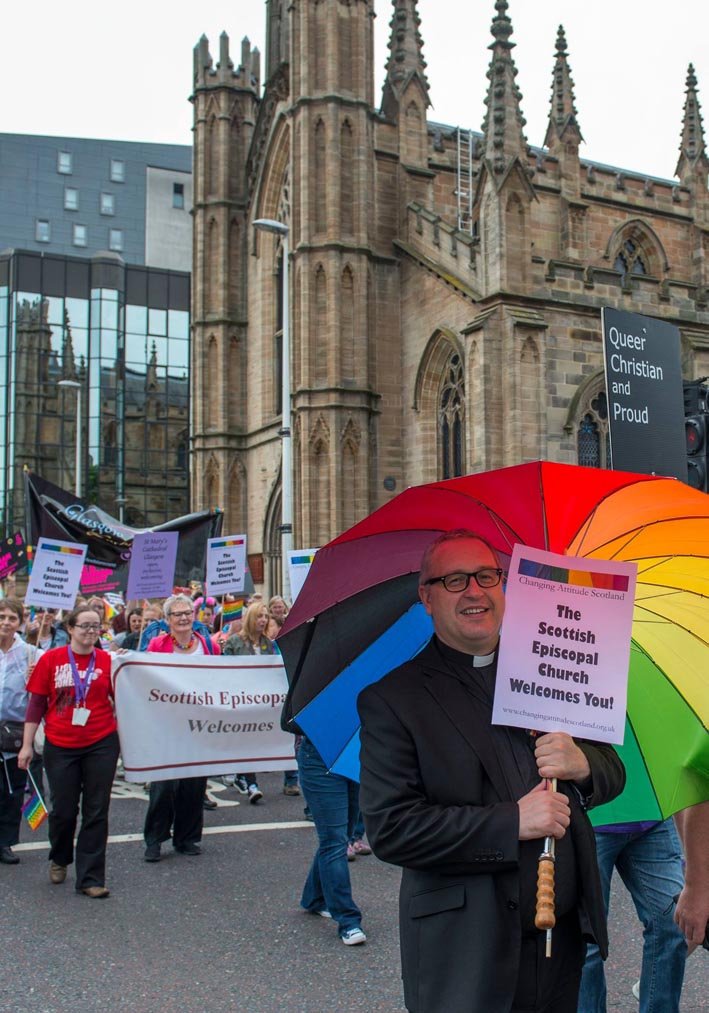
    Kelvin Holdsworth at Pride MarchI rejoice in the progress that we’ve made. But I’m impatient for more. I’ll carry my placard on Saturday at Pride and put a smile on my face. Blessed Are The Fabulous I’ll proclaim and I’ll mean it. But I’ll still be walking on streets in which it only feels safe for most same-sex couples to walk hand-in-hand for a couple of hours a year during Pride itself.

    I’ll also be marching wearing a black suit, clerical shirt and a white clerical collar because of the thousands who will be there for whom that will be an extraordinary thing to witness and something that they can scarcely believe possible.

    Yes, my own small corner of the world still has a lot of work to do. In my own diocese, the clergy asked clearly during the last Episcopal vacancy for intentional work to be done on racism, sexism and homophobia, recognising that these were all issues that were real in the diocese and that our attitudes to difference had played an ugly part in our attempts to try to choose a new bishop. A few years later, we are going into another Episcopal vacancy with none of that work done. And yes, what I experience as homophobia is deeply related to what my female colleagues experience and it is made out of the same basic material as the racist presumptions that black colleagues know well. And even since that time, anti-trans prejudice has grown and grown like an invasive new plant species. It poisons and diminishes all who taste its fruit.

    There’s nothing new about that poison either. Lots of us know it all too well.

    The easiest prejudice to counter is that which is most obvious. In-your-face discrimination is easy to point out if you are able to speak from a place of safety. Much harder is the bitter prejudice of the well meaning – that of those who couldn’t possibly be homophobic because they went to such a lovely wedding only last month, who can’t be sexist because isn’t it wonderful that we have lady vicars now and who couldn’t possibly be racist because that would be just unthinkable!

    Prejudice is part of the psychological air we breathe. It forms part of who each of us are.

    Think you don’t have any yourself?

    Think again.

    Think I don’t have it?

    I wish.

    How long will it be before it is unthinkable that women colleagues will ask whether another woman will ever be elected as a bishop due to accusations being made about the alleged behaviour of a bishop who happens to be a woman right now? How long before the qualifications of those who arrive in the church who happen to be black will be treated as being on a par with those who happen not to be? How long before I can simply sit and eat a pie?

    For all these reasons and 10000 other micro and macro aggressions, I’ll be marching at Glasgow Pride on Saturday.

    Anyone who shares the dream of a world where we are all treated equally and treated well is welcome to join me.

    Blessed are the fabulous.

    And blessed are the impatient too.

7 responses to “Twitter and the Church”

  1. Justin Avatar

    First, congratulations Kelvin on your appointment as I&C Board convenor, and thanks to you and all who contributed to the SEC’s Synod Twitter coverage, which worked really well.

    Some thoughts:

    Next year, as was suggested by some of the Synod ‘Twitterarti’ we should have a proper Synod 2009 Twitter account, like that set up by the Church of Scotland for their Assembly. And it needs to be integrated into the Synod pages on the Provincial website from the outset.

    It would also be good to integrate the #pisky Twitter stream into the Provincial site on a permanent basis, or to set up an SEC account for that purpose. I would also suggest making the site’s SEC blogroll more prominent. And the SEC Flickr streams.

    I understand the concerns some have about the impossibility of monitoring what’s said on Twitter and the blogosphere, and its undeniable that sometimes people will say insensitive and daft things that will offend and hurt.

    But that is part of the very nature of online communication. The days when organisations could manage their channels of communication through press releases and a limited number of printed publications are gone. The web has democratised communications media, offering a low cost platform for all members of an organisation: the concept of gatekeepers at the top approving and filtering information is redundant.

    Like all organisations the SEC needs to embrace and engage with things like Twitter, blogs and other social networking tools, or people will simply bypass the ‘official’ channels and jump straight to where the real conversation is happening, like your blog.

    It’s not just Twitter we need to embrace, but the existing web platforms we’ve already got in place. I’ve been honoured to be asked to develop a number of websites for the SEC over the past couple of years, including the Provincial site and a few diocesan sites.

    Some good use has been made of these – Kennedy in particular has been doing some great stuff on the Glasgow site over the past few weeks. But my perception is that the web still plays a very muted second fiddle to print as a means of communication within our church.

    At Provincial level I don’t see why all the good news material should be kept for inspires magazine. I think it should go straight onto the website as soon as it becomes available. If it’s kept in inspires nobody outside the church can see what’s going on. I don’t think subscription rates to the magazine would be affected at all if inspires material also appeared online: most commercial magazines have found that putting selected material online serves to promote rather than threaten their presence on the newstands. There are now more printed magazines than ever, and they all have websites.

    I think we should allow the boards and committees to post their material direct to the SEC News section. That would, I think, encourage far more of them to contribute their material to the website.

    The same applies at diocesan level: nearly all the good news is kept back for the diocesan magazines, and almost none of it makes its way to the website (again, I know Kennedy is doing his best for the Glasgow site).

    News and events functionality, RSS feeds, photo galleries: they are all there on the diocesan websites waiting to be used. I have to be frank and say that communicating our diocesan news through rather poorly designed newsletters (where the Comic-Sans wars are still taking place) received only by insiders, makes us look very old-fashioned and insular.

    I realise that sounds rather harsh, and that people are volunteering their time to put together the magazines. But I don’t see why we are spending so much time and money doing it that way when the web is there waiting to be used. I love the church and want it to grow, not continue to decline. The web is our friend, offering so many exciting possibilities, and its importance as a means of communication will not be grasped unless we keep banging on about it!

    My tuppenceworth. Very interested to hear what others think. Congrats again and best wishes in the new post.

  2. gaielle Avatar
    gaielle

    Congrats and Best Wishes indeed, Kelvin. A most demanding role and requirement.

    Encouraged by Justin, I shall add a penny-ha’pennies-worth.

    Communication in the world of today is a serious and complex undertaking, isn’t it, not least because there are so many across-generation and accessibilty issues involved, leaving the ‘non-tech’ community disenfranchised if the ‘old fashioned’ hard copy approach is neglected – or perceived to be neglected. Hard copy will continue to be an essential medium for a while yet – and rightly so.

    But equally important, and especially for reaching, including and empowering the youngest generations in the SEC, is the recognition and inclusion of new and newest technologies. Perhaps the teenagers in our midst have some useful insights to offer us for Developing Mission Outreach. The Good News was given to us to share – with everyone.

    Good – effective – communication is a great thing when you encounter it. Rare Creature tho it be. Fully – and clearly intended to BE – fully inclusive, and therefore encompassing and using ALL practical and available methods of communication.

    Problems in achieving Good Communication so often seem to be due to omission, oversight and a lack of appreciation of The Need To Try.

    So, for instance, I Receive Information From Other, I process this internally with every intention that my Final Response will then be shared comprehensively – but I first neglected to Assure The Other that I had Actually Understood What They Were Saying. In consequence the Information I have Taken On Board may be incomplete or flawed – hence I have (inadvertently no doubt) neglected that very important step of Ensuring My Understanding Of Information Matched what Was Being Said…….

    “What Is Said”, what is “Intended To Be Heard”, “What Is Heard” and “What Is Understood” are frequently 4 different things. However, effective/”good” communication requires a thorough appreciation of such likely mis-match, and also requires enormous strategic endeavour (until the skill becomes second nature) to outwit the intervention of MisUnderstanding.

    As with anything in life, a little digging, hoeing, watering, general nurture and attention will reap a fine result. It takes time, and it takes effort. Such, however, are well worth investment.

    But you will know these things. There is no need for me to be teaching you to suck eggs. I was just mulling out loud.

    All Very Best Wishes for balancing the new hat. (I assume the new post includes a hat ?)

  3. gaielle Avatar
    gaielle

    PS. If there is currently no hat, maybe we could invent one…………..

  4. Kennedy Avatar
    Kennedy

    Perhaps one of our issues is that in the absence of any centrally provided forums for discussion – eg. we don’t normally have a letters page in Inspires – then the blogs and other social media just step in and provide the forum for the sort of discussion that people obviously seek.

    If staff at GSO aren’t involved then the discussion is the poorer for that.

  5. jaye richards Avatar

    Just a little point, and I’m curious as to your thoughts on this, but how would you feel about someone tweeting during , say, one of your sermons or during a particularly uplifting piece of music ? is there a time and a place for this kind of communication, and might this include a religious service

  6. Kelvin Avatar
    Kelvin

    I’d be bothered if someone was disturbing others with their tweeting. However, I was chastened a couple of years ago when I became a little distracted by someone near the front apparently unable to sit still and seeming to send lots of text messages.

    It turned out however that he had the whole bible on his mobile phone and was simply looking up the passages as they were being talked about.

    So, I’m not bothered about discreet twittering, I don’t think, though someone might well choose not to twitter in order to be able to concentrate more on what was going on. Part of a spiritual life in most traditions is about learning not to be distracted sometimes, and choosing not to be distracted during worship would be an admirable path to try to follow.

  7. jaye richards Avatar

    I have to admit to being disturbed sometimes during conference presentations by those around me twittering, although I do it myself so perhaps I shouldn’t complain ! I do think there’s a time and a place though, and for me, anyway, a sacred service is not the place to tweet from.

Leave a Reply

Your email address will not be published. Required fields are marked *

Previous Posts

  • Statement on the fire at Notre Dame

    The fire at Notre Dame Cathedral is a tragedy not only for Paris and the people of France but for the world. Those who know the building will be unable to see the pictures of the fire without feeling heartbroken. So many different things that make up the building are priceless – the medieval roof,…

  • If I had just one more sermon to preach…

    During Lent, members of the clergy at St Mary’s are giving addresses at Choral Evensong on the theme “If I had just one more sermon to preach…” Here’s mine: In the name of God, Father, Son and Holy Spirit. Amen. If I had just one more sermon to preach, I’d tell people that God loved…

  • Statement on the Christchurch Terror Attacks Against Muslims

    Glasgow in Scotland and Christchurch in New Zealand are linked by the fact that each contains a cathedral built to an identical design. Christ Church Cathedral and St Mary’s Cathedral, Glasgow were built to identical plans. Christian hearts and Muslim hearts are made to the same design as one another. Today we weep for all…

  • Teaching sermon on Confession and Absolution

    During Lent, I’m preaching giving simple teaching addresses focussing on different things that we do during the Eucharist. In the name of God, Father, Son and Holy Spirit. Amen. I don’t know whether you’ve given something up for Lent. These days I often tend to think of taking something up for Lent rather than giving…