
• AI Ethics Questions for Preachers

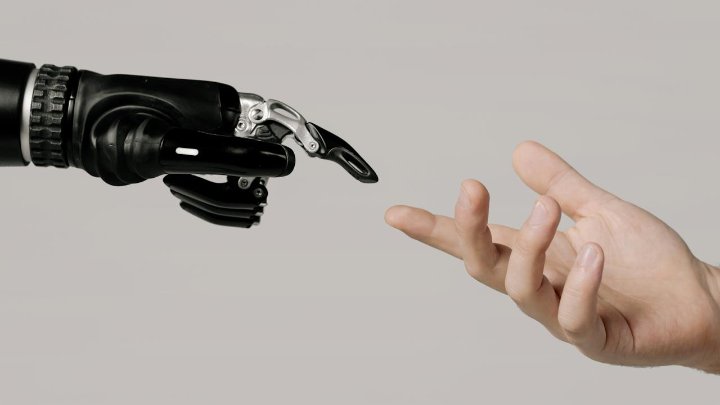
    Picture of robotic hand reaching out to a human hand like the image of God and Adam reaching towards one another in the Sistine Chapel

    The first time that I encountered ChatGPT was three years ago when I was staying in a seminary in the USA. It was a place dedicated to teaching theology and particularly to training Episcopal clergy.
    The ChatGPT preview release was let loose on the world on 30 November 2022, so I must have discovered it very early on. AI has moved on significantly since then but at the time one could use it to render a piece of text in the voice of someone well-known. The entertainment at mealtimes was to give it a well-known piece of the Bible such as Psalm 23 and get it to rewrite the text in the voice of a well-known American politician.

    The Lord is my shepherd — a truly incredible shepherd, by the way, the best. Nobody shepherds like He does!
    I’m not going to want; I’ve got everything I need. Believe me!

    This seemed very entertaining to the students though I suspect that the joke may not be quite so entertaining these days.

    ChatGPT seemed an incredible plaything. A novelty. A curiosity. A wonderful new internet gewgaw.

    Three years on and a lot of development later, AI has changed a lot even if people haven’t yet moved on quite so much and many are still using it primarily as a novelty. You can still ask ChatGPT to translate bits of the Bible into the voice of someone else. It still seems remarkable to many that a machine can write anything at all.

    The primary thing that people think of when they think of text-based AI is still the creation of written material in response to some kind of prompt though there are vastly more interesting things that one can do with AI than you could back in the olden days of December 2022.

    There have been a number of surveys released this year which focus on the use of AI by preachers and I thought that it might be interesting to mull over a few questions in order to think about the ethics of using AI in sermon generation.

    The obvious question is perhaps the least interesting though I’m not 100% sure that it has a clear answer.

    Is it ethical to preach a sermon generated by AI rather than something that you’ve thought up yourself?

    I think many people might initially answer this question in the negative and be fairly sure that this isn’t OK. However, I find myself remembering being trained by clerics when I was first ordained and clearly remember being told – “If you find you don’t have a sermon of your own, then preach someone else’s”. In the intervening years, the internet has come of age and that has complicated this question. There are sites dedicated to providing sermons for particular Sundays. I sometimes read a few sermons by other people on a particular text before settling myself down to write one of my own. I suspect most people would think that was absolutely fine ethically – indeed it falls well within the learning and study that clerics are all supposed to pursue.

    Would I lift an idea from someone else’s sermon?

    Yes, absolutely.

    You get to know the preachers who inspire you. I would pay particular tribute to the preaching of Fr Grant Gallup who, when he was alive preached audacious sermons. I think it is a positive good to catch hold of things that inspire you and let them inform your own thinking.

    But would I lift a paragraph from someone else’s sermon?

    No, I don’t think I would, though I have come across people who do. (And I’ve known people do it with things I’ve written).

    I remember once assessing someone for a job and looking at some of the sermons that he had been preaching. Something didn’t seem quite right about them. A little clever googling revealed that he was simply lifting sermons wholesale from one particular preacher from the other side of the world and preaching them as though they were his own. “And that reminds me of something that happened to me this week…” falls a little flat when you know that the same thing happened word for word to someone else three years ago in the lectionary cycle.

    I never outed him as stealing ideas from someone else. But there was no chance of him getting the job.

    I’m not convinced that it is ethical to preach someone else’s words verbatim in a sermon.

    AI raises whole new questions beyond that though.

    It is more or less ethical to lift a paragraph from a sermon that no human being ever wrote?

    I think that’s a complicated question and is made even more complicated for me by my knowing that some AI engines have been trained on my own sermons.

    Indeed, one of my tests when looking at a new AI tool is sometimes to ask it to write a sermon in the voice and style of Kelvin Holdsworth on the Bible passages for a particular set of Bible readings. This test, which I have to acknowledge I’m rather pleased with myself for devising certainly sorts out the AI sheep from the AI goats.

    I did it recently with one engine and it produced this paragraph:

    “It reminds me of the week before my mother-in-law comes to visit. You know the drill. It doesn’t matter if the house is generally tidy; you go into a state of panic. You’re not just cleaning the surfaces; you’re clearing the cupboards and organising the spice rack. Why? Because you’re trying to create a perfect space for a very important guest. You want the place to look like your best self, a version of reality that lasts exactly as long as the visit.”

    Now there’s no risk in my stealing anything from this at all. It doesn’t sound like my spoken style and anyone who has ever shared an office with me knows that tidiness isn’t necessarily next to provostness. The really exciting thing, I thought, was the appearance of a mother-in-law. I rather like the idea that in some alternative cyberspace I’m tidy, happily married and have a well-organised spice rack.

    Here, in the real world alas, things are different.

    However, I asked another AI engine to come up with a sermon in my style and the more I read, the more I realised that it had been trained on my own sermons, most of which have been freely available online for the last 25 years or so. Here’s a fragment that I asked it to generate for a sermon in my voice for Midnight Mass.

    “And so we come here at midnight—a time for secrets, hushed voices, and the honest acknowledgement that the world is not always as we wish it to be. Midnight is truthful. It exposes our longings. It meets us without the polite veneer we put on during the day. Midnight Mass is the Church daring to say: God meets us in the dark.”

    It isn’t better than me and the middle sentences are a bit vapid. But there’s an idea in there at the end that I could have come up with and could have preached. And maybe, who knows yet, maybe I will.

    So it is ethical to preach a sermon that is generated from an AI engine that has been trained on one’s own voice?

    That’s a really complicated question and worth a good deal of pondering. And it is a very different question from those facing authors who make a living from their work.

    As I try to think about the ethics of where the words come from there will always be people who tell me that nothing ethical comes from AI because of the world’s resources of power and water that are consumed in their production. I get it. But people have frequently taken to social media to make that point to me without acknowledging the irony of doing so. We are living beyond our means environmentally in so many areas of life. Yes, AI contributes negatively to this. But I don’t think that fact is going to put it back in its box.

    At the moment I’ve never read a sermon from an AI engine that I think is better than any that I could have written. However, I suspect that in a year’s time I won’t be able to make that claim.

    So, is it AI generated sermons from me from now on?

    No actually. But primarily because I enjoy the writing. Wrestling with the ideas, thinking about the scripture and pondering where the world is at gives me life and I suspect that ultimately those listening to sermons can tell whether there’s life and spirit in them. And being a preacher who does grapple with the text is part of who I think I am and part of what I think the church has formed me to do.

    Are there easy ethical answers to AI related questions for preachers? I don’t think so. And I think that’s what makes those questions so very interesting.


    Photo by cottonbro studio: https://www.pexels.com/photo/hand-of-a-person-and-a-bionic-hand-6153343/

7 responses to “Twitter and the Church”

  1. Justin Avatar

    First, congratulations Kelvin on your appointment as I&C Board convenor, and thanks to you and all who contributed to the SEC’s Synod Twitter coverage, which worked really well.

    Some thoughts:

    Next year, as was suggested by some of the Synod ‘Twitterarti’ we should have a proper Synod 2009 Twitter account, like that set up by the Church of Scotland for their Assembly. And it needs to be integrated into the Synod pages on the Provincial website from the outset.

    It would also be good to integrate the #pisky Twitter stream into the Provincial site on a permanent basis, or to set up an SEC account for that purpose. I would also suggest making the site’s SEC blogroll more prominent. And the SEC Flickr streams.

    I understand the concerns some have about the impossibility of monitoring what’s said on Twitter and the blogosphere, and its undeniable that sometimes people will say insensitive and daft things that will offend and hurt.

    But that is part of the very nature of online communication. The days when organisations could manage their channels of communication through press releases and a limited number of printed publications are gone. The web has democratised communications media, offering a low cost platform for all members of an organisation: the concept of gatekeepers at the top approving and filtering information is redundant.

    Like all organisations the SEC needs to embrace and engage with things like Twitter, blogs and other social networking tools, or people will simply bypass the ‘official’ channels and jump straight to where the real conversation is happening, like your blog.

    It’s not just Twitter we need to embrace, but the existing web platforms we’ve already got in place. I’ve been honoured to be asked to develop a number of websites for the SEC over the past couple of years, including the Provincial site and a few diocesan sites.

    Some good use has been made of these – Kennedy in particular has been doing some great stuff on the Glasgow site over the past few weeks. But my perception is that the web still plays a very muted second fiddle to print as a means of communication within our church.

    At Provincial level I don’t see why all the good news material should be kept for inspires magazine. I think it should go straight onto the website as soon as it becomes available. If it’s kept in inspires nobody outside the church can see what’s going on. I don’t think subscription rates to the magazine would be affected at all if inspires material also appeared online: most commercial magazines have found that putting selected material online serves to promote rather than threaten their presence on the newstands. There are now more printed magazines than ever, and they all have websites.

    I think we should allow the boards and committees to post their material direct to the SEC News section. That would, I think, encourage far more of them to contribute their material to the website.

    The same applies at diocesan level: nearly all the good news is kept back for the diocesan magazines, and almost none of it makes its way to the website (again, I know Kennedy is doing his best for the Glasgow site).

    News and events functionality, RSS feeds, photo galleries: they are all there on the diocesan websites waiting to be used. I have to be frank and say that communicating our diocesan news through rather poorly designed newsletters (where the Comic-Sans wars are still taking place) received only by insiders, makes us look very old-fashioned and insular.

    I realise that sounds rather harsh, and that people are volunteering their time to put together the magazines. But I don’t see why we are spending so much time and money doing it that way when the web is there waiting to be used. I love the church and want it to grow, not continue to decline. The web is our friend, offering so many exciting possibilities, and its importance as a means of communication will not be grasped unless we keep banging on about it!

    My tuppenceworth. Very interested to hear what others think. Congrats again and best wishes in the new post.

  2. gaielle Avatar
    gaielle

    Congrats and Best Wishes indeed, Kelvin. A most demanding role and requirement.

    Encouraged by Justin, I shall add a penny-ha’pennies-worth.

    Communication in the world of today is a serious and complex undertaking, isn’t it, not least because there are so many across-generation and accessibilty issues involved, leaving the ‘non-tech’ community disenfranchised if the ‘old fashioned’ hard copy approach is neglected – or perceived to be neglected. Hard copy will continue to be an essential medium for a while yet – and rightly so.

    But equally important, and especially for reaching, including and empowering the youngest generations in the SEC, is the recognition and inclusion of new and newest technologies. Perhaps the teenagers in our midst have some useful insights to offer us for Developing Mission Outreach. The Good News was given to us to share – with everyone.

    Good – effective – communication is a great thing when you encounter it. Rare Creature tho it be. Fully – and clearly intended to BE – fully inclusive, and therefore encompassing and using ALL practical and available methods of communication.

    Problems in achieving Good Communication so often seem to be due to omission, oversight and a lack of appreciation of The Need To Try.

    So, for instance, I Receive Information From Other, I process this internally with every intention that my Final Response will then be shared comprehensively – but I first neglected to Assure The Other that I had Actually Understood What They Were Saying. In consequence the Information I have Taken On Board may be incomplete or flawed – hence I have (inadvertently no doubt) neglected that very important step of Ensuring My Understanding Of Information Matched what Was Being Said…….

    “What Is Said”, what is “Intended To Be Heard”, “What Is Heard” and “What Is Understood” are frequently 4 different things. However, effective/”good” communication requires a thorough appreciation of such likely mis-match, and also requires enormous strategic endeavour (until the skill becomes second nature) to outwit the intervention of MisUnderstanding.

    As with anything in life, a little digging, hoeing, watering, general nurture and attention will reap a fine result. It takes time, and it takes effort. Such, however, are well worth investment.

    But you will know these things. There is no need for me to be teaching you to suck eggs. I was just mulling out loud.

    All Very Best Wishes for balancing the new hat. (I assume the new post includes a hat ?)

  3. gaielle Avatar
    gaielle

    PS. If there is currently no hat, maybe we could invent one…………..

  4. Kennedy Avatar
    Kennedy

    Perhaps one of our issues is that in the absence of any centrally provided forums for discussion – eg. we don’t normally have a letters page in Inspires – then the blogs and other social media just step in and provide the forum for the sort of discussion that people obviously seek.

    If staff at GSO aren’t involved then the discussion is the poorer for that.

  5. jaye richards Avatar

    Just a little point, and I’m curious as to your thoughts on this, but how would you feel about someone tweeting during , say, one of your sermons or during a particularly uplifting piece of music ? is there a time and a place for this kind of communication, and might this include a religious service

  6. Kelvin Avatar
    Kelvin

    I’d be bothered if someone was disturbing others with their tweeting. However, I was chastened a couple of years ago when I became a little distracted by someone near the front apparently unable to sit still and seeming to send lots of text messages.

    It turned out however that he had the whole bible on his mobile phone and was simply looking up the passages as they were being talked about.

    So, I’m not bothered about discreet twittering, I don’t think, though someone might well choose not to twitter in order to be able to concentrate more on what was going on. Part of a spiritual life in most traditions is about learning not to be distracted sometimes, and choosing not to be distracted during worship would be an admirable path to try to follow.

  7. jaye richards Avatar

    I have to admit to being disturbed sometimes during conference presentations by those around me twittering, although I do it myself so perhaps I shouldn’t complain ! I do think there’s a time and a place though, and for me, anyway, a sacred service is not the place to tweet from.

Leave a Reply

Your email address will not be published. Required fields are marked *

Previous Posts

  • Easter Day Sermon 2024 – It is started

    It comes in waves, grief does. It is not a constant thing. And when you think that you are moving on another wave can hit you by surprise and leave you right back in the place you were trying to crawl out of. A big part of my life over the last 18 months has…

  • Good Friday Sermon 2024 – It is finished

    In the name of the Father and of the Son and of the Holy Spirit. Amen I remember some years ago hearing someone speaking about what made people compatible. I think that it was someone who was a statistician who was making quite a living by advising people who were designing dating apps on what…

  • What’s really happening to the churches in Scotland

    Over the last few weeks there’s been a number of articles that have appeared in the press highlighting decline in the religious life of Scotland and claiming in particular that it indicates a sudden decline in interest in organised religion in Scotland. On the face of it, this seems difficult to argue with. Fewer people…

  • Predictions for 2024

    General Election in UK – Labour landslide. PM – Sir Keir Starmer. (No great change in policies from the Tory government that Labour will replace). US politics will continue to be dominated by Donald Trump In the US Presidential election in November there will be victory for the Republican Party. AI/Deepfakes have a significant effect…