
• Review: Nixon in China – Scottish Opera – ****

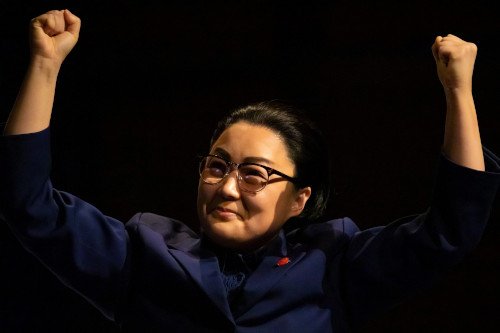
    Madame Mao
    Hye-Youn Lee as Madame Mao. Photograph: James Glossop

    Do we make history or does it make us?

    Scottish Opera’s co-production of Nixon in China is a timely and intelligent piece that asks questions about things that many in the audience will remember yet provides no easy answers. This is not a simple morality tale, nor a love story, nor a tragedy. It is an opportunity for every audience member to reflect on the swirling currents of modern political life. It is a piece that is at once about how strange the past seems to be and how even stranger, the present.

    The dominant theme in John Fulljames’s production is looking back. The whole story is told as a retrospective study of documents within an archive storage facility. Everything is either memory or historical record.

    This is an innovative staging making clever use of video throughout. Some of this is simply projected pictures. More interestingly though, much is seen in the form of layers of documents laid down under a digital vizualiser on a desk on the stage.

    The bold scoring of the arrival of the plane in China (Landing of the Spirit of ’76) is matched with a particularly fabulous kaleidoscope of projected images on stage.

    Joana Caneiro’s conducting shows some restraint throughout the evening. Both orchestra and singers seem a little underpowered. There was no trouble with balance between the pit and the stage but as the action and the theatre heated up, the sound of the fans on the large digital projector in the auditorium were more of a distraction than they should have been.

    None of this took away from the sheer excitement of the score. This is a phenomenal musical work. The retrospective mood on the stage perfectly matches the retrospective mood of much of the music, referencing, Wagner, Stravinsky, dance tunes and so forth. This is a production which also emphasises that though radical in some ways, the piece is fundamentally rooted in an operatic tradition. The various set pieces between the six characters, the three female secretaries singing in a semi-chorus, the quotes from other musical works and librettist Alice Goodman’s teasing playfulness with rhyming couplets all emphasise that this is a piece that refreshes a tradition that we already know well.

    The singing honours have to be awarded to the two female principals. The arrival of Hye-Youn Lee as Madame Mao in the second act was brilliantly exciting. The role demands an agile coloratura soprano and Hye-Youn Lee did not disappoint. Julia Sporsén’s portrayal of Pat Nixon was also astonishing and she completely dominated Act II. Indeed, there was the creeping realisation that there’s an ambiguity in the title of the work. Which Nixon are we celebrating coming to China – Richard or Pat? John Fulljames missed a trick in not bringing Ms Sporsén on last to receive the audience’s appreciation at the end of the evening to make the point that the piece is largely about Pat Nixon rather than her tricky husband. This was particularly seen throughout the revolutionary ballet when the action was entirely focused on Pat. Throughout everything her voice and hair were coiffed to perfection. She looked and sounded impeccable.

    Amongst the men, Eric Greene’s Richard Nixon was interesting and even vulnerable and Nicholas Lester’s final valediction as Chou En-lai the Premier of China moving, elegiac and world-weary.

    As the final archive box was put away with its characters in it, one felt thankful that this work had been brought out of storage by those intelligent enough to make it compelling and interesting. In a world still functionally unable to make sense of the relationship between power and the people this was a production that seemed necessary. I came out at the end of the evening feeling that I understood the world better than I did before. I also came out feeling that the world was also more perplexing than it seemed earlier in the evening.

    Both things can be true.


    Rating: ★★★★☆

    This review was published first by Scene Alba.

18 responses to “To the synod office”

  1. Robin Avatar
    Robin

    > Would it be out of the question, Robin, for Ms Goldie to become the new Bishop of Glasgow and Galloway?

    As far as I know, it would be OK, since she’s baptised and over 30! And Glasgow & Galloway has had a Bishop Goldie before, so there’s precedent!

  2. kelvin Avatar

    Robin – we are in the process of removing the 30 year lower age limit for bishops this year. If Ms Goldie turns out to be younger than we think, she is still in with a shout.

    David – thanks for your post. It is similar to what’s been said to me in synod. To be honest, as someone whose formative years were mainly in a part of the country where the dominant industry was coal, the idea that the farming/rural economy has been particularly ill treated by either European or national government thinking has always seemed very puzzling.

    There are many things which bring town and country together. Clergy complain of the same degrees of isolation in town and country, for example. People also often complain about the ability of young people in the country to find affordable housing locally. However, to someone who has lived succesively in Perth, Bridge of Allan and the West End of Glasgow, that complaint again seems to unite rather than divide us.

    As for field sports, I feel less strongly about the sports themselves than I did when I was younger. However, I feel more strongly than ever that all of us, whatever sector of society we live in can only muddle along by a common respect for the law and it has sometimes been difficult for someone like me to perceive such a respect in those advocating certain field sports.

    I don’t think field sports are a human rights issue. And I don’t think that civil disobedience (ie lawbreaking) is an appropriate or proportionate response to the banning of hunting with hounds.

  3. Robin Avatar
    Robin

    > Robin – we are in the process of removing the 30 year lower age limit for bishops this year.

    Is this to remedy the understandable confusion potentially caused among electors by your being eminently ‘episcopabile’ while you still look as if you’re well under 30?

  4. kelvin Avatar

    I’m ridiculously flattered on all counts. But no – I’m 42.

    Lower age limits are being removed from ordination canons because of the risk of it being seen as age discrimination.

    (Well, actually, because it was clear age discrimination).

  5. Robin Avatar
    Robin

    > But no – I’m 42.

    So you *are* the answer to the riddle of the Universe!

    I’d have imagined there would have been an exemption for such things. An 18yo Bishop would be a bit ridiculous, to say nothing of the risk of being stuck with her/him if she/he proved a bad choice. However, I don’t expect it will make any practical difference. Even under the existing Canon, did we ever have a Bishop as young as 30? The youngest I can think of was my own mentor, Bishop George Sessford, who was 42 when he was consecrated . . .

  6. Robin Avatar
    Robin

    I meant to write,

    “being stuck with her/him for half a century if….”

  7. David Bayne Avatar
    David Bayne

    “Annabelle, our Bishop” has a certain something, don’t you think?

    The age restrictions on Ordination that we are in process of removing did have a point. They were introduced across most post-Reformation denominations (I’m not sure about the RCC) to prevent beardless youths being presented to (with!) prosperous and influential livings by well-connected parents. My favourite Scottish example is Alexander Stewart, the illegitimate son of James IV who was made Archbishop of St. Andrews in 1504 at the age of 14 – or, possibly, 11. The archdiocese didn’t have to cope with a half-century episcopate, though: he died fighting beside his father at Flodden.

    Being of a slightly earlier vintage than The Provost, it’s the moving of the upper limit that has me exercised. Combined with the hole in the pension fund, it hints at a return to “ad vitam aut culpam” By the time people are worried about me having done 50 years in CD, I’ll be 97………..

  8. Andrew Avatar
    Andrew

    I think that it is nearer to the mark to describe ‘The Scottish Field’ (or was when we lived in Bromley and it was the most exciting post of the month) as ‘Unionist’
    The Editor in the 1950’s lived about 2 miles away in South London so The Scottish Field kept us in touch with Jimmy Shand, John Buchan, The Edinburgh Tattoo and The Fortingall Yew Tree. And those sherry party photographs to commemorate Law Firm anniversaries. We couldn’t recognise anyone but they looked nicer than the people who came to our own parties. So we grew in ignorance monthly as we happily anticipated another 3 weeks in Pitlochry.
    However in 2009, Old SF’s appearing in Room 1 must herald the employment of a dentist in Forbes House, or a gentle reminder of ‘The Homecoming’. I believe they provide the ‘Peoples Friend’ at 121 George Street, but I could be wrong.

Leave a Reply

Your email address will not be published. Required fields are marked *

Previous Posts

  • Prayers for Remembrance

    Last Sunday evening we had an extraordinary Choral Evensong. The idea was simple – to mark the start of the First World War by singing some of the music that the cathedral choir was singing 100 years ago. The idea came from Pam Barrowman, one of the members of the choir whose historical research includes…

  • Jericho, Berlin and what wall next?

    I remember going on a school trip to Germany when I was a young teenager. I don’t remember that much about the visit to be honest, but I do remember the wall. We were not in Berlin but we were staying near enough to the border between East Germany and West Germany to warrant a…

  • Somewhere over the rainbow

    I’ve just heard that I’ve been included in the Independent on Sunday’s Rainbow List. This is the new name for the Pink List – a list of gay, lesbian, bi and trans people whom the newspaper wants to celebrate as people who have made a difference in the past year. To be honest I’m surprised…

  • Becoming a Welcoming Cathedral

    Someone who is visiting Glasgow at the moment and who has been to St Mary’s a couple of times, said to me this week, “Well, whatever you are telling those people about Welcome, they are actually doing it.” It reminded me of someone in the congregation who said early on in my ministry here, “You…