
This review appeared first at Opera Britannia
Scottish Opera’s new production of Ariodante has a huge amount going for it. Performed by a solid cast, there’s a cracking trouser role, glittering sopranos and a pantomime baddie countertenor to boot. Only some dubious work in the pit and some slightly odd decisions from the director get in this way of this being a complete knockout. However, it is still a highly entertaining night out and would make a good first production for anyone wanting to give opera a go.
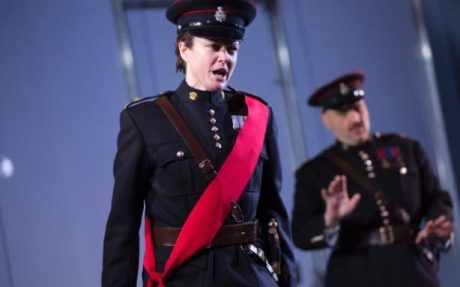
This is an opera completely driven by brilliant singing. Caitlin Hulcup completely owns the title role. She looked dashing as the young Ariodante (a soldier, in this production) and took the audience deftly through a rollercoaster of emotions. Her “Scherza infida“, which came shortly before the interval in this production, was pure, heart wrenching sadness. Sung from an awkward crouching position, the sheer knots of grief that betrayal can engender were laid out before us. It was pure, it was sad and it was lovely. Later on, Miss Hulcup gave an astonishingly virtuoso performance of “Dopo notte” – precise, joyful and exquisitely sung. It was all the more remarkable, coming towards the end of quite a long evening of singing.
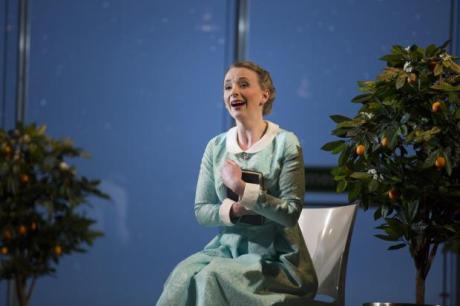
However, Miss Hulcup was not the only star in the firmament. The parts of Ginevra and Dalinda were sung by two very fine sopranos indeed. Sarah Tynan’s voice brought a rich elegance to Ginevra, whilst Jennifer France, a Scottish Opera Emerging Artist, gave a fantastic show-stealing performance playing the maid Dalinda.
The men were good too. Lurcanio was played by Ed Lyon whose acting was as precise and deft as his long vocal runs. Meanwhile, the villain of the piece Polinesso was played for laughs by Xavier Sabata, who somehow seemed to have acquired from somewhere Windsor Davies’s moustache. He was a crowd-pleasing villain – generous ironic boos being interspersed with his applause when all was done.
The King was sung by a rich sonorous Neal Davies, who made particularly good work of “Voli colla sua tromba”. Unfortunately, this wasn’t matched in the pit, where there seemed to be a sudden and unfortunate outbreak of Fluffy Horn Syndrome. This was not the only time in the evening when there were some disappointing sounds from below. String intonation was a bit of a worry throughout and it sounded rather as though the orchestra were a little on the unprepared side. Maybe things will warm up through the run, but this wasn’t a great first night sound. Conductor Nicholas Kraemer kept things nicely balanced – no-one was overwhelmed by the orchestra. However, it was the singing that shone musically rather than the orchestra.
But where were we and what was going on?
The lyrics tell us that we were in Scotland. The set told us that we were mostly in a large atrium in a land of snow and ice. And the director seemed to be telling us that we were somewhere where the puritans were in power, putting adulterers to death for breaking biblical injunctions.
A very striking non-singing opening scene was introduced during the overture – two unfortunate sinners were shown on the point of being hanged by their necks until they were dead. Indeed, they were each still trembling as they hang from the scaffold which we saw when the curtain went up. An Anglican bishop in modern dress seemed to be in charge of these proceedings, which were attended by an elegant crowd who seemed to have recently rediscovered something attractive about Edwardian clothing. This brief glimpse of the terrible fate of two individuals was then replaced with a curtain bearing the chilling words of Deuteronomy 22 about stoning adulterers to death.

Now, I like a bit of religion but I was struggling a bit to get my head around all this. There was a big concept at work that I’m not entirely sure was ever entirely coherent. The trouble is, Ariodante is not a particularly religious opera. It is about virtue – doing good and being seen to do good. It isn’t particularly about anything more spiritual than that and certainly isn’t about Christianity. And yet we had the words “Trust in the Lord” emblazoned across the stage throughout the whole proceedings.
It is perhaps simply a relief that the big concept didn’t particularly detract from the performance but it didn’t add that much either.
For the outdoor scenes we were transported to a snowy wilderness where all the men who had either been wearing modern suits, clerical dress of very uncertain vintage or Edwardian military uniforms suddenly appeared sporting Russian-looking hats. I almost expected a walrus, polar bear or penguin to appear, which might have given us some geographical certainty about where we were but none came.
Perhaps director Harry Fehr had simply given designer Yannis Thavoris the instruction to keep the audience wondering throughout the whole evening. Not that things were ever dull though. Although some of the changes of scene were a little clumsy with an ever falling dark curtain drop in danger of cutting off the action, the stage-work was interesting. The first scenes were set amongst fruit bushes which were doing rather well whilst love was in the air but as soon as betrayals and deception entered the scene, they died and rotted almost instantly.
At various points, a couple of dancers appeared and danced their way through dream sequences. This was pretty but didn’t add that much to the storytelling and could easily have been cut without the evening losing terribly much.
However, none of this should detract from what was a very enjoyable evening indeed. The first act particularly flew by and there was simply so much good singing that it seems almost churlish to be puzzled by whatever was going on in the director’s head.
Notwithstanding some reservations, this remained enjoyable, entertaining and life-enhancing opera.
Rating: 


Leave a Reply