
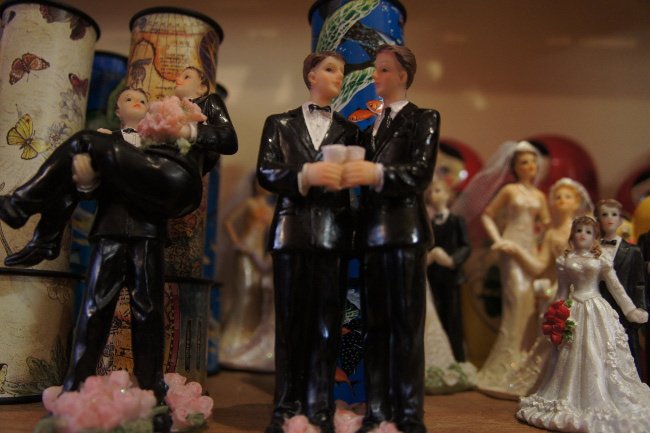
• Same-sex Marriage Date for Scotland – 31 December 2014

    SONY DSC

    Exciting news this morning – we have a date for the first same-sex marriages in Scotland. The date is within this year – just. The first day on which most couples will be able to get married will be 31 December 2014, the day known in Scotland as Hogmanay. There’s going to be some parties north of the border that night, I can tell you.

    The law will actually change in mid-December, as expected but the Scottish Government has delayed its proposal to increase the notice period to 28 days. Thus, same-sex marriage becomes legal on 16 December 2014. If a couple have been married in another jurisdiction (eg England) then they will be regarded in Scotland as being in a Civil Partnership until midnight on 15 December and regarded as a married couple on 16 December. Couples can give notice to marry on that day and a couple of weeks later can get married on 31 December 2014.

    From 16 December 2014 a couple in extenuating circumstances will be able to apply to be able to get married more quickly – this usually applies if one partner is near to death. It is entirely possible that such a couple may be the first to be married but the big celebrations will come right at the turn of the year.

    From 16 December, trans people can get gender recognition without having to be divorced.

    Couples who have entered a Civil Partnership will be able to apply to a Registrar to convert that to a marriage from 16 December 2014 and it will be free to do so for the first year. (You pay for the marriage certificate just like anyone else but there is no processing fee). Alternatively, couples may pay the usual fees for a marriage ceremony. Couples will be able to be married in a Register Office or by religious or humanist celebrants in certain circumstances.

    Couples will be able to be married in the Scottish Episcopal Church with the permission of the House of Bishops, the House of Clergy and the House of Laity meeting in General Synod.

    Any couple who has entered into a Civil Partnership who converts it to a marriage is welcome if they wish to bring the certificate to St Mary’s where it can be laid on the altar at a Eucharist in thanksgiving for the partnership and for this change in the law.

    Civil Partnerships will continue to be available to same-sex couples (but not to straight couples) and I am more than willing to go on blessing such couples.

    I’m also willing to bless all couples who have married by a Registrar, using the Service of Benediction that I drew people’s attention to earlier.

    Here’s the prayer I will be using to bless couples in church:
    God the Father,
    God the Son,
    God the Holy Spirit,
    bless, preserve and keep you;
    the Lord look upon you with favour and mercy
    and so fill you with all spiritual benediction and grace,
    that you may so live together in this life
    that in the world to come you may have life everlasting.
    Amen

    Straight couples marrying who wish to express solidarity with gay couples who wish to get married in Scottish Episcopal Churches should get married in a Register Office and come to church for the Benediction of their marriage just like anyone else wanting to get married.

    I’ve yet to decide whether or not to continue to perform legal marriages for straight couples in church after 31 December 2014.

    Congratulations are in order not only to those who will be getting married soon but also to all those campaigners who worked to change the law, to parliamentarians who voted for it and civil servants who have been working on it. The brilliant campaigning of the Equality Network has been a powerful force in bringing about change. And inevitably, my mind turns in awe to the members of St Mary’s Cathedral, particularly those belonging to the LGBT group who went out collecting signatures to bring in petition to the Scottish Parliament long before the big campaigns got going.

    We changed the world.


    Picture Credit – Peter Kolkman Copyright – Creative Commons Some Rights Reserved

4 responses to “To be an Episcopalian is not to be respectable”

  1. Eamonn Avatar

    Superb take on this difficult story from Matthew, and the other stories of Jonathan Daniels and Robin Angus. Thank you.

  2. Philip Almond Avatar

    But Mark records Jesus as saying, ‘Permit first to be satisfied the children;for it is not good to take the bread of the children and to the dogs to throw[it]’. That word ‘first’ tells us that Jesus already knows that there will be a ‘second’, that his ministry will extend beyond the lost sheep of the house of Israel.

    These words of Jesus also suggest that ‘I was not sent except to the lost sheep of [the] house of Israel’ refers to this phase of his ministry.

    Also, if the following incidents were earlier in time than the incident of the healing of the woman’s daughter, your

    ‘In that moment, she seems to know his mission to save the whole world considerably better than he did. And she changes him. He thinks again’.

    is disproved.

    Luke’s account (chapter 4) of the visit to Nazareth, because Jesus’ reference to Naaman and the widow of Sidon suggest that he was aware that his mission, like that of Elijah and Elisha, would extend beyond the covenant people.
    Matthew’s account (chapter 8) of the healing of the centurion’s servant, giving rise to Jesus’ ‘And I say unto you, That many shall come from the east and west, and shall sit down with Abraham, and Isaac, and Jacob, in the kingdom of heaven. But the children of the kingdom shall be cast out into outer darkness: there shall be weeping and gnashing of teeth’.
    Jesus’ explanation (Matthew 13) of the parable of the tares of the field: the one sowing the good seed is the Son of man; the field is the world (my emphasis); the good seed are the sons of the kingdom; the tares are the sons of the evil one.

    What are your reasons for being sure that these three events are later in time than the healing of the woman’s daughter?

  3. Martin Reynolds Avatar
    Martin Reynolds

    We do not live for the poor, we do not live with the poor, we do not identify with the poor.
    We wear silk vestment adorn ourselves with elegant titles and eat at the best tables and are welcome in the highest corridors of power.

  4. Sarah Lawton Avatar
    Sarah Lawton

    Kelvin, thank you for your email today pointing back to this sermon. I appreciate your pointing to Jonathan Myrick Daniels, who was a friend of my parents. My mother always felt she had a part in his death, I think, because she was one of the organizers of the seminary group that responded to the Rev. Dr. King’s call for church leaders to go to Selma, and it was she who persuaded Jon to go. One of her last acts on this Earth was to help put his name on our Church’s calendar (first reading, General Convention 1991). But then, we are baptized into Christ and therefore each other, which is I think what you are saying in this sermon. That means we are implicated in the ills of this world but also share in Jon’s martyrdom. We live in the hope of resurrection but the way there is through the utter scandal of the cross. Jon in his latter months of life rejected theologies of complacency and also self-righteousness as he committed himself to a ministry of presence.

    Martin Reynolds, there is no question our particular church tradition has some history with money and power. My own little congregation identifies strongly with the poor, the folks sleeping rough right outside our doors, and the immigrant families of our neighborhood. Our Sunday services can be a little chaotic as a consequence of the varieties of folks in various states of mind who come on a Sunday, but our spiritual life as a congregation is pretty good; it honestly feels like a gift to be there in the communion circle. We’re a longtime LGBT congregation, so I think it’s part of who we are to have economic diversity and also a rejection of traditional social masks. We’re also deeply rooted in prayer, which is how we got through worst of the AIDS years and all the funerals.

Leave a Reply

Your email address will not be published. Required fields are marked *

Previous Posts

  • Sermon – preached on 15 Nov 2009

    Here is this morning’s sermon: It is quite difficult to get our minds inside the kind of readings that we get at this time of the year in church. We tend to get readings (and this will go on for a week or two) which emphasis quite tricky topics. In particular, we get lots of…

  • What people are looking for

    The following searches have recently resulted in people finding themselves directed to this blog: virgin mary knitting church fudge nun black coat brown shoes clerical tartans, tartans associated with clergy aberdeen and orkney synod head of john the baptist relic making oils potions and powders color of candles for advent wreath 2009 lgbt ethics women’s…

  • Are bishops above the law?

    There was an excellent adjournment debate in the House of Commons this week. Not attended by many and not reported that widely either. It was secured by Robert Key MP, the member for Salisbury, whom I remember meeting earlier in the year, when I was preaching in Salisbury Cathedral. The question that he was raising…

  • To the East

    Off last night to one of the East End churches to celebrate a mid-week communion. Its very rare indeed that I celebrate anywhere other than St Mary’s Cathedral. Indeed, I’m not sure whether I can remember doing so since I came here. Bishops (and I suspect Deans) must spend all their time dotting around celebrating…