
• Listen up! Moocs are the future

    OK listen up. Moocs are the future.

    Now before we go any further, let’s get the usual responses out of the way. The usual responses are twofold:

    1. What’s a mooc?  (Most people)
    2. *rolls eyeballs* (lots of academics, including quite a few in my congregation)

    Firstly, a mooc is a term used for a new form of education that you engage in online. It stands for Massively Open Online Course. Such things have been around for the last couple of years and there’s a good wikipedia page on the concept.

    The basic idea is that you do a course online along with many thousands of other people all at once (massive) which you have easy/free (open) online (online!) access to. It is a way for someone to teach many people. Many, many people. I’ve just finished doing a mooc where a team of three people were attempting to teach 13000 students all around the world.

    But why the eyeball-rolling from clever people?

    Well, any teacher worth their salt is going to say, “Ah, but wait a minute? Hang on there… what do you mean…. that’s not a learning experience that is equivalent to what I can do in a classroom.”

    And you know what? It isn’t.

    However, it is here, it is now and it is going to develop in the future all the same.

    Now, are you thinking you’ve heard all this before – are you thinking this is just a glorified correspondence course? Sure you are. But this is a bit more than that. Typically in a mooc, you get video lectures or other content to download, maybe on a weekly basis. You work through that stuff and you get online quizzes and exercises that you do along the way. If the course is well designed, you get instant feedback on how you are doing and can go back and review any of the bits that you didn’t understand.

    But here’s the thing – it isn’t just you. It is social. There’s a whole bunch of people out there doing the same course as you. And you can get to interact with them on the forums. Indeed, some of the ways that the mooc is assessed may include interaction on the forums. (Cue eyeball rolling from academics who can’t work out that this is the equivalent of giving a mark for interaction in class discussions, which is a relatively common practise in some institutions).

    Then, when all is done, you may well have a final piece of work to submit and this will be marked. But hey, how do you mark 13000 pieces of work? Well, if it is not machine markable material (multiple-guess questions) then the mooc method is to get students to peer review. In the mooc I’ve just participated in, we were encouraged to produce a final video and to pass the course you had to, not only submit your own video, but assess three (or more) others.

    Then you get your certificate and there is much rejoicing.

    Now, here’s where the Eyeball Rollers have started to harumph loudly. “What use is a certificate when no-one qualified has seen the work? Isn’t this the dumb assessing the dumber?”

    Well, the truth is, such a certificate is worth precisely nothing in terms of the educative processes that we have been used to.

    But get this, moocs are not really about what the certificate is worth. The satisfaction comes from having learned something new. Getting the certificate is just icing on the beans. Yet getting that certificate is oddly fulfilling – it is part of the gamification of learning. You get a certificate, you want another. You unlock a level badge, you go  back to try to accomplish the next level.

    Anyway at the end of this post is my certificate from the mooc I recently completed. I don’t care what you think about its value – for me it represents a whole bunch of skills that I just learned. It is for a course that was really for school teachers on Blended Learning – that’s about how to mix learning that takes place in an online setting with more traditional face-to-face teaching. I took the course because I want to be able to offer some online courses at St Mary’s as well doing what we already do. It seemed sensible to do the course and also learn from completing the mooc itself.

    What does this mean for the church at large – well it means that education needs to get slicker. In the same way that new technology has meant that we need to up our game in religious circles in the way we communicate with people, so we need to do the same with how we teach. That scrappy stapled-together church magazine is a great means of communicating but it does so on two levels. On one level, it communicates to those who have always received it that things are carrying on just the same as ever and even lets them know whether they are on the coffee rota on Sunday. To the more casual reader, however, it probably communicates that you are not terribly professional, have low expectations which will carry forward into worship and that you are desperate for someone to join the coffee rota to try to replace the people who are dying off.

    It is the same with education. Sitting around a flipchart with half a dozen people is something that I continue to do. However, increasingly as I do it, I’m aware that the ways in which people learn are changing. Gamification (rewards – yes, sometimes silly little rewards) is here to stay. Blending of online and offline worlds is how people are doing everything from shopping to looking after their health so why shouldn’t that affect how we learn about Things That Matter in church circles? And yes, self directed learning is here to stay.

    There’s new technology on offer here. Who knows what we’re going to do with it?

    And here’s my certificate, which I’m terribly proud of, can you tell?
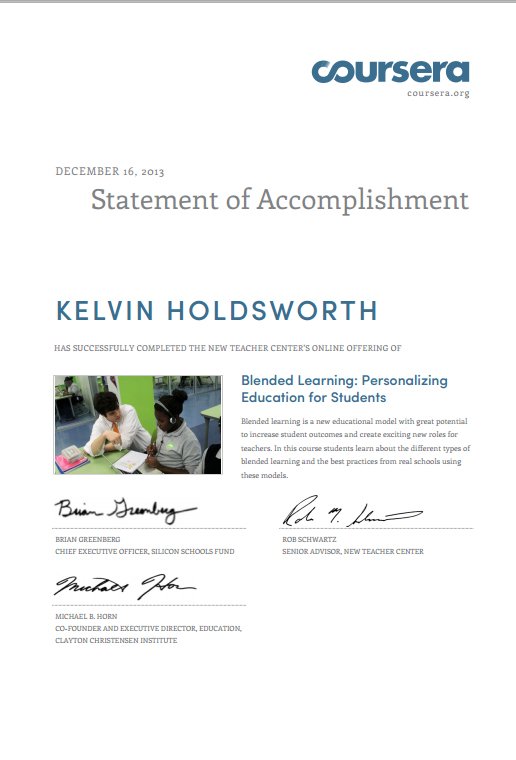
    Blended Learning

10 responses to “The Tim Farron Question and the Archbishop of Canterbury”

  1. Bro David Avatar
    Bro David

    This brings up an interesting memory with the long-time leader of Changing Attitude England (CA). This leader was taken in by Andrew Marin, founder of the Marin Foundation (MF) when he visited the UK in conjunction with some big outdoor Christian festival you lot hold anually. Marin and his followers were attending Pride Marches/Parades around the US and getting their photos taken hunging GLBTQ folks in the marches. His foundation claims to be attempting to build a bridge between the LGBTQ community and conservative Christian communities.
    Marin was invited to comment on the CA blog. He spouted his pablum message of love for LGBTQ folks. Then, in a comment, I point blank asked Marin if he believed that we LGBTQ folks were sinners and needed to repent and become straight. He refused to answer the question. He said that I was asking the “wrong” question. Then he gave this answer verbatim from the Marin Foundation website;
    “We call these the “Big 5.” They are:
    Do you think that gays and lesbians are born that way?
    Do you think homosexuality is a sin?
    Can a LGBTQ person “change?”
    Do you think that someone can be gay and Christian?
    Are LGBTQ people going to hell?
    “The one common theme of these “Big 5” is that they are all close-ended, yes-or-no questions. Each of them must be answered with one word and they are all meant to end conversation. Based solely on one’s close-ended answers, it is easy to label, judge and dismiss the other community entirely. Thus we dehumanize a community based off of a word rather than create a productive conversation. In essence, by close-ended answers either the conservative or the LGBTQ community judges who you are, what you believe, whose team you’re on and how you should be treated.
    “Rather than answering close-ended questions, The Marin Foundation seeks to elevate the conversation and continual fruitful dialogue, as tense as that may be. This is a model taken from Jesus throughout the Gospels. Of the 25 times Jesus was asked close-ended questions, only three times did he respond with a yes or no. These three times were only after he was arrested and admitting he was the Messiah. Prior to this, Jesus never answered close-ended questions with a yes or a no. Instead, he elevated the conversation.”
    I spent the next three days searching the MF website and reading through articles and white papers. I realized that it was a ministry to the LGBTQ of wolves in sheep’s clothing. These people were trying to love vulnerable LGBTQ folks into their embrace, to slowly chip away at them until they had brought them to realize that their sexual/gender orientation was false, acting upon it was a sin and they needed to seek the help of Jesus to beome heterosexual and accept their gender assigned by birth.
    I posted my findings on the CA blog and was promply chastized and barred from further posts. In a personal email from the leader of CA I was ripped a new arsehole and declared anathema. Sadly, even LGBTQ folks in prominent positions are taken in by these folks. I think that we need to continually ask the Big 5, of everyone, epsecially those non-LGBTQ folks who profess to be our allies and supporters, secular or religious.

  2. Peter Davison Avatar

    Good column.
    So who is entitled to express opinions on ethical issues? I’ve long understood it’s the duty of all of us to have INFORMED consciences and to obey them. We may wish to consult people we believe to be more informed than we are, such as our presumed leaders, but in the end, when asked, we should at least be ready to state, however firmly or tentatively, where we stand. As for our leaders, they may or may not be better informed than we are; but we also know that ‘experts’ may be people who know more and more about less and less – and that politics often intrude into our public morality. Much of ethics is situational. That said, Jesus seems to have had much more compassion for alleged ‘sinners’ than for those who chose to label them as such. And much of our present troubles seem to stem from our desire to label and scapegoat people who appear to be different. What would happen if we simply accepted people for who they are and learned to accept that love is indeed ‘a many splendoured thing’?

  3. Graham Evans Avatar
    Graham Evans

    A very interesting new perspective and certainly a question that should be put to all the Anglican bishops who sit in the house of Lords.

  4. The Rev Sr Helena Barrett, OSB Avatar
    The Rev Sr Helena Barrett, OSB

    Absolutely spot on, Kelvin. The ABC should be asked The Question until he is sufficiently exhausted to give a clear and honest answer (whatever it may turn out to be) instead of the usual yards of ecclesiastical flannel.

    1. June B Butler Avatar
      June B Butler

      “The ABC should be asked The Question until he is sufficiently exhausted to give a clear and honest answer…”

      Justin Welby wails piteously: “I’m not the pope.”

  5. the Rev. Grant Barber Avatar
    the Rev. Grant Barber

    I always wondered how the preachers in Pepys’ diary could preach such long sermons. I think I understand better now. So glad we’ve already settled the matter in the Episcopal Church. (Oh, the answer can be a succinct “no, not sin just by its nature).

  6. Bernard Silverman Avatar
    Bernard Silverman

    if I asked an archbishop whether deliberately stamping on someone’s toe is a sin they would give a direct answer. So they should be asked the Farron question over and over again until they do similarly. If the Prime Minister can do that so can they. Indeed the question should be “the PM thinks that gay sex is not a sin. Was she right?”

  7. Kate Odling Avatar
    Kate Odling

    Very interesting. I always think that if someone does not give a clear answer to a question that they have something to hide or that their true belief/thought would be unpopular. I think the ABC has looked very uncomfortable when any direct questioning about LGBT issues are raised. So someone should ask & not accept anything but a straightforward answer. My final thought is that we are all qualified to have an opinion – what’s wrong with that?

  8. Bruce Gulland Avatar

    Whatever I think about the answer to the question, I did rather enjoy the style of your post – you had me on the edge of my seat!

Leave a Reply

Your email address will not be published. Required fields are marked *

Previous Posts

  • Random advice to someone newly ordained

    Treat everyone as though they are an adult. Especially children. When any hand is held out for communion, think WWJD? Don’t diss the Mothers’ Union You have been given the power to bind and loose. That means you have to say yes to everyone all the time, sometimes by saying no.

  • Guild of Servers

    To Hyndland yesterday to the annual festival of the Scottish Guild of Servers. Having previously chuntered to the guild office bearers about having the service in far-flung places (including our companion diocese of Argyll and The Isles, over the water), I decided that I had better turn up yesterday when it was just a couple…

  • Most commented

    Someone said to me that yesterday’s post looked like the most commented upon post on the blog. Not so, in fact. Most discussed posts so far have been: The Advent Candle Controversy – 47 comments and counting Two Literary Questions – 42 The Episcopal Brown Shoe Scandal – 33 Collecting things (the Collaborative Ministry thread)…

  • Liturgy should say what it means, and …

    The chiasmus that is so often quoted about liturgy these days is that liturgical writing should say what it means and mean what it says. By and large, I agree with that, though we do have to allow space for the times when we cannot grasp or explain all that God is. However, I have…