
• Can you backdate a marriage?

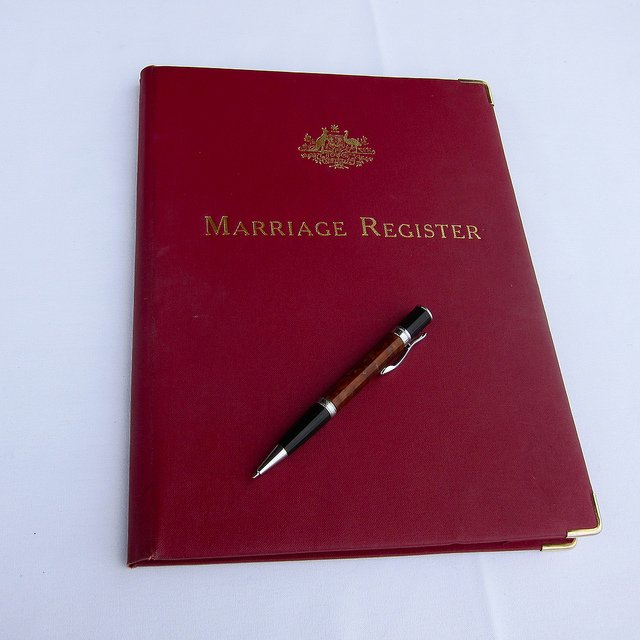
    Marriage Register

    How interesting to learn about the new rules that will govern couples in England and Wales who have been in a Civil Partnership who wish to change (upgrade?) their relationship status to a marriage.

    It seems that they are going to be able to do so easily and will receive a “backdated” marriage certificate which will state that their marriage began when they entered into their Civil Partnership.

    I’ve some reservations about this but I know it will be warmly welcomed by many and it would be churlish to oppose it.

    It is interesting though and there will be pressure now in Scotland for the Scottish Government to do the same.

    Here are some obvious issues.

    • It is quite odd to think that some might find themselves to have been married without their, at the time they entered into their marriage, believing that they wanted to be married.
    • People who have been blessing Civil Partnerships are going to find that they’ve been blessing marriages all along.
    • People will be able, I think, to find themselves married who never went through any ceremony at all – they may simply have signed the papers. (This is a new thing).
    • There’s no doubt going to be some grumpiness from those who trusted the politicians who said that Civil Partnerships were definately not marriages and that it had been invented in order to do something different to marriage.
    • In a sense, it is rewriting history. People are going to have marriage certificates that date from a time when they were not in fact married at all.
    • The Bishops of the Church of England in the House of Lords might feel that the Government has pulled the rug out from under them.
    • I think, that people can end up married whose proposal to marry has never been published either by banns on in a registrar’s office. I’ll be interested to see whether the registrars publish the names of those converting their status. My guess is that they won’t and thus people will end up married in law who have never had their intent to enter marriage advertised to anyone.
    • It is quite odd to think that a status like marriage can be backdated. Is there any comparable status that can be changed like that?

    Personally, I would have preferred the solution to be that people would get new full marriage certificates when they requested to change their relationship status into a marriage. I think this because I think that marriage ought to require a clear statement of consent at the time it is entered into. (Indeed, many of the rules surrounding marriage are about getting unambiguous consent from both parties, freely given).

    Interesting times. Uncomfortable times for the churches, particularly the Church of England.

    Photo Credit – Dale Gillard Copyright: Creative Commons Attribution-NonCommercial-ShareAlike 2.0 Generic (CC BY-NC-SA 2.0)


14 responses to “Liturgical sadness”

  1. Robin Avatar
    Robin

    Has anyone else been following the series in ‘The Tablet’ taking the Latin Sunday Collects from the Roman Missal (Ordinary Form), printing alongside them the official English translations and then commenting on the Collects?

    The effect the series has on me is not what was intended. I spend much of my time being puzzled and irritated by the looseness of the translations from the Latin – words and phrases left out, new ideas included, and sometimes translations which are at best a paraphrase.

    The point of mentioning this is that what I’ve seen of the new English translation of the Roman Mass is undoubtedly more faithful to the Latin, which is, after all, the definitive form.

    This will be important to some and, I expect, an irrelevance to others. However, an ecumenical gesture we could make (pause for breathtakingly unpopular suggestion!) would be to incorporate the new relevant parts of the new translation in our own Liturgy. That really *would* show ecumenical goodwill.

  2. David |Dah • veed| Avatar
    David |Dah • veed|

    “…the Latin, which is, after all, the definitive form.”

    That is certainly debatable. I fail to see that the purpose of the liturgical reforms of the 70s and 80s which resulted in many new liturgical books for most major denominations and prayer books for Anglicans, was to get us all back to the Latin Mass.

    Rome has pretty much cut the rest of us “free” so to speak, as irredeemable for all the heresies of women’s ordination and now GLBT ordinations and same sex blessings, and I am fine with that. I would not go anywhere near the Tiber, but I share Kelvin’s sense of loss of something we pew sitters shared around the world.

  3. Robin Avatar
    Robin

    Just to clarify, when I wrote “…the Latin, which is, after all, the definitive form” I meant that it was the definitive form for Roman Catholics.

  4. Ritualist Robert Avatar
    Ritualist Robert

    Vicky wrote: “… it is unlikely new conversion areas such as China would find Latin accessible.”

    A Roman friend of mine who probably would know said to me the other day that the Catholics in China use the Latin mass because they missed out on the reforms of Vatican II. Does anybody know if this is true?

    I went recently to a Latin mass here in Sydney with the same friend and most of the servers and the priest were from Vietnam … and a good deal of the back-to-the-future seminarians one sees at the papist cathedral seem to be Korean … so I am not sure that the formality of the Latin mass, or a more formal English one will put off Asian converts.

    It’s a pity that the ecumenical implications of this translation exercise haven’t been pondered a bit more.

Leave a Reply

Your email address will not be published. Required fields are marked *

Previous Posts

  • Sermon – 11 October 2009 – Job

    Here is this morning’s sermon. There is a short hiatus near the beginning whilst microphones were sorted out. Fortunately one member of the congregation decided that she did want to hear me preach rather than just see me preach and waved her arms until it was sorted out. Many thanks Peggy. In the name of…

  • Sermon for St Francis 4 October 2009

    Here is the sermon preached yesterday for St Francis That Gospel reading is our jumping off point this week because it was a jumping off point for St Francis himself. It was on hearing this gospel that his manner of life was changed. He heard it and believed it was a call directly to him…

  • Here is a sermon I prepared earlier

    Preached in St Mary’s on 6 September 2009. I can’t remember why I didn’t put it online ealier. This morning I want to talk about the Syrophoenician woman whom we have just heard about in the gospel reading. This woman, whose name is unknown, is an intriguing character. She was an outsider for a number…

  • Twenty Years On

    It is funny how anniversaries creep up on you. It is twenty years ago this week since I went to read theology at the University of St Andrews. I can remember Freshers’ Week very clearly all these years later. Inevitably, some of those whom I met in the first few days there, I have lost…