
• Review: Nixon in China – Scottish Opera – ****

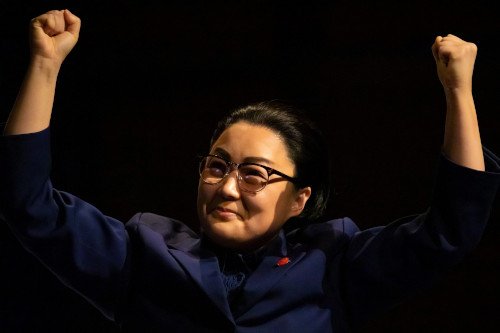
    Madame Mao
    Hye-Youn Lee as Madame Mao. Photograph: James Glossop

    Do we make history or does it make us?

    Scottish Opera’s co-production of Nixon in China is a timely and intelligent piece that asks questions about things that many in the audience will remember yet provides no easy answers. This is not a simple morality tale, nor a love story, nor a tragedy. It is an opportunity for every audience member to reflect on the swirling currents of modern political life. It is a piece that is at once about how strange the past seems to be and how even stranger, the present.

    The dominant theme in John Fulljames’s production is looking back. The whole story is told as a retrospective study of documents within an archive storage facility. Everything is either memory or historical record.

    This is an innovative staging making clever use of video throughout. Some of this is simply projected pictures. More interestingly though, much is seen in the form of layers of documents laid down under a digital vizualiser on a desk on the stage.

    The bold scoring of the arrival of the plane in China (Landing of the Spirit of ’76) is matched with a particularly fabulous kaleidoscope of projected images on stage.

    Joana Caneiro’s conducting shows some restraint throughout the evening. Both orchestra and singers seem a little underpowered. There was no trouble with balance between the pit and the stage but as the action and the theatre heated up, the sound of the fans on the large digital projector in the auditorium were more of a distraction than they should have been.

    None of this took away from the sheer excitement of the score. This is a phenomenal musical work. The retrospective mood on the stage perfectly matches the retrospective mood of much of the music, referencing, Wagner, Stravinsky, dance tunes and so forth. This is a production which also emphasises that though radical in some ways, the piece is fundamentally rooted in an operatic tradition. The various set pieces between the six characters, the three female secretaries singing in a semi-chorus, the quotes from other musical works and librettist Alice Goodman’s teasing playfulness with rhyming couplets all emphasise that this is a piece that refreshes a tradition that we already know well.

    The singing honours have to be awarded to the two female principals. The arrival of Hye-Youn Lee as Madame Mao in the second act was brilliantly exciting. The role demands an agile coloratura soprano and Hye-Youn Lee did not disappoint. Julia Sporsén’s portrayal of Pat Nixon was also astonishing and she completely dominated Act II. Indeed, there was the creeping realisation that there’s an ambiguity in the title of the work. Which Nixon are we celebrating coming to China – Richard or Pat? John Fulljames missed a trick in not bringing Ms Sporsén on last to receive the audience’s appreciation at the end of the evening to make the point that the piece is largely about Pat Nixon rather than her tricky husband. This was particularly seen throughout the revolutionary ballet when the action was entirely focused on Pat. Throughout everything her voice and hair were coiffed to perfection. She looked and sounded impeccable.

    Amongst the men, Eric Greene’s Richard Nixon was interesting and even vulnerable and Nicholas Lester’s final valediction as Chou En-lai the Premier of China moving, elegiac and world-weary.

    As the final archive box was put away with its characters in it, one felt thankful that this work had been brought out of storage by those intelligent enough to make it compelling and interesting. In a world still functionally unable to make sense of the relationship between power and the people this was a production that seemed necessary. I came out at the end of the evening feeling that I understood the world better than I did before. I also came out feeling that the world was also more perplexing than it seemed earlier in the evening.

    Both things can be true.


    Rating: ★★★★☆

    This review was published first by Scene Alba.

7 responses to “Eucharistic Prayer”

  1. Stewart Avatar

    Another great clip Kelvin – The singing is great.

    I found myself singing along with the Santus and Benedictus.

    Please more of the service. The cathedral always sounds great when the a large congregation is being supported by the organ. The snippet of “All people that on earth do dwell” to the tune of Jerusalem on the BBC website leaves me wanting more.

  2. ryan Avatar
    ryan

    Yeah, I think ours are the best (although I heard New Zealand’s are lovely too). Who actually writes these things? The then-bishops themselves? Artistic clergy? I can see why they would want them to be written in house but (personally) I think it would be great , in the future, to approach notable writers/poets to do them (Edwin Morgan!) irrespective of belief, and have them checked for theological accuracy by someone appropriate.

  3. Caron Avatar
    Caron

    Do you know, I always thought the 1970 Liturgy was best and I couldn’t come to terms with the modern stuff. I might be more open to persuasion than I thought.

    The atmosphere at the service must have been wonderful and it does come across in the video clip.

    As for the angel – thank you so much for having that attitude to a baby. Others are not so tolerant.

  4. John Penman Avatar
    John Penman

    Totally agree on the excellence of the modern Scottish Liturgy. Having had to suffer the Roman Rite and the ASB when working in Englandshire and occassional exposure to Common Worship (which is both), it was nice to come back to what was/is “simply the best”. Being picky tho, we took a wee while to get there: 1982 was the 1st Eucharistic Prayer – the other 4 were authorised in 1990! Like Caron I was a 1970 fan, but exposure to the Blue Book has made it much more “home” for me.

  5. Eamonn Avatar
    Eamonn

    I agree that the 1982 Liturgy is unbeatable. Every time I visit the C of E or the C of I, the liturgies used seem (with respect) to have yawning gaps in them.

    Caron, the 1970 Liturgy has strengths if you want the underlying theology spelt out in propositional statements. The 1982 service more often expresses the theology through imagery, which to some of us speaks more eloquently. As it happens, a bishop who is a published poet was involved in the drafting.

  6. MadPriest Avatar
    MadPriest

    “Now, what do you want next”
    Have you got any Simpsons, or maybe an early Torchwood episode?

  7. Thomas L W Graham Avatar
    Thomas L W Graham

    Just visiting these sites for the first time. What a wonderful innovation to include all these video’s and sermons etc on the web. Hope the enclosed donation is of some assistance.

Leave a Reply

Your email address will not be published. Required fields are marked *

Previous Posts

  • Prayers for Remembrance

    Last Sunday evening we had an extraordinary Choral Evensong. The idea was simple – to mark the start of the First World War by singing some of the music that the cathedral choir was singing 100 years ago. The idea came from Pam Barrowman, one of the members of the choir whose historical research includes…

  • Jericho, Berlin and what wall next?

    I remember going on a school trip to Germany when I was a young teenager. I don’t remember that much about the visit to be honest, but I do remember the wall. We were not in Berlin but we were staying near enough to the border between East Germany and West Germany to warrant a…

  • Somewhere over the rainbow

    I’ve just heard that I’ve been included in the Independent on Sunday’s Rainbow List. This is the new name for the Pink List – a list of gay, lesbian, bi and trans people whom the newspaper wants to celebrate as people who have made a difference in the past year. To be honest I’m surprised…

  • Becoming a Welcoming Cathedral

    Someone who is visiting Glasgow at the moment and who has been to St Mary’s a couple of times, said to me this week, “Well, whatever you are telling those people about Welcome, they are actually doing it.” It reminded me of someone in the congregation who said early on in my ministry here, “You…