
UPDATE
Free Pride has now updated its policy and welcomes Drag Performers.
See here for details: https://freeprideglasgow.wordpress.com/2015/07/22/free-pride-to-welcome-drag-performers/
I’m leaving the post below up here as the discussions it has started seem to me to have value in themselves.
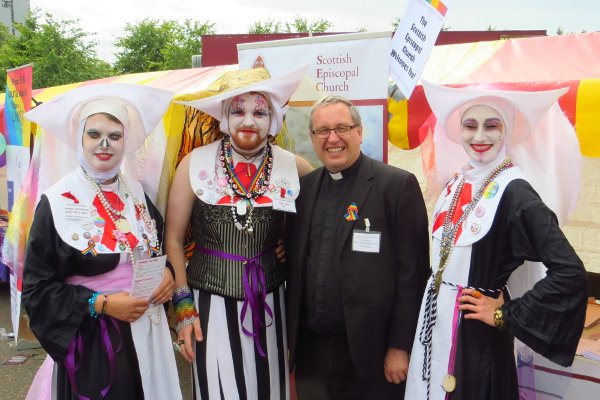
“Can I walk with you a bit? I’ve got some questions.”
“Hi there, of course you can. Where are you from?”
“Well, from Australia actually. This is my first Pride.”
“Oh right, are you enjoying it?”
“Oh yes, but I wanted to ask you something. The thing is, I was wondering if you are real. Are you real?”
“Oh yes, I’m real.”
“But the nuns…they’re not real, right?”
The picture at the top is one of my favourite pictures from Pride and the conversation I’ve just related is one of my favourite pride encounters.
This week there’s a bit of a stooshie going on in the LGBT+ world because of plans for a Pride event in Glasgow in a couple of weeks time.
First of all, you need to know that there’s been a schism. Pride Glasgow is the main event and will be organising the Pride March through Glasgow, starting and ending at the dear green place – Glasgow Green. Secondly you need to know that once the march is over there will be a day long event on the Green. And thirdly you need to know that there’s a charge being imposed on those who want to get into the event. And therein lies the schism. There is a body of opinion, with which I have some sympathy, which finds gates and barriers around Pride a nonsense. And thus there has evolved a split, a schism, a divergence. There will be a new event this year called Free Pride which does what it says on the tin – it will be a free event that you don’t have to pay to attend. Yes, that’s right, it is a bit like the Church of Scotland and the Free Church of Scotland. Close your eyes and make a wish and you’ll find out that there will be Wee Free Pride before we get to August too.
Furthermore, Free Pride has issued an edict saying that it won’t book any cis drag acts (in other words, men who were born as men presenting themselves as female characters (caricatures?) for the entertainment of the company, out of sensitivity to those in the Free Pride movement who are trans people and those who don’t identify as one gender or another.
This has led to headlines going all around the world suggesting that drag has been banned at Pride in Glasgow. Now, that’s not true. There will be drag acts at the main Pride. And at Free Pride, people of any gender (however one defines that) will be able to attend wearing anything they like and presenting themselves as any gender(s) they choose.
Nonetheless there has been searing condemnation of the Free Pride movement from some quarters and the whole thing gives me much to think about. What’s more, what I think about it changes whenever I think about it, which may be entirely appropriate when considering those who live out the fluidity of gender more than I do most of the time.
So anyway here’s a five questions that I’m trying to think through about pride, gender, drag and religion.
How are religious people going to begin a conversation about trans and non-binary issues?
The truth is, I’ve been engaged in LGBT+ conversations with LGBT+ people for a very long time. The reality is that the church conversation has focussed on G a huge amount, L not so much, B hardly at all, T almost never and the + just makes people say “What?”
And yet in every congregation I’ve worked in there have been people making huge decisions about themselves in terms of gender.
I’ve yet to hear from an anti-gay, anti-divorce evangelical as to what a straight married couple should do if one of them transitions and begins to live life from within a different gender identity.
Now, I know that all couples are different and need to make their own decisions for themselves, all people’s experience is different and all that, but to someone who holds anti-gay, anti-divorce views, which trumps which? Should such a couple stay together if they want to? Are they then in a same-sex marriage or are they not? Might either of them be refused ordination or ministry on the grounds of their situation?
And believe me, these are not hypothetical questions. Not at all.
When I was a university chaplain, I sometimes worked with people who were one gender when they came to university and who had a different gender identity when they left. For people of faith who are living with such a situation, there’s all kinds of questions that have no answer and no-where even to ask the questions.
I don’t incidentally think that the difference between a drag act and a trans person is always the difference between apples and pears. Usually it is. Sometimes it just isn’t. I’ve known people who did drag because for one reason or another they couldn’t transition and didn’t feel able to come out as anything other than an act. This identity stuff is hugely complex.
There’s a suggestion currently in the Episcopal Church based in the USA that a naming ceremony might be devised which might enable people in a new identity to have that marked in a religious way. My own view is that here in Scotland we’ve already got quite a useful liturgy in the form of the Affirmation liturgy which might well be used for such a situation. However, I’ve never heard of any bishop’s guidelines on how to use it. If I asked for such guidelines, I have to say I’d be surprised if they were useful.
How can the LGBT+ communities combat transphobia and sexism?
But if there’s a silence about trans issues in religious communities, there’s not always silence in LGBT+ communities and yet what we hear isn’t always good. Now, in my view, gay men have more of a problem being respectful of others who might find themselves identifying under the LGBT+ umbrella than others do. I don’t know why that should be but I do know that in my world those who are closeted are very often less respectful of women than those who are not and I suspect that reaches out across the rainbow.
As people come out more and more, I think we can have more of an open conversation about these issues but I suspect that it won’t always be easy.
I’ve been surprised by the Free Pride decision about drag acts and I don’t entirely agree with it. However, I can understand how some people might think that some drag is less than affirming. Of course it is. Sometimes it is downright offensive. But is it offensive intrinsically or isn’t it? I’m not convinced that it is though I’m also not sure I’ll always hold that view. Notwithstanding the fact that I don’t entirely agree with the Free Pride position, I can’t say I entirely disagree with it either.
Can we speak of ethical drag?
So, can we speak of drag acts that are ethically better than other drag acts? Heavens!
I think my position on this begins by remembering the heritage of those in drag who have fought for my freedoms. It was drag queens who were at the front of the action at the Stonewall Riots in 1969. There’s a long heritage of people speaking truth from under a cross-dressing wig.
This has perhaps been exemplified most brilliantly recently by some of the speeches of Panti Bliss in Ireland.
I can’t speak against someone who can do this. I want to add my own standing ovation:
Indeed, I’m in awe of such a powerful political speech. You can hear the passion, the frustration, the fury – and it is fury that took its own place in helping to change the law in Ireland recently.
What about clerical drag?
People who have silk robes in their vestry closets should not cast aspersions. The truth is, clerics have been dragging up for years though not entirely for the same reasons as drag acts at Pride.
I was recently doing one of my Sacristy Safari tours and reached into a cupboard for some robes. As soon as I put them on, someone gasped, “Oh, you look different in those; no, you are different in those!” And I think that’s true.
Generally speaking, I think that clerical drag is used to de-emphasise sexuality and gender identity. I can understand female colleagues wanting good fitting clerical shirts but I’ve never been able to understand how anyone would want feminine vestments. When we put on our drag it is to take (drag?) attention away from ourselves rather than towards it. At least, I think that’s what is going on. But then I’m not (contrary to what most people think) a vestment queen.
How will the the future will judge us?
One of the reasons that I’ve hesitated before commenting on the situation with Pride and Free Pride in Glasgow is that I’ve found myself unable to work out how the future will judge us.
I can imagine that in 50 years, drag acts might well be seen as being as uncomfortable to watch as the Black and White Minstrel Show is today – an anachronism of history that people simply will struggle to believe was ever acceptable.
However, I can also imagine and alternative to that too in that in 50 years our attitude to gender might be completely different to the way it is today. I can imagine a future where all gender is regarded as performative, where gender-play is taught in nursery school and where the drag queens of old are hailed as the vanguard in a movement that has freed the world from expectation and conformity.
I have no idea which future is the more likely.
The truth is, it isn’t just gender that is fluid. Mores and morals are fluid too and we don’t know how our own times are going to be judged.
I happen to think that I’ve seen drag acts that have made me laugh and I’ve certainly known drag artist(e)s who have brought about the liberation of others, built community and done lots of good. I also know people who are offended by drag itself and who find themselves silenced as they try to express why.
Glasgow’s going to have a pretty good Pride offering this year, in amongst all this. We’re going to have a Pride event as of old where anyone living in any gender identity can come and enjoy a range of acts including cis drag acts. We’re also going to have a Free Pride event where anyone living in any gender identity can come and enjoy themselves in a place where there won’t be such performers.
I’m not sure whether it is because I’m a good Anglican trying to find a via media or whether it is because I’m trying to be a good catholic embracing all that God has made or whether it is just that I can’t make my mind up, but I find that I have a foot in both camps. (So to speak).
Let there be Pride – lots of it. Let there be love, joy and peace.
And let us, inside and outside closets, churches, LGBT+ communities and yes, both within and far outside our comfort zones talk about these things. For they are not settled, not clear-cut and downright interesting.
Amen


Leave a Reply