• Herald Article: Pride and Frustration

    This article appeared in the Herald newspaper today.

    I will be joining the Pride Glasgow march this weekend with mixed feelings – pride at how much has been achieved and concern at how much that needs to be done.

    I’ll be marching with hopes high that before Pride comes around next year, the Scottish Parliament will have passed new laws to allow same-sex couples to marry. Marriage law is one of the greatest barriers to equality for gay people in Scotland. Access to marriage isn’t the only big change gay people need. However, it remains such a big prize for gay campaigners because those marching through Glasgow all know how much social attitudes have softened since civil partnerships came in and all hope for even more once same-sex marriage is part of our common life.

    Changes to the law are hugely welcome, but still don’t represent equality – just ask any gay couple wanting to get married in church on the same basis as the straight couple sitting in the pew next to them. The overly cautious legislation that will be passed next year is a consequence of politicians still giving credence to religious voices of intolerance.

    Another issue that still needs a lot of work is access to education free from prejudice. It means education authorities and individual schools working on homophobic bullying. Part of the means of achieving that is to ensure that gay teachers in schools are able to be the role models that both gay and straight kids need. Those teachers need to know that they can live outside school time without fear of what might happen in school if their relationships are known about.

    Notwithstanding the high spirits that are a feature of every Pride march, I’ll be marching to express a good dose of anger and frustration. Every Pride is a celebration but every Pride is a protest too. This time the most immediate part of the world which is causing concern is Russia. President Putin’s sudden recent crackdown against lesbian, gay, bisexual and transgender (LGBT) people has been brutal, unexpected and frightening and greatly under-reported in the mainstream media in the UK. Glasgow’s Lord Provost’s letter to her opposite number in twinned Rostov-on-Don this week is welcome but far too weak. She has invited a delegation from Russia to “share more of our good experience of working to include LGBT citizens as a valued part of our city”. Meanwhile, Glasgow’s actual LGBT citizens might be rather puzzled, given the history and demise of the LGBT centre in the city, as to how that support is being expressed.

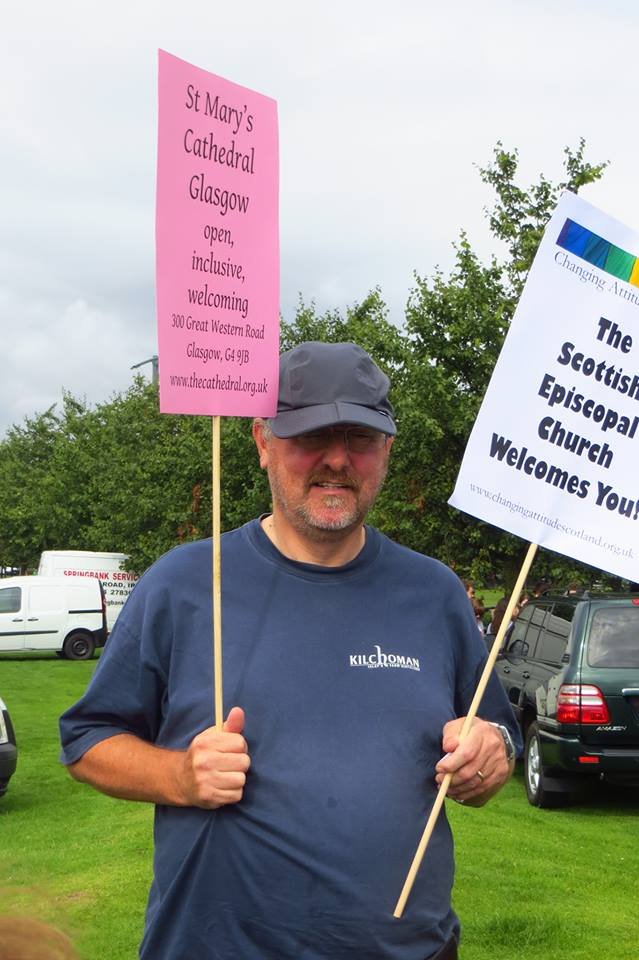
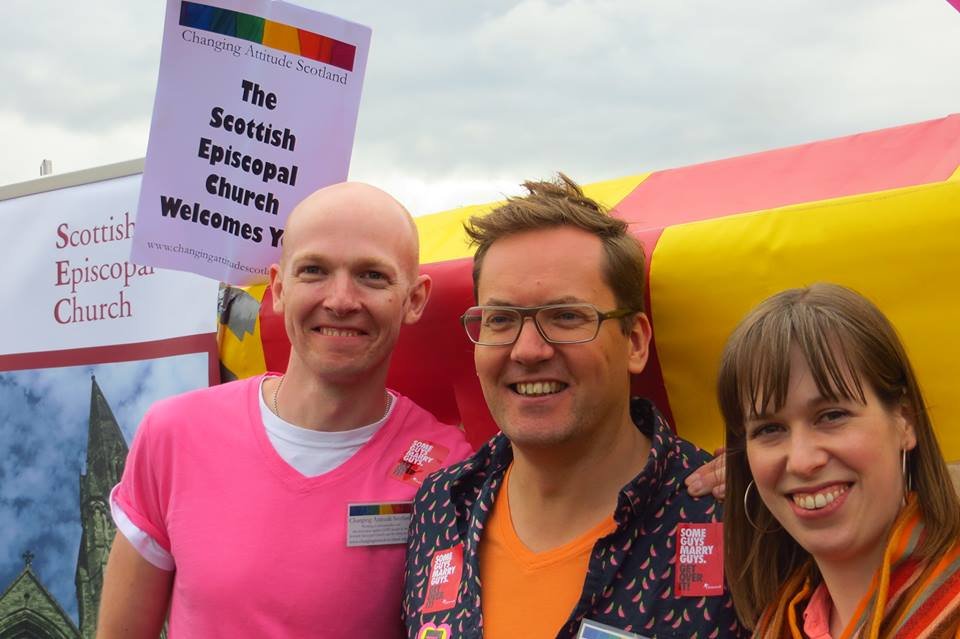
    This weekend at Pride, I’ll be marching, as usual, with thousands of others. This time, though, I’ll be marching with members of my own congregation. There will be several older members coming along to march in support of their gay and lesbian children and grandchildren. I’ll be marching alongside a couple whose civil partnership I’ll be blessing in a couple of weeks as they make their journey towards legal marriage. Alongside me there will be clergy from my own Scottish Episcopal Church and ecumenical friends in the crowd in clerical-collars answering all the usual questions that arise about how to find a church that is open, inclusive and welcoming to all. I’ll also be walking alongside a young straight couple who have told me they want to bring their toddler, a member of the Young Church at St Mary’s Cathedral. They want to be able to tell him he was at Pride the year of the legislation allowing gay and lesbian couples to marry. My earliest memory is of being woken by my parents to see the moon landings. These days, for some parents bringing up children, equalizing the law on marriage is the equivalent kind of life defining moment.

    And I’ll be marching with LGBT folk from my congregation too; people who work and struggle and pray for justice in the church and beyond. I march this year because I’m immensely proud of them all.

8 responses to “More sermons”

  1. ryan Avatar
    ryan

    Listened to one of the sermons (the wife for Isaac one) and it struck me that the one thing all proper episcopal preachers that I’ve heard have in common is an attractive voice. Is this taught at theological college, or are prospective ordinands vetted, Simon Cowell on X Factor style?

  2. kelvin Avatar

    You are too kind Ryan. And the idea that people at theological college should be taught anything to do with preaching is delightfully charming.

  3. morag Avatar

    just read the kingfisher sermon,you really do have a beautiful way with words and imagery.I believe God is with us every day.I was walking with my dog in Kelvingrove park the other night and in the pond standing quite still and majestic was a large heron.He looked magnificent but nobody else seemed to notice they just walked on by.God is definitely in my local park,Victoria.There is a sort of semi wild section of large yellow Peace roses there and their scent is truly heaven “scent”I love to sit theredrinking it in and have quiet thoughts with God.This web page you have is truly unique and it is wonderful to come across someone in the church who so obviously has a living ,loving relationship with God

  4. David |daveed| Avatar
    David |daveed|

    And the idea that people at theological college should be taught anything to do with preaching is delightfully charming.

    May I beg to differ, at least for this side of the pond.

    Both of the seminaries which I attended in the USA, had a department with professors dedicated to teaching homiletics & worship. At Perkins School of Theology, SMU, we took two required semesters, which included writing weekly sermons to be delivered in class for critique by both professors and classmates. Each semester we also had three sermons which were videotaped at staggered points in the class for us to be able to witness and have record of our own improvements.

    I was even asked to preach one of my three in my native Spanish and was critiqued by the hispanic community, staff & students at Perkins.

    Preaching and Worship are pretty standard fare at seminaries in the USA & Canada.

  5. kelvin Avatar

    My apologies, David. I’d forgotten that we had gone global.

    I would say that I learned a lot about liturgy and worship during my training, much of it from other students. I don’t think there was much more than 15 minutes devoted to homiletics in all my training.

    I think that the theory was that this would be done whilst on placements in congregations. Although one can learn a lot in such placements, I think that preaching is something that everyone can always learn to do a bit better and that the church should not be shy of trying to teach.

  6. ryan Avatar
    ryan

    I’m always curious as to whether preachers write out a full script of a sermon, actor giving a reading style, or if there is an element of improvisation. A 60 minute sermon,at average speaking speed, works out at 6,000 words which is surely a lot to write out in full each week.And what happens if there are pastoral crises that prevent completing the writing of a sermon? Do you guys have a folder of back-up material for such occasions? Are you allowed to plagiarise or is that a big a vice as it is in academia?

  7. kelvin Avatar

    Thanks Ryan. Those are good questions.

    First of all, no-one in their right mind preaches for 60 minutes in the UK, do they? I think you will find on listening to mine that you get about 12 minutes. I think that if you are a regular preacher and you can’t say what you want to say in St Mary’s in 15 minutes you’ve probably started to preach next week’s sermon a week early. My recent one about dating strategies was just over 10, and there was a lot packed in!

    The readings that we use come round in a three year cycle so quite often one may have as a starting point what was said three years ago or six years ago. Using a common lectionary also means that a lot of people are preaching on the same thing at the same time and there are a lot of websites with emergency resources and other people’s ideas.

    I’d say that most preachers use other people’s ideas. Often it is nice to acknowledge them. Since putting all mine online, I’d say that I use other people’s material much less. I do sometimes use things that I’ve used before and in other contexts. If it was worth saying once, it might be worth saying again. Again, however, putting it online makes that kind of thing more risky now. They might have heard the jokes before.

    In a good week, I will have been thinking about the lectionary readings all through the week even through the pastoral events that come along. They feed into it somehow.

    Lots of my influences come from people I encountered when I was reading Divinity at St Andrew’s University. At the time I learned a lot from a prominent feminist theologian and have since learnt the importance of the Liberation Theologians that people were trying to get me to appreciate. At the time, it bored me silly. Now it is the stuff of life.

    They key is to develop a range of ways of reading the Bible. A repertoire of styles.

  8. David |daveed| Avatar
    David |daveed|

    Ryan, there are many styles, and we all have to find which of them is a best fit for us personally. I know a few who preach from the barest of notes on a 3 x 5 card. Others who read verbatim from a type written manuscript. I think the majority of us type a manuscript and refer to it, however, certainly not slavishly, leaving room to expand or alter “as the Spirit moves.”

    The axiom I was taught by both John Holbert and Marjorie Procter-Smith was that if you preach more than 15 minutes, you do not know what you are talking about.

Leave a Reply

Your email address will not be published. Required fields are marked *

Previous Posts

  • Lonely hearts

    When I was involved in the design and format discussions for inspires magazine there were two things that I wanted to see which never made it onto the pages. The first was an agony column (Dear Father…) and the second was a lonely hearts column. I seem to remember some nervous tittering about what categories…

  • Let us haste to Kelvingrove

    To Kelvingrove Art Gallery and Museum yesterday along with thousands of other people each determined to make sure it was open once again.Of course, I had a sneak preview a month ago when I went there for a press-call with the Lord Provost. I could see then that the place was looking good.The highlights for…

  • Liberal Theology – Making your mind up

    Fr Gadgetvicar, amongst others, points towards Oliver Donovan’s learnèd diatribe against Liberalism on the Fulcrum website.Who would be a Liberal believer after reading all that? As polemic goes, it is all very clever, but it does rather miss the point by refraining from asking where and why people find faith and nourishment in liberal thinking.…