
Scottish opera reach the end of their rather thin main stage season with a well sung Eugene Onegin which brings with it a lot of surprises.
The action begins, not with the overture but with silence. An older woman – Tatyana herself in old age, we are to discover, stumbles into the wreck of an old country house. A sense of melancholy pervades the scene even before she flings open tall window-shutters and lets in light and mist and music.
The older Tatyana remains on stage throughout the evening and clearly we are seeing things through her memory. This doesn’t particularly get in the way though it is all rather reminiscent of the end of last year’s Scottish Opera season which saw La Boheme through the unlikely eyes of an older reminiscing Mimi.
Director OIiver Mears keeps quite a lot of the action off stage – including everything to do with the chorus. When they are peasants, their singing can be heard through the tall windows and when they are at the ball later on they are kept behind a gauze at the back of the stage which, thanks to Fabiano Piccioli’s lighting design is sometimes the back wall of the room in the country house where we seem to be and sometimes dissolves to show a scene behind it. This sits rather well with an opera which never attempts to tell the whole story. Tchaikovsky picks and chooses individual scenes from Pushkin’s story of Onegin and so a lot of the action is happening off-stage anyway.
In terms of the singing, there are great riches on offer. Onegin himself is played rather cool and aloof by Samuel Dale Johnson. His passions come to life at the end of the piece when he realises that he made a huge mistake in spurning the love of Tatyana. Why anyone should spurn Tatyana when she is played by Natalya Romaniw escapes me. Her singing was one glorious scene of passion after another. She seemed to completely inhabit the besotted Tatyana and it felt as though there was nothing that she wouldn’t do to get her man. Onegin’s friend Lensky was also well served, being sung superbly by Peter Auty.
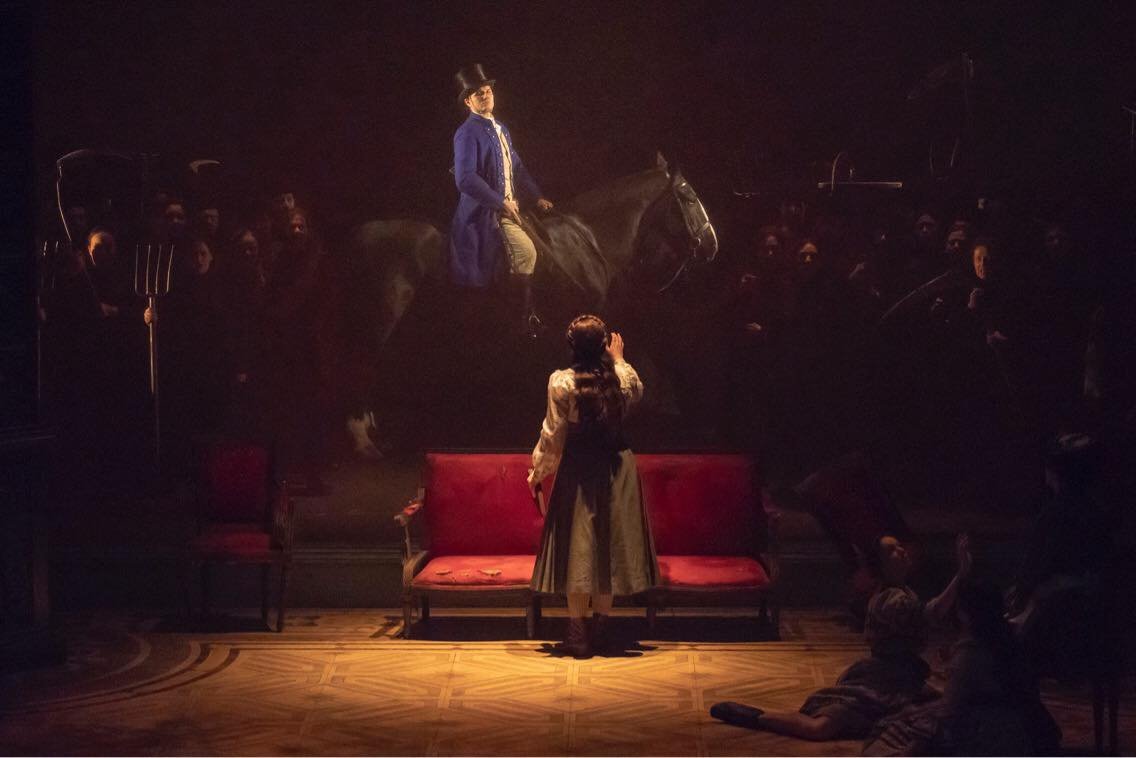
There was quite a lot to compete with the singing however, and certainly in the first act, the music was quite upstaged by some complex stage business. At one point the peasant chorus could be seen in dull light behind the gauze at the back of the stage. They parted in the manner of Moses parting the Red Sea to reveal the dim figure of Onegin sitting astride a horse. It took a few moments to realise that this was in fact a living and breathing real live horse.
Indeed, although the horse was scarcely visible for more than 25 seconds of the production, it made the strongest impression possible, for it next appeared bounding onto the stage though one of the tall windows, still with Onegin on its back.
Alas, for the singers, the horse also turned out to be a disgruntled opera critic and was soon followed by a Russian looking ostler with an all too necessary bucket and shovel.
Sadly the horse did not receive the dignity of a namecheck in the programme.
However, the musicians carried on regardless through all this and through other more successful pieces of stage business including the members of the chorus striking ball silhouettes, the sudden and rather unexpected appearance of Onegin standing naked in his bath and a group of figures who appeared around a table.
Some of these scenes were seen through the back-wall gauze and were very effective. It worked well though one had to remember that for some of these scenes we seemed to be seeing what was in the head of a character who was comprised of the memories of another character, which takes quite a suspension of disbelief. Sadly too, there’s a price to pay for putting the chorus at the back of the stage and effectively behind a curtain and this left the second act which should be overwhelming feeling a little underpowered.
There are a couple of rather odd historical oddities. Presumably the gloopy bubble-gum dripping off Onegin’s boot wasn’t meant to be there but it wasn’t at all clear how Tatyana managed to write with a fountain pen in the 1830s.
Tatyana’s Pen was in fact sponsored by 19 donors, most of whom were named in the programme so clearly it wasn’t a last minute thought.
Stuart Sutherland’s musical direction was assured and confident. Indeed, it was difficult to believe that this was the same orchestra who sounded so shambolic just weeks ago for Ariadne Auf Naxos.
Tchaikovsky was clearly on the run from his own sexuality when he composed this piece. In Scottish Opera’s hands, the experience of unrequited and then impossible love and rejection never sounded so good.
Do say – “that was a stunning end to Scottish Opera’s season”.
Don’t say – “how do they train a horse to defecate in time to Tchaikovsky?”
Rating: 

This review appeared first in Scene Alba.


Leave a Reply