
Back at the end of September I suddenly saw that a Trump victory was possible. Suddenly, with a horrible clarity I could see that there was a credible way for him to get to the White House. And once it was credible, it suddenly seemed inevitable.
And for that reason, I don’t wake to a feeling of astonishment and surprise today. This American election result is not what I hoped for but it is kind of what I’ve spent large parts of the last few weeks not merely fearing but expecting.
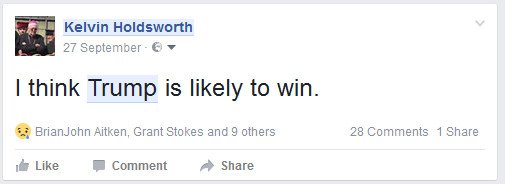
It is rare that I wish that I had been wrong, but I do today.
The election of Donald Trump is to be deeply regretted. However, it also needs to be understood and those who regret it most deeply need to think not merely about how to cope with the news but about what comes next.
The true enormity of the defeat of Hilary Clinton has to be faced head on. I’m sorry for Hilary Clinton but this isn’t merely a personal defeat. It is a defeat of a whole set of liberal values that millions of us hold throughout the world. If we want to know where to go next with those values there are some tough truths that we need to face.
- Donald Trump didn’t win the election despite being a xenophobe. He won it because he was a xenophobe.
- Donald Trump didn’t win the election despite being sexist. He won it because he was sexist.
- Donald Trump didn’t win the election despite being anti-LGBT. He won it because he was anti-LGBT.
- Donald Trump didn’t win the election despite being unqualified for office. He won it because he was unqualified for office.
- Donald Trump didn’t win the election despite being against every progressive value people like me hold. He won it because he was.
He won it because he was.
That’s the point.
That’s the fact that has to be faced. The enormity of that fact has to be faced. People wanted this. A majority of people wanted this.
It seems to me that people have used the ballot box to express a desire for change – change from a system which was not taking everyone along with it.
I feel the frustration myself. It is the frustration of seeing the rich getting richer and the poor getting poorer. It is the frustration of seeing people hungry in the richest economies of the world. It is the frustration of seeing young people with no hope for jobs. It is the frustration of seeing social security systems undermined. It is the frustration of seeing pensions squeezed and being told that is a price worth paying. It is the frustration of seeing financial institutions rescued whilst blue-collar jobs have been seen as expendable.
There is much that is wrong with our world.
And one of the things that is wrong with the world is the presumption on the part of so many of us who hold liberal views that if things get more difficult for people then those same people will automatically turn with joy and thanksgiving to the solutions of the liberal-left. The reality is far from that. People who are frightened for themselves more often turn to the right.
This election result is a trump of judgement for those of us who are liberals. The #Brexit result was another such trump but I fear neither will be the last.
If we want liberal democracies then we will need to work for them them and fight for them and if I’m honest I’m still thinking through what that means for me personally on this rawest of political days.
Liberal complacency is partly to blame for the situation that we find ourselves in. Liberal values have largely kept the peace between nations in the West for 60 years. However, they have not kept everyone fed. And if you want peace, you must feed the poor.
So what comes next?
What next? How to cope with today? Take joy in the small things and work to change the big things.
— Kelvin Holdsworth (@thurible) November 9, 2016
Somehow we need to remember to be kind to one another. And that means being kind to those with whom we disagree profoundly. Then we need to take joy in the small things. The sunrise, the love of lovers and the the light of a candle in the darkness are all unaffected by the political events of the last 24 hours.
But then we need to pick ourselves up and do what liberals do. We need to organise, protect, witness, learn and love.
Organise. Protect. Witness. Learn. Love
— Kelvin Holdsworth (@thurible) November 9, 2016
We need to organise because that’s the way the world changes. People voted for change in this election. Let us never forget that they can vote for change again – in America, in the UK, all around the world. It is those who organise who have a head start in getting the change they hope for.
We need to protect because right now a load of people are going to be feeling vulnerable. We need to work out how to protect and stand alongside the Muslim who has heard the call to ban Muslims from entering the greatest economic power in the free world. Or the Mexican with relatives on both sides of the wall that is already being built in Trump’s mind. Or the woman who fears bringing an accusation against an abuser. Or the LGBT teenager who hears the most powerful people in the world talking about conversion therapy. Or so many others. People need to be protected. People we know need to be protected.
We need to witness to the fact that we believe in better values than those which have seemed to triumph today. That means taking a full part in the frightening world of public discourse that we now have. Social media can’t be put back in a bottle and bunged up only to be opened once we have learned how to deal with it. Those who wish to lead and guide need to be right in the midst of the people advocating things worth believing in and social media is right where the people are whether we like it or not. Church leaders need to note this particularly. The anodyne tweeting only of inane bible verses, where you went to bless a Mothers’ Union banner or excerpts from the Daily Office do not count as serious engagement with the modern world. Yes, the online world needs those things, and a dose of humour too, but it needs more than that. Our world needs ideas worth believing in and people who can articulate them in the prevailing culture.
We need to learn because our ideas need to change and because some of our ideas have not been fit for purpose. Only the most arrogant could simply believe that the majority of people in America were wrong without trying to learn something themselves. I fear more than Donald Trump that liberals will not learn the lessons of this day. Prosperity must be prosperity for a far wider group in society. Do we have the courage to speak of reducing the gap between rich and poor for the sake of a greater whole? Are we prepared to advocate broader prosperity that might lead to our own pockets being lighter? Are we prepared to learn the tricks of the new media world that, so far, the political right is so perplexingly more savvy at using than the liberal left? Are we prepared to say that we’ve not yet found the answers to all that ails us? Are we prepared to face the fact that in assuming that people would turn towards collective institutions (the EU, the UN, the Climate Change agreements etc) that we were wrong. Are we prepared to educate and teach, relentlessly the values we hold to those whom we raise?
And we need to love. There’s a whole lot of loving needed today and there’s a whole lot of loving going to be needed in the days ahead.
I happen to believe that love wins.
Even on days when it doesn’t feel like it.
That’s what makes me a liberal.
And I hear the call loud and clear to live the values I believe in.


Leave a Reply