• Herald Article: Pride and Frustration

    This article appeared in the Herald newspaper today.

    I will be joining the Pride Glasgow march this weekend with mixed feelings – pride at how much has been achieved and concern at how much that needs to be done.

    I’ll be marching with hopes high that before Pride comes around next year, the Scottish Parliament will have passed new laws to allow same-sex couples to marry. Marriage law is one of the greatest barriers to equality for gay people in Scotland. Access to marriage isn’t the only big change gay people need. However, it remains such a big prize for gay campaigners because those marching through Glasgow all know how much social attitudes have softened since civil partnerships came in and all hope for even more once same-sex marriage is part of our common life.

    Changes to the law are hugely welcome, but still don’t represent equality – just ask any gay couple wanting to get married in church on the same basis as the straight couple sitting in the pew next to them. The overly cautious legislation that will be passed next year is a consequence of politicians still giving credence to religious voices of intolerance.

    Another issue that still needs a lot of work is access to education free from prejudice. It means education authorities and individual schools working on homophobic bullying. Part of the means of achieving that is to ensure that gay teachers in schools are able to be the role models that both gay and straight kids need. Those teachers need to know that they can live outside school time without fear of what might happen in school if their relationships are known about.

    Notwithstanding the high spirits that are a feature of every Pride march, I’ll be marching to express a good dose of anger and frustration. Every Pride is a celebration but every Pride is a protest too. This time the most immediate part of the world which is causing concern is Russia. President Putin’s sudden recent crackdown against lesbian, gay, bisexual and transgender (LGBT) people has been brutal, unexpected and frightening and greatly under-reported in the mainstream media in the UK. Glasgow’s Lord Provost’s letter to her opposite number in twinned Rostov-on-Don this week is welcome but far too weak. She has invited a delegation from Russia to “share more of our good experience of working to include LGBT citizens as a valued part of our city”. Meanwhile, Glasgow’s actual LGBT citizens might be rather puzzled, given the history and demise of the LGBT centre in the city, as to how that support is being expressed.

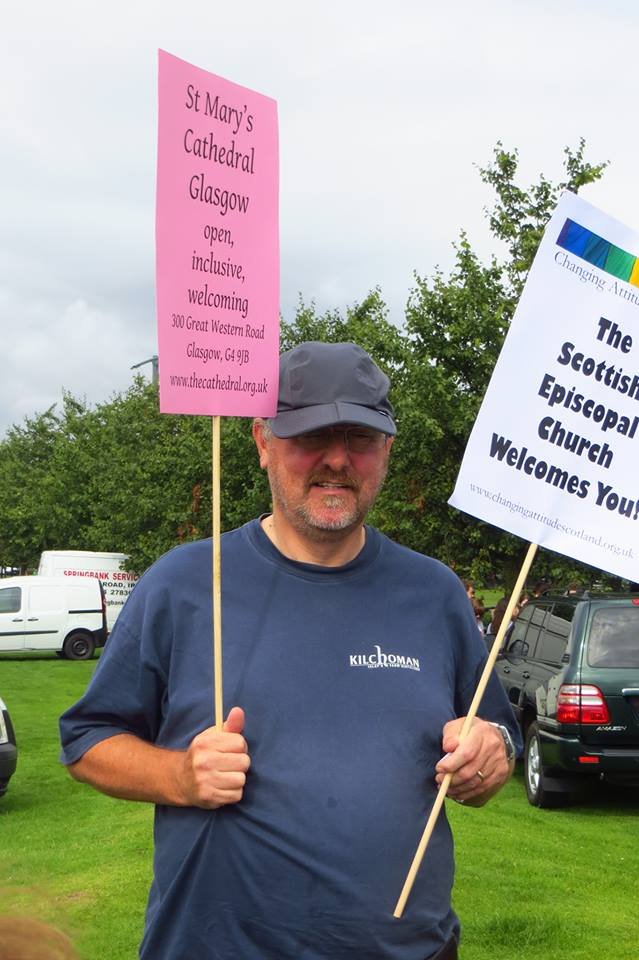
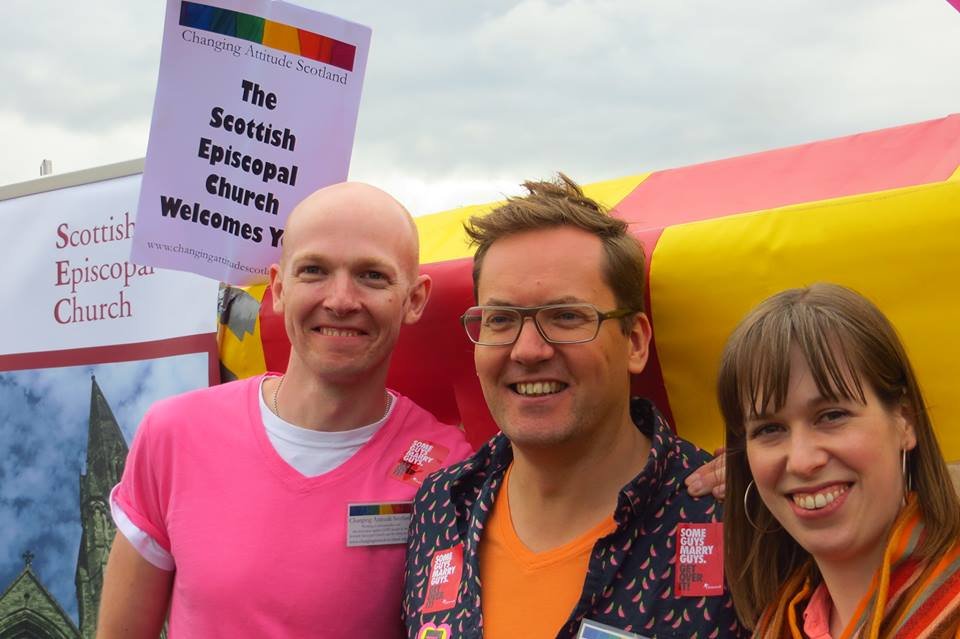
    This weekend at Pride, I’ll be marching, as usual, with thousands of others. This time, though, I’ll be marching with members of my own congregation. There will be several older members coming along to march in support of their gay and lesbian children and grandchildren. I’ll be marching alongside a couple whose civil partnership I’ll be blessing in a couple of weeks as they make their journey towards legal marriage. Alongside me there will be clergy from my own Scottish Episcopal Church and ecumenical friends in the crowd in clerical-collars answering all the usual questions that arise about how to find a church that is open, inclusive and welcoming to all. I’ll also be walking alongside a young straight couple who have told me they want to bring their toddler, a member of the Young Church at St Mary’s Cathedral. They want to be able to tell him he was at Pride the year of the legislation allowing gay and lesbian couples to marry. My earliest memory is of being woken by my parents to see the moon landings. These days, for some parents bringing up children, equalizing the law on marriage is the equivalent kind of life defining moment.

    And I’ll be marching with LGBT folk from my congregation too; people who work and struggle and pray for justice in the church and beyond. I march this year because I’m immensely proud of them all.

7 responses to “Sermon – 1 June 2008”

  1. Di Avatar

    It seems to me more and more important for us to rediscover the idea of the divine inspiration of the reader of scripture as well as that of the authors.

    Thank you for this, Kelvin. I agree with you wholeheartedly. After all, only the author truly knows what was in his head when he wrote it and indeed, where the inspiration came from.

    Oh, and I enjoyed the rest too.

  2. Marion Conn Avatar
    Marion Conn

    Once again I’m listening to this late at night. Definitely food for thought and prayer. I was outside in the rain tonight, I really like the idea of that I was not just wet, but drenched in Grace. Thanks Kelvin.

    Good Night.

  3. Jonathan Ensor Avatar
    Jonathan Ensor

    I believe that everyone has a right to freedom of thought. Freedom of speech is a circumscribed fact of life in the UK and it is certainly an interesting idea that reading can be inspired, but who is the arbiter of what is inspired and who is the arbiter of what is apostate. I may believe with all my heart that I am divinely inspired, but I still have to convince other people that this is the case and that I am not being grandiose etc. If I pontificate about a text in the common domain, I may well have to justify myself and/or defend my position at some considerable cost, which I may or may not be willing to pay.

  4. kelvin Avatar

    Thank you for your comments.

    Jonathan – I think that I was suggesting that we see both the authorship of texts and the reading of texts as activities that can be inspired. I think that there has to be some dialogue between author and reader.

    I also think that in the history of looking at biblical texts, some people have emphasised the value of the text to the individual whilst others have read the text in community. (We might also presume that the texts themselves were gathered in community). I don’t think that I’d like to lose sight of that idea of inspiration coming when a community reads a text together. That idea is important to me as it counters against the idea of individuals thinking that they (alone) are divinely inspired.

    It seems to me that more people have believed that they alone were the only proper source of truth or inspiration or legitimacy than has actually been the case.

  5. Elizabeth Avatar
    Elizabeth

    Having heard this text spoken of many, many, many times in the context of Luther’s reading, I must say it was an enormous relief to hear this other way of reading. This tempts me to return to other texts of Paul’s that might be worth re-reading without Evangelical/Calvinist/Lutheran-coloured glasses.

  6. Jonathan Ensor Avatar
    Jonathan Ensor

    Kelvin, I agree that there has to be a community, but pretty universally in churches I have been to the Minister has preached and the community has continued to be fragmented. Also there is no chance of dialogue with dead authors and in the realm of art, once a work is in the public realm it is available for multiple interpretations which the artist may well never have considered. Even legal documents which attempt to define the law are interpreted by the judiciary. There is little chance for art or literature or the bible to be consistently read because the implications of certain phrases or sentences may reside in the way that they are written rather than in the mind of the author and the definitions may be too loosely drawn.

  7. kelvin Avatar

    Many thanks for your comments.

Leave a Reply

Your email address will not be published. Required fields are marked *

Previous Posts

  • Lonely hearts

    When I was involved in the design and format discussions for inspires magazine there were two things that I wanted to see which never made it onto the pages. The first was an agony column (Dear Father…) and the second was a lonely hearts column. I seem to remember some nervous tittering about what categories…

  • Let us haste to Kelvingrove

    To Kelvingrove Art Gallery and Museum yesterday along with thousands of other people each determined to make sure it was open once again.Of course, I had a sneak preview a month ago when I went there for a press-call with the Lord Provost. I could see then that the place was looking good.The highlights for…

  • Liberal Theology – Making your mind up

    Fr Gadgetvicar, amongst others, points towards Oliver Donovan’s learnèd diatribe against Liberalism on the Fulcrum website.Who would be a Liberal believer after reading all that? As polemic goes, it is all very clever, but it does rather miss the point by refraining from asking where and why people find faith and nourishment in liberal thinking.…