
I’m currently writing a series of articles on the sacraments for the cathedral website. They are being posted here in case anyone wants to comment or ask any further questions.
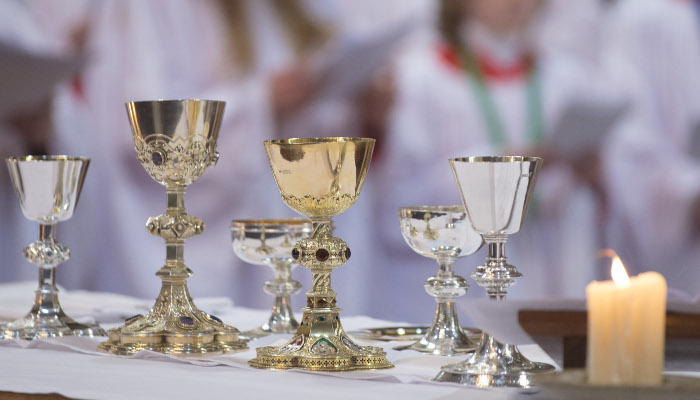
Several times a year there is the opportunity to receive baptism at St Mary’s. The primary time for baptisms to take place is at the Easter Vigil early on Easter Day. Other opportunities are available throughout the year though there is always a connection with the events of Easter. It is at the Easter Vigil that the font is filled with water and the Bishop breathes over the water praying that all who are baptised in the water will receive the holy spirit. It is also at the Easter Vigil that the great Paschal Candle is lit from the Easter Fire and brought into the church. Every baptism takes place in the light of Easter and the Paschal candle is lit near to the font to indicate this.
As with all the sacraments, the symbols surrounding baptism are rich. A number of different physical things happen in the course of a baptism which help to form our beliefs about what is happening when someone is baptised.
Baptism is intrinsically tied up with the events of Holy Week as the original symbolism of baptism – plunging someone into water and them rising out of it again is symbolic of Jesus dying and being buried and rising again. The bible speaks of us being baptised “into Christ’s death” in order that we might rise with Christ. For this reason, baptism cannot really be understood as anything other than one of the symbols of the new life and resurrection that we believe Jesus brought us.
Very many religious traditions use water symbolically and baptism is one of the ways that Christians use water to express theological truths. (Washing feet on Maundy Thursday is another vivid way in which water is used in the liturgy). In common with the way other religious people use water, there is an element of symbolic washing that is involved in the ceremony of baptism. Every week in church we say when we say the Creed together that we acknowledge “one baptism for the remission of sins”.
At the heart of the baptism ceremony is a beautiful prayer over the water which recalls some of the ways in which God’s people have seen the love of God in the world through watery symbols.
Holy God, well-spring of life,
in your love and justice,
you use the gift of water to declare your saving power.
In the beginning your Spirit moved over the face of the waters.
By the gentle dew, the steady rain,
you nourish and give increase to all that grows;
you make the desert a watered garden.
You command the wildness of the waves;
when the storm rages you calm our fear;
in the stillness you lead us to a deeper faith.
In the life-giving rivers and the rainbow
Israel discerned your mercy.
You divided the Red Sea to let them pass from slavery in Egypt
to freedom in the Promised Land.
In the waters of Jordan
penitents found forgiveness in the baptism of John.
There, Jesus your beloved child was anointed with the Holy Spirit,
that he might bring us
to the glorious liberty of the children of God.
As well as water, we use oil and light to symbolise what is happening at baptism. After being baptised in water, a sign of the cross is made on the person’s head using oil which the bishop blesses each year on Maundy Thursday – again connecting baptism with the events of Holy Week. At some point in the service, a candle will be kindled from the Pascal Candle and presented to the candidate. In the case of children who are baptised, parents or godparents can light the candle every year on the person’s birthday or the anniversary of the baptism until such a time as they ask why the candle is being lit and can hear the story of their own baptism.
At St Mary’s we gather everyone who is present around the font. Everyone who is baptised is surrounded by the love of the whole community. Together we have a responsibility to help all who are baptised to live out their Christian faith.
It is the ancient tradition of the church that you are only baptised once and so we don’t re-baptise anyone who has been baptised already. In common with many of the churches in Scotland we recognise that if someone has been baptised in water in the name of the Father and the Son and the Holy Spirit within the context of a different denomination to our own then they have been properly baptised. You can’t be baptised into being an Episcopalian. You are baptised into the Christian faith.
Many people are brought for baptism when they are babies or very young children by those bringing them up. When we baptise infants who cannot comprehend what is happening to them or indeed make their own assent to what is being done, we are rejoicing that God’s love is there for everyone whether or not they know it. In baptism we celebrate our belief that everyone is utterly loved by God whether they know they are or even whether they want to be or not.
For those coming into the life of the church who are adults, baptism is a powerful statement that they themselves confess that they know that they are known and loved by God. people who are adults who wish to make a similar statement who were baptised as children sometimes find that the sacrament of Confirmation offers them an opportunity to do something similar in which some of the symbols of baptism are recalled.
Baptism is a sacrament – an outward sign of an inward spiritual grace, because we use physical things (water, oil, candles) to speak of deep spiritual truths – the passion of God in saving the the world through the actions of Christ that we remember in Holy Week, the fact that Christians have an expectation of rising to new life with Christ who rose from the grave and the joy of celebrating the uniqueness of each individual within the context of God’s overwhelming love.
Frequently Asked Questions
Do you baptise adults or children at St Mary’s?
Both adults and children are baptised in St Mary’s.
Can you be baptised by full immersion in St Mary’s?
Our font is not designed for full immersion baptisms but if you would like to explore the possibility of being baptised by full immersion, please speak to a member of the clergy.
I was baptised as a baby in St Mary’s does that mean I am a member and can vote at church meetings?
You are a member of the Christian faith by virtue of your baptism (and consequently welcome to receive communion in any Scottish Episcopal Church) but legal membership of a congregation is something different and you need to speak to a member of the clergy to ensure you are included on the membership roll.
Any further questions or comments?

37 responses to “Keeping the faith”
It was an inspiring recitation. Following the English translation in the service sheet provided added insight to the life of Mary. All the more so as the cathedral is dedicated to St Mary. You are reminded of Mary every time you walk into the building with the Gwyneth Leech mural over the High Altar.
Kelvin is quite right. The very self-righteous defenders of the Bible (including the ones who trolled a brave young Muslim woman, for days, with the most vile language, and those who did not reprimand them) totally ignored the Biblical instructions for raising concerns with a brother in faith (Matthew 18:15; 2 Tim 23). Very practical instruction too! As anyone who has ever lived in community can verify. Could all these obsessive men *please* stop trying to divide our communities in Glasgow. We will not be divided. At the first sign of trouble we rush out to embrace one another. These abusers have much to repent of, even if *just* standing by while others throw stones.
I HATE it when the wrong tune is picked for a hymn … it is simply an abomination before God.
However, helping people to think about how we share hospitality, welcome and learn from each other is the WAY of God! Blessings on you Kelvin.
Some reasons why this time was different:
1. The other quaran recitations you mentioned happened at Nine Lessons and Carols, or special ecuminical and interfaith events. While 9L&C was originally a modified Evensong, nowadays it’s usually considered a seasonal community musical recitial with a religious tinge, so having a Muslim from the community recite something from their faith would seem natural enough. Civic and interfaith services will likewise naturally include representatives of every faith in the community. By contrast the Eucharist is the central act of Christian worship and people expect to hear ONLY Christian doctrine proclaimed in the Holy Eucharist. In other words, this was the wrong venue for showing hospitality to Muslim neighbors. You did not intend to practice syncretism, but I think the outcome was syncretic despite your good intentions.
2. Post Brexit (and post Trump) British Muslims are now seen as alien invaders rather than fellow members of the community.
3. Because hostility to Muslims is now fashionable, the Express and rest of the gutter press decided that this was a story worth reporting. Since conservative Americans often read the online editions of the British gutter press, the story then went global.
4. Because you are gay and out, your every action is scrutinized for any possible hint of heresy by GAFCON and Co.
Of all these reasons, only reason #1 is a legitimate criticism, but I hope you do think about criticism #1 as well as defending yourself from other, illegitimate criticisms.
Thank you for your comment Whit J – all the more because it is a thoughtful criticism.
I’ve plenty to reflect on about the how and the when we do things like that and I do hear loudly and clearly that many people think this was an inappropriate context. Though of course, I’d be bound to say that some are saying that the Eucharist is precisely the place indeed there are some saying that is what it is for.
I’m not going to get into a back and forth with all the comments on this post and I’m deliberately not letting through things that have already been said but be assured that I’ve heard the criticism and will reflect on it not simply now but over coming months. (I’ve learned a lot about where God is this week that will take a long time to process). I’m grateful for the way you’ve made your point.
I think there is a good deal in what Whit J says, although I am not sure the effect actually was syncretic. I think one does perhaps have to be a regular worshipper at St Mary’s to understand how totally orthodox the worship there is, and how much Jesus is the focus of worship – how utterly unlikely it is that anyone there would make the mistake of thinking he was not revered by the congregation as a whole as very God from very God. It would be impossible for them not to realise that all the clergy there rejoice in this belief. The congregation saw the words of the Qu’ran in an English translation which portrayed that book’s far-from-easy-to-follow account of Islam’s view of the conception of Jesus, in which there was nothing offensive, and heard a very beautiful voice singing in a strange and glorious language. These were clearly indicated to be the beliefs of another faith. We certainly neither saw or heard or understood any insult to the person of Christ. I am sure none was intended, either. Whereas, and this bears repeating, I am totally sure that many of those commenting (not of course by any means all of them, and nobody whose comments are published here) simply wish harm to relationships between the great faiths in Glasgow.
I have spent my whole adult life in dialogue with people of other religious traditions, it has been deeply rewarding. However I feel that what happened at this service was profoundly wrong. When we are truly ourselves we allow other people to be profoundly themselves. The truth of Christianity is not compatible with any other religion. To avoid that incompatibility is to avoid reality. Worship of Jesus is the fountain of our faith the Qu’ran is opposed to that. I love Jesus and therefore cannot conceive of reading the Qu’ran in an act of worship – no problem doing so in other contexts but not in worship. I am profoundly disturbed that you cannot see this Kelvin.
There are so many things aren’t there, not just around this issue which we hold dear in faith and which we can’t see from another perspective?
I can hear and see that people are upset by this and clearly there are many people not upset by it too. And obviously, at least I hope obviously, I love Jesus too.
The trouble with religious questions and the questions that religious people have I think is that so often that our love for our faith can make it impossible to comprehend others who also claim to love the same faith but who take different views about things. We can hear them claim that love but be intellectually unable to process it because it leads them to different conclusions.
I’ve found the same thing to be true in the sexuality debates very frequently though I perceive that to be changing sometimes now. Similarly with other identity issues and some political issues. Israel/Palestine conversations for example often seem to be conducted (when they are conducted at all) by people who seem to behave like ships passing in the night.
I happen to have views about Church Schools which are pretty intransigent and negative. You are one of the few people, no the only person, who ever made me really think there might be a point of view about them other than mine which might have an integrity I could respect. And I’m very grateful for that.
Kelvin, thank you for your reply. I have enormous respect for you. I have no doubt that church schools can be argued against from perfectly respectable positions. Worship of Jesus is simply a different order, it cannot include a reading from the Qu’ran. Worship is one thing, study, dialogue, relationship something else.
I am really grateful to Richard for the phrase “When we are truly ourselves we allow other people to be profoundly themselves” which reflects my experience of interfacing with sincere people of other faiths. Is a Christian Eucharist a place this should happen? I can understand some Christians feeling it is not, but as long as everything was clearly labelled as what it was and the integrity of the liturgy was intact, I can also understand some feeling it is.
Brother Kelvin,
Although I do not agree with allowing the Koran to be read in our Christian churches, I truly appreciated your firm and resolute stand for the deity of Jesus. He is our great God and Savior and I love Him very much. Blessings from Tennessee.
Just as a perhaps amusing point of reference, the 1982 hymnal of the Episcopal church in the USA has “Brightest and best of the STARS” (caps mine) “of the morning,” apparently so as to avoid offending any daughters who might be present, and the two tunes included are “Morning Star” by James Proctor Harding (1850-1911) and “Star in the East” from The Southern Harmony (1835). The Harding tune was also in the 1940 Hymnal, wherein the word “sons” was still used.
I am not clear as to whether the hospitality at St Mary’s anticipates infinite extension of parallel lines between Islam and the Church in Glasgow. Are you planning some opportunities for Glasgow Muslims to understand the Christian faith and prepare for Baptism and the glorious liberty of regeneration by the Holy Spirit? (In whichever order; no axe about that!) As you move around the Glasgow community and meet more Christians of Islamic background, why not invite such to participate in groups for new Muslim enquirers? The testimony of an ex-Muslim can express vibrantly “How I know He lives” (as your SA brethren would sing). You might find not only new hearts from a divine work of grace among your Muslim neighbours but in other neighbours too. Amen. Inshallah!
There are a small number of people in St Mary’s who are converts from Islam to Christianity just as there are a small number of people in local mosques who are converts from Christianity to Islam.
St Mary’s regularly puts on events and courses for people discovering and exploring Christianity. Most living religions do the same thing.