
So far as I can tell, most Christians believe that right at the centre of the public square there grows a tall tree called Christians Ethics. And Christians think that they sit up in its gentle branches presiding over the moral dilemmas of this world greatly blessed by what the good Lord has given unto them.
Christians tend to think that they hold a privileged position when it comes to moral decision making.
And Christians are wrong.
And this isn’t just limited to Christians either. It applies to other faith groups and even to non-believers, who sometimes seem to presume that the Tree of Atheist Goodness is nudging just a little higher than everyone else’s tree and that this means that the privileges of Being In Charge of morality should naturally cross over to them.
They are wrong too. And mostly for the same reasons.
Ten years ago I was a candidate in a General Election for the Liberal Democrats at a time when being a Lib Dem was both more popular and more respectable than it is today. (I’m no longer a member of the party as it happens, and didn’t vote Lib Dem at the last election).
When you are a candidate in an election, you have to be prepared for people asking you questions before they cast their vote. For a relatively small number of people will chose how to vote directly on the basis of their interaction with candidates over questions which they care about. You have to be ready with an answer about taxation, abortion, nuclear weapons and so on. Political parties tend to help out with answering these questions – when you sign up for a party ticket you sign up to represent a particular manifesto of positions after all. However, manifestos don’t cover everything and in any case, some people want to interact with a candidate directly.
The most difficult question that I had when I was a candidate came from a couple who were obviously thinking very deeply about how they would cast their vote. Their question was along these lines: “We are disposed to vote for a liberal candidate but we hesitate to vote for you because we know from your profession that you are a Christian. To be honest we are worried about the values that you hold and we presume that your values are not our values. We don’t think Christian values are particularly nice values. Can you reassure us that if elected you will conduct yourself as a Liberal rather than according to a Christian agenda?”
It was a great question and made me think a lot. I did engage with the couple and in the end they told me that they did indeed intend to vote for me.
I was lucky in being able to talk to them about the issues they were concerned about and put my own position over which in the end was not that different from their own. There was no alternative but to go through things issue by issue. As it happened, being able to talk at first hand about being a gay member of the clergy did give them some reassurance.
But the point is, they had come to the view that Christians have a considerably more unpleasant ethical position than decent people in society.
And I fear that this is increasingly the case and that most Christians neither believe that others hold this view nor care about it either. After all, they are still up in their tree.
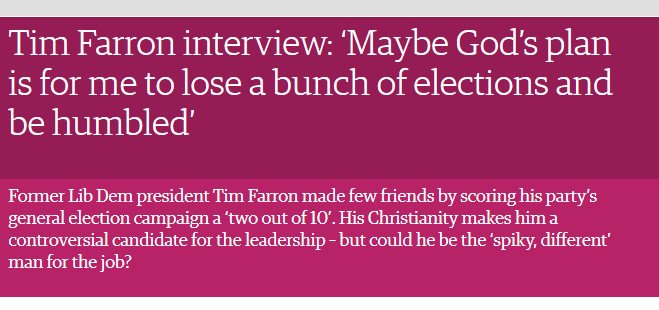
Today there is a new interview with Tim Farron that has been published and it bears some reflection. Tim is likely to be elected as the Leader of the Liberal Democrats over the next couple of weeks. It is a car crash of an interview and heralds the fact that the decimation of the liberal cause in British political life is not yet complete. Its likely new leader seems intent on finishing off a liberal tradition that is already gasping for breath.
First we’ve the headline: “Maybe God’s plan is for me to lose a bunch of elections and be humbled”
Then we’ve the content which shows that the headline is lifted out of a quote of jaw-dropping stupidity both politically and theologically.
Farron believes that everyone will go to either heaven or hell. “I think the Bible is clear. Everybody has something coming after.” As a non-believer, will I go to hell? “Well, it’s not for me to make that judgement. It’s a real cop-out, this one, but Abraham says: ‘Will not the judge of all things do right?’ And at the end, no one will disagree with the justice of what God has done.”
I ask if he consulted God when considering whether to stand for the party leadership. “Of course you do, of course you do. Obviously you ask for His guidance.” Does he think God has a plan for him? “I think He has a plan for everybody.” I’m not sure what that means. “Well, God is sovereign. Dreadful things happen in this world, but that reminds us that we need a saviour. I don’t go round fixating that God has some major plan for me. Maybe his plan is for me to lose a bunch of elections and be humbled. God’s plan could be that some pretty brutal things happen to you. But the one thing I fall back on is that God’s overall plan is good.”
One wonders where to begin. It seems to me that what we’ve got from Tim Farron here is bad politics and even worse theology.
Let us presume for a moment that God is in the business of direct meddling in human politics. (I don’t think that God is in that business, but let us presume that it is true). Might we not think that God in her wisdom might have more on her mind than whether Tim Farron or someone else leads a political party which is likely to be locked out of power for years? We might also draw breath at the idea that if God wants Farron to lose a bunch of elections and be humbled then “God’s plan” might be for the Tories to be in power. Is someone really as capable of giving such a crass quote to the newspapers really going to lead a political party in the UK?
Incidentally, the “Will not the judge of all things do right?” quote comes from Genesis Chapter 18 and Tim Farron seems to have been reading the Living Bible paraphrase. What you need to know is this – it comes straight out of the Sodom and Gomorrah story. It is interesting that given the controversy surrounding Tim Farron’s voting record on gay rights that he lifts a quote from scripture right out of that particular ancient saga. It is also interesting that he chooses a portion of scripture where many liberals reading it might well say that the human being (Abraham) in the story had a more secure grasp of justice, righteousness, compassion and fairness than the God depicted there, who is indeed said to rain down arbitrary terror upon people.
A lot of the trouble here comes from the idea that God has an overall plan. Tim Farron believes it but I don’t – or at least not in that way. If God has a plan then it is not unreasonable to ask why God is hanging about and not implementing it more quickly than God does. Providence gives us a God to blame for the way things are rather than giving us a prompt to take responsibility as autonomous subjects both for being honest about our past and in driving the future forward towards justice.
I tend to believe much more in vocation than in providence. I’d be happy to hear from any political leader about how their religious views (Christian, Muslim Buddhist, Atheist or whatever) give them a drive to bring about a better world. I believe in people being in touch with an inner calling to put the world to rights.
However, I’m very suspicious of people believing God to be on their side and believing that they are in the business of implementing God’s plan for the world.
Tim Farron seems to me to be unfit to lead the Liberal Democrat party and I say that as one of the very few who predicted the near wipe-out of Liberal Democrat seats that took place at the General Election.
I’ve been troubled by the attitude of Lib Dem friends to his voting record on LGBT issues. Farron famously voted in favour of giving registrars the “right” to opt out of dealing with gay couples. This has been dismissed as a side issue by Tim’s supporters. The trouble is, these are not side issues, these are my rights.
The election of Tim Farron will show that the party has learned nothing at all from the Tuition Fees debacle. At the time of that disaster, the party chose pragmatism over party policy. Choosing cheeky-chappy Tim Farron as leader because he has a good record in winning elections despite the fact that he has an illiberal voting record on key touchstone issues seems to me to be remarkably similar.
The trouble is, choosing good policy over pragmatism is exactly what liberalism actually is.
37 responses to “Keeping the faith”
It was an inspiring recitation. Following the English translation in the service sheet provided added insight to the life of Mary. All the more so as the cathedral is dedicated to St Mary. You are reminded of Mary every time you walk into the building with the Gwyneth Leech mural over the High Altar.
Kelvin is quite right. The very self-righteous defenders of the Bible (including the ones who trolled a brave young Muslim woman, for days, with the most vile language, and those who did not reprimand them) totally ignored the Biblical instructions for raising concerns with a brother in faith (Matthew 18:15; 2 Tim 23). Very practical instruction too! As anyone who has ever lived in community can verify. Could all these obsessive men *please* stop trying to divide our communities in Glasgow. We will not be divided. At the first sign of trouble we rush out to embrace one another. These abusers have much to repent of, even if *just* standing by while others throw stones.
I HATE it when the wrong tune is picked for a hymn … it is simply an abomination before God.
However, helping people to think about how we share hospitality, welcome and learn from each other is the WAY of God! Blessings on you Kelvin.
Some reasons why this time was different:
1. The other quaran recitations you mentioned happened at Nine Lessons and Carols, or special ecuminical and interfaith events. While 9L&C was originally a modified Evensong, nowadays it’s usually considered a seasonal community musical recitial with a religious tinge, so having a Muslim from the community recite something from their faith would seem natural enough. Civic and interfaith services will likewise naturally include representatives of every faith in the community. By contrast the Eucharist is the central act of Christian worship and people expect to hear ONLY Christian doctrine proclaimed in the Holy Eucharist. In other words, this was the wrong venue for showing hospitality to Muslim neighbors. You did not intend to practice syncretism, but I think the outcome was syncretic despite your good intentions.
2. Post Brexit (and post Trump) British Muslims are now seen as alien invaders rather than fellow members of the community.
3. Because hostility to Muslims is now fashionable, the Express and rest of the gutter press decided that this was a story worth reporting. Since conservative Americans often read the online editions of the British gutter press, the story then went global.
4. Because you are gay and out, your every action is scrutinized for any possible hint of heresy by GAFCON and Co.
Of all these reasons, only reason #1 is a legitimate criticism, but I hope you do think about criticism #1 as well as defending yourself from other, illegitimate criticisms.
Thank you for your comment Whit J – all the more because it is a thoughtful criticism.
I’ve plenty to reflect on about the how and the when we do things like that and I do hear loudly and clearly that many people think this was an inappropriate context. Though of course, I’d be bound to say that some are saying that the Eucharist is precisely the place indeed there are some saying that is what it is for.
I’m not going to get into a back and forth with all the comments on this post and I’m deliberately not letting through things that have already been said but be assured that I’ve heard the criticism and will reflect on it not simply now but over coming months. (I’ve learned a lot about where God is this week that will take a long time to process). I’m grateful for the way you’ve made your point.
I think there is a good deal in what Whit J says, although I am not sure the effect actually was syncretic. I think one does perhaps have to be a regular worshipper at St Mary’s to understand how totally orthodox the worship there is, and how much Jesus is the focus of worship – how utterly unlikely it is that anyone there would make the mistake of thinking he was not revered by the congregation as a whole as very God from very God. It would be impossible for them not to realise that all the clergy there rejoice in this belief. The congregation saw the words of the Qu’ran in an English translation which portrayed that book’s far-from-easy-to-follow account of Islam’s view of the conception of Jesus, in which there was nothing offensive, and heard a very beautiful voice singing in a strange and glorious language. These were clearly indicated to be the beliefs of another faith. We certainly neither saw or heard or understood any insult to the person of Christ. I am sure none was intended, either. Whereas, and this bears repeating, I am totally sure that many of those commenting (not of course by any means all of them, and nobody whose comments are published here) simply wish harm to relationships between the great faiths in Glasgow.
I have spent my whole adult life in dialogue with people of other religious traditions, it has been deeply rewarding. However I feel that what happened at this service was profoundly wrong. When we are truly ourselves we allow other people to be profoundly themselves. The truth of Christianity is not compatible with any other religion. To avoid that incompatibility is to avoid reality. Worship of Jesus is the fountain of our faith the Qu’ran is opposed to that. I love Jesus and therefore cannot conceive of reading the Qu’ran in an act of worship – no problem doing so in other contexts but not in worship. I am profoundly disturbed that you cannot see this Kelvin.
There are so many things aren’t there, not just around this issue which we hold dear in faith and which we can’t see from another perspective?
I can hear and see that people are upset by this and clearly there are many people not upset by it too. And obviously, at least I hope obviously, I love Jesus too.
The trouble with religious questions and the questions that religious people have I think is that so often that our love for our faith can make it impossible to comprehend others who also claim to love the same faith but who take different views about things. We can hear them claim that love but be intellectually unable to process it because it leads them to different conclusions.
I’ve found the same thing to be true in the sexuality debates very frequently though I perceive that to be changing sometimes now. Similarly with other identity issues and some political issues. Israel/Palestine conversations for example often seem to be conducted (when they are conducted at all) by people who seem to behave like ships passing in the night.
I happen to have views about Church Schools which are pretty intransigent and negative. You are one of the few people, no the only person, who ever made me really think there might be a point of view about them other than mine which might have an integrity I could respect. And I’m very grateful for that.
Kelvin, thank you for your reply. I have enormous respect for you. I have no doubt that church schools can be argued against from perfectly respectable positions. Worship of Jesus is simply a different order, it cannot include a reading from the Qu’ran. Worship is one thing, study, dialogue, relationship something else.
I am really grateful to Richard for the phrase “When we are truly ourselves we allow other people to be profoundly themselves” which reflects my experience of interfacing with sincere people of other faiths. Is a Christian Eucharist a place this should happen? I can understand some Christians feeling it is not, but as long as everything was clearly labelled as what it was and the integrity of the liturgy was intact, I can also understand some feeling it is.
Brother Kelvin,
Although I do not agree with allowing the Koran to be read in our Christian churches, I truly appreciated your firm and resolute stand for the deity of Jesus. He is our great God and Savior and I love Him very much. Blessings from Tennessee.
Just as a perhaps amusing point of reference, the 1982 hymnal of the Episcopal church in the USA has “Brightest and best of the STARS” (caps mine) “of the morning,” apparently so as to avoid offending any daughters who might be present, and the two tunes included are “Morning Star” by James Proctor Harding (1850-1911) and “Star in the East” from The Southern Harmony (1835). The Harding tune was also in the 1940 Hymnal, wherein the word “sons” was still used.
I am not clear as to whether the hospitality at St Mary’s anticipates infinite extension of parallel lines between Islam and the Church in Glasgow. Are you planning some opportunities for Glasgow Muslims to understand the Christian faith and prepare for Baptism and the glorious liberty of regeneration by the Holy Spirit? (In whichever order; no axe about that!) As you move around the Glasgow community and meet more Christians of Islamic background, why not invite such to participate in groups for new Muslim enquirers? The testimony of an ex-Muslim can express vibrantly “How I know He lives” (as your SA brethren would sing). You might find not only new hearts from a divine work of grace among your Muslim neighbours but in other neighbours too. Amen. Inshallah!
There are a small number of people in St Mary’s who are converts from Islam to Christianity just as there are a small number of people in local mosques who are converts from Christianity to Islam.
St Mary’s regularly puts on events and courses for people discovering and exploring Christianity. Most living religions do the same thing.