
I slipped into an unknown pub in Middle England to get out of the rain and have a pub lunch. It was welcoming and cosy. Steak and ale pie, since you ask.
The part of the pub I was sitting in was right next to the bar. A small snug. The kind of room where you can hear everyone else’s conversations though it wasn’t too busy. Just a group of fifty-something men in for their pies a table a few feet from me, right next to the bar. It wasn’t terribly busy and so our host behind the bar joined in with their conversation, which soon turned to the result of the General Election. Everyone was interested in what it might mean for them. (Bartenders round here want firm action on business rates, I can tell you.)
After a while, one of the pie-eaters suddenly said for all to hear, “Did you know that 61% of the new MPs are gay?” The others at his table and the host at the bar expressed surprise that it should be as high as that. “It just isn’t right – not that number, that’s far too many of them. How have we become a country where 61% of our MPs are gay?”.
And I remained silent.
I remained silent because I was in a strange place and didn’t want to risk any unpleasantness.
Well no, I remained silent because homophobia stalks my world. I remained silent because I didn’t know how anything I might say might be taken. It probably wouldn’t have led to a punch in the face but the truth is, you never know.
The person making the claim about the number of gay MPs was wrong. Spectacularly wrong. I suspect he’d been told that 61 MPs were gay and had heard it as 61% and accepted that as being true. It was true in his inner world, a world in which the gays were getting above themselves. It was also a believable fact for those around him. They were surprised it was 61% and yes, that did seem a bit high. And yes, the gays were getting a bit above themselves.
I gather that a few more LGBT+ MPs exist than 61 – the number is about 66. That means that it is about 10% of the MPs in the House of Commons. LGBT+ people are sometimes estimated to account for about 10% of the population. So 60-odd members of parliament who fit that profile is something to be celebrated as a good example of representation. Once upon a time, every one of those MPs would have been subject to blackmail or worse. Once upon a time, every one of them would be silent.
Me remaining silent in the pub for 10 minutes and then, after finishing the pie, going off without a word, is minor when compared with the violence that many gay people face on a daily basis in other parts of the world.
Yet that incident played in my mind the rest of the day. I went over it again and again. Should I have spoken up and called out this nonsense? I can argue that both ways. But the thing that I care more about than putting someone right in a pub is that this nonsense claim inhabited my head for half a day. Not so much the absurdity of the suggestion that 61% of MPs were gay but the commonplace assumption, held by a group of apparently nice people in an agreeable country pub, that yes, the gays were getting above themselves. Too many in parliament. Too many in power.
Power that should, apparently, be exercised by the dominant majority. By people who are not like me.
How many gay MPs should we have anyway? And how many is too many?
It is these thought patterns which form the framework in which homophobia thrives.
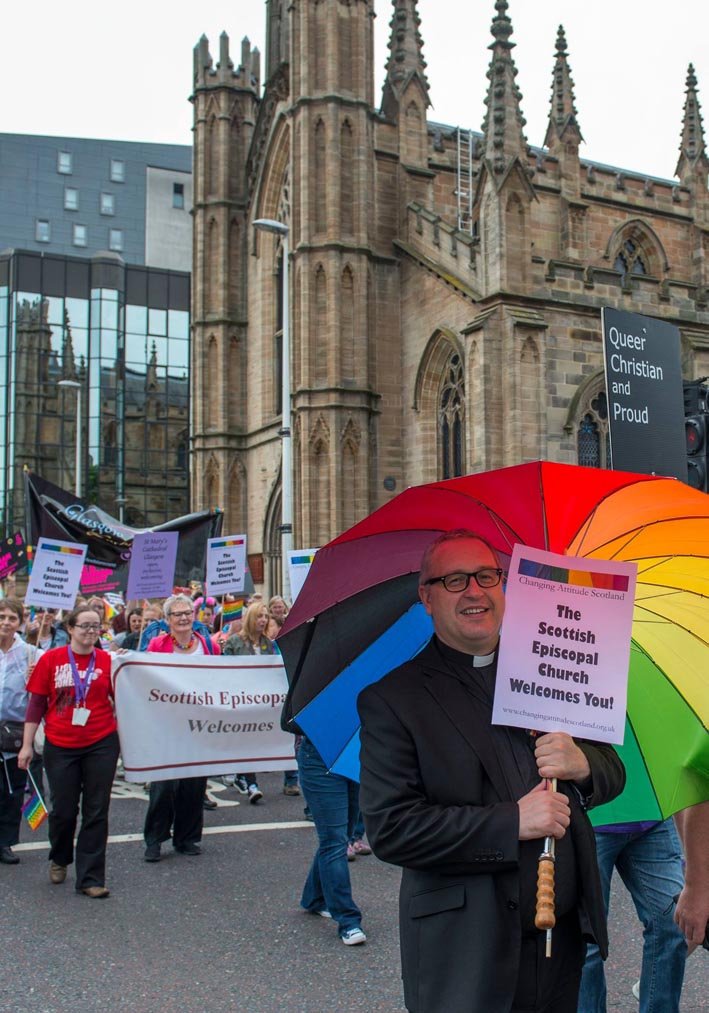 I rejoice in the progress that we’ve made. But I’m impatient for more. I’ll carry my placard on Saturday at Pride and put a smile on my face. Blessed Are The Fabulous I’ll proclaim and I’ll mean it. But I’ll still be walking on streets in which it only feels safe for most same-sex couples to walk hand-in-hand for a couple of hours a year during Pride itself.
I’ll also be marching wearing a black suit, clerical shirt and a white clerical collar because of the thousands who will be there for whom that will be an extraordinary thing to witness and something that they can scarcely believe possible.
Yes, my own small corner of the world still has a lot of work to do. In my own diocese, the clergy asked clearly during the last Episcopal vacancy for intentional work to be done on racism, sexism and homophobia, recognising that these were all issues that were real in the diocese and that our attitudes to difference had played an ugly part in our attempts to try to choose a new bishop. A few years later, we are going into another Episcopal vacancy with none of that work done. And yes, what I experience as homophobia is deeply related to what my female colleagues experience and it is made out of the same basic material as the racist presumptions that black colleagues know well. And even since that time, anti-trans prejudice has grown and grown like an invasive new plant species. It poisons and diminishes all who taste its fruit.
There’s nothing new about that poison either. Lots of us know it all too well.
The easiest prejudice to counter is that which is most obvious. In-your-face discrimination is easy to point out if you are able to speak from a place of safety. Much harder is the bitter prejudice of the well meaning – that of those who couldn’t possibly be homophobic because they went to such a lovely wedding only last month, who can’t be sexist because isn’t it wonderful that we have lady vicars now and who couldn’t possibly be racist because that would be just unthinkable!
Prejudice is part of the psychological air we breathe. It forms part of who each of us are.
Think you don’t have any yourself?
Think again.
Think I don’t have it?
I wish.
How long will it be before it is unthinkable that women colleagues will ask whether another woman will ever be elected as a bishop due to accusations being made about the alleged behaviour of a bishop who happens to be a woman right now? How long before the qualifications of those who arrive in the church who happen to be black will be treated as being on a par with those who happen not to be? How long before I can simply sit and eat a pie?
For all these reasons and 10000 other micro and macro aggressions, I’ll be marching at Glasgow Pride on Saturday.
Anyone who shares the dream of a world where we are all treated equally and treated well is welcome to join me.
Blessed are the fabulous.
And blessed are the impatient too.
37 responses to “Keeping the faith”
It was an inspiring recitation. Following the English translation in the service sheet provided added insight to the life of Mary. All the more so as the cathedral is dedicated to St Mary. You are reminded of Mary every time you walk into the building with the Gwyneth Leech mural over the High Altar.
Kelvin is quite right. The very self-righteous defenders of the Bible (including the ones who trolled a brave young Muslim woman, for days, with the most vile language, and those who did not reprimand them) totally ignored the Biblical instructions for raising concerns with a brother in faith (Matthew 18:15; 2 Tim 23). Very practical instruction too! As anyone who has ever lived in community can verify. Could all these obsessive men *please* stop trying to divide our communities in Glasgow. We will not be divided. At the first sign of trouble we rush out to embrace one another. These abusers have much to repent of, even if *just* standing by while others throw stones.
I HATE it when the wrong tune is picked for a hymn … it is simply an abomination before God.
However, helping people to think about how we share hospitality, welcome and learn from each other is the WAY of God! Blessings on you Kelvin.
Some reasons why this time was different:
1. The other quaran recitations you mentioned happened at Nine Lessons and Carols, or special ecuminical and interfaith events. While 9L&C was originally a modified Evensong, nowadays it’s usually considered a seasonal community musical recitial with a religious tinge, so having a Muslim from the community recite something from their faith would seem natural enough. Civic and interfaith services will likewise naturally include representatives of every faith in the community. By contrast the Eucharist is the central act of Christian worship and people expect to hear ONLY Christian doctrine proclaimed in the Holy Eucharist. In other words, this was the wrong venue for showing hospitality to Muslim neighbors. You did not intend to practice syncretism, but I think the outcome was syncretic despite your good intentions.
2. Post Brexit (and post Trump) British Muslims are now seen as alien invaders rather than fellow members of the community.
3. Because hostility to Muslims is now fashionable, the Express and rest of the gutter press decided that this was a story worth reporting. Since conservative Americans often read the online editions of the British gutter press, the story then went global.
4. Because you are gay and out, your every action is scrutinized for any possible hint of heresy by GAFCON and Co.
Of all these reasons, only reason #1 is a legitimate criticism, but I hope you do think about criticism #1 as well as defending yourself from other, illegitimate criticisms.
Thank you for your comment Whit J – all the more because it is a thoughtful criticism.
I’ve plenty to reflect on about the how and the when we do things like that and I do hear loudly and clearly that many people think this was an inappropriate context. Though of course, I’d be bound to say that some are saying that the Eucharist is precisely the place indeed there are some saying that is what it is for.
I’m not going to get into a back and forth with all the comments on this post and I’m deliberately not letting through things that have already been said but be assured that I’ve heard the criticism and will reflect on it not simply now but over coming months. (I’ve learned a lot about where God is this week that will take a long time to process). I’m grateful for the way you’ve made your point.
I think there is a good deal in what Whit J says, although I am not sure the effect actually was syncretic. I think one does perhaps have to be a regular worshipper at St Mary’s to understand how totally orthodox the worship there is, and how much Jesus is the focus of worship – how utterly unlikely it is that anyone there would make the mistake of thinking he was not revered by the congregation as a whole as very God from very God. It would be impossible for them not to realise that all the clergy there rejoice in this belief. The congregation saw the words of the Qu’ran in an English translation which portrayed that book’s far-from-easy-to-follow account of Islam’s view of the conception of Jesus, in which there was nothing offensive, and heard a very beautiful voice singing in a strange and glorious language. These were clearly indicated to be the beliefs of another faith. We certainly neither saw or heard or understood any insult to the person of Christ. I am sure none was intended, either. Whereas, and this bears repeating, I am totally sure that many of those commenting (not of course by any means all of them, and nobody whose comments are published here) simply wish harm to relationships between the great faiths in Glasgow.
I have spent my whole adult life in dialogue with people of other religious traditions, it has been deeply rewarding. However I feel that what happened at this service was profoundly wrong. When we are truly ourselves we allow other people to be profoundly themselves. The truth of Christianity is not compatible with any other religion. To avoid that incompatibility is to avoid reality. Worship of Jesus is the fountain of our faith the Qu’ran is opposed to that. I love Jesus and therefore cannot conceive of reading the Qu’ran in an act of worship – no problem doing so in other contexts but not in worship. I am profoundly disturbed that you cannot see this Kelvin.
There are so many things aren’t there, not just around this issue which we hold dear in faith and which we can’t see from another perspective?
I can hear and see that people are upset by this and clearly there are many people not upset by it too. And obviously, at least I hope obviously, I love Jesus too.
The trouble with religious questions and the questions that religious people have I think is that so often that our love for our faith can make it impossible to comprehend others who also claim to love the same faith but who take different views about things. We can hear them claim that love but be intellectually unable to process it because it leads them to different conclusions.
I’ve found the same thing to be true in the sexuality debates very frequently though I perceive that to be changing sometimes now. Similarly with other identity issues and some political issues. Israel/Palestine conversations for example often seem to be conducted (when they are conducted at all) by people who seem to behave like ships passing in the night.
I happen to have views about Church Schools which are pretty intransigent and negative. You are one of the few people, no the only person, who ever made me really think there might be a point of view about them other than mine which might have an integrity I could respect. And I’m very grateful for that.
Kelvin, thank you for your reply. I have enormous respect for you. I have no doubt that church schools can be argued against from perfectly respectable positions. Worship of Jesus is simply a different order, it cannot include a reading from the Qu’ran. Worship is one thing, study, dialogue, relationship something else.
I am really grateful to Richard for the phrase “When we are truly ourselves we allow other people to be profoundly themselves” which reflects my experience of interfacing with sincere people of other faiths. Is a Christian Eucharist a place this should happen? I can understand some Christians feeling it is not, but as long as everything was clearly labelled as what it was and the integrity of the liturgy was intact, I can also understand some feeling it is.
Brother Kelvin,
Although I do not agree with allowing the Koran to be read in our Christian churches, I truly appreciated your firm and resolute stand for the deity of Jesus. He is our great God and Savior and I love Him very much. Blessings from Tennessee.
Just as a perhaps amusing point of reference, the 1982 hymnal of the Episcopal church in the USA has “Brightest and best of the STARS” (caps mine) “of the morning,” apparently so as to avoid offending any daughters who might be present, and the two tunes included are “Morning Star” by James Proctor Harding (1850-1911) and “Star in the East” from The Southern Harmony (1835). The Harding tune was also in the 1940 Hymnal, wherein the word “sons” was still used.
I am not clear as to whether the hospitality at St Mary’s anticipates infinite extension of parallel lines between Islam and the Church in Glasgow. Are you planning some opportunities for Glasgow Muslims to understand the Christian faith and prepare for Baptism and the glorious liberty of regeneration by the Holy Spirit? (In whichever order; no axe about that!) As you move around the Glasgow community and meet more Christians of Islamic background, why not invite such to participate in groups for new Muslim enquirers? The testimony of an ex-Muslim can express vibrantly “How I know He lives” (as your SA brethren would sing). You might find not only new hearts from a divine work of grace among your Muslim neighbours but in other neighbours too. Amen. Inshallah!
There are a small number of people in St Mary’s who are converts from Islam to Christianity just as there are a small number of people in local mosques who are converts from Christianity to Islam.
St Mary’s regularly puts on events and courses for people discovering and exploring Christianity. Most living religions do the same thing.