
The first time that I encountered ChatGPT was three years ago when I was staying in a seminary in the USA. It was a place dedicated to teaching theology and particularly to training Episcopal clergy.
The ChatGPT preview release was let loose on the world on 30 November 2022, so I must have discovered it very early on. AI has moved on significantly since then but at the time one could use it to render a piece of text in the voice of someone well-known. The entertainment at mealtimes was to give it a well-known piece of the Bible such as Psalm 23 and get it to rewrite the text in the voice of a well-known American politician.
The Lord is my shepherd — a truly incredible shepherd, by the way, the best. Nobody shepherds like He does!
I’m not going to want; I’ve got everything I need. Believe me!
This seemed very entertaining to the students though I suspect that the joke may not be quite so entertaining these days.
ChatGPT seemed an incredible plaything. A novelty. A curiosity. A wonderful new internet gewgaw.
Three years on and a lot of development later, AI has changed a lot even if people haven’t yet moved on quite so much and many are still using it primarily as a novelty. You can still ask ChatGPT to translate bits of the Bible into the voice of someone else. It still seems remarkable to many that a machine can write anything at all.
The primary thing that people think of when they think of text-based AI is still the creation of written material in response to some kind of prompt though there are vastly more interesting things that one can do with AI than you could back in the olden days of December 2022.
There have been a number of surveys released this year which focus on the use of AI by preachers and I thought that it might be interesting to mull over a few questions in order to think about the ethics of using AI in sermon generation.
The obvious question is perhaps the least interesting though I’m not 100% sure that it has a clear answer.
Is it ethical to preach a sermon generated by AI rather than something that you’ve thought up yourself?
I think many people might initially answer this question in the negative and be fairly sure that this isn’t OK. However, I find myself remembering being trained by clerics when I was first ordained and clearly remember being told – “If you find you don’t have a sermon of your own, then preach someone else’s”. In the intervening years, the internet has come of age and that has complicated this question. There are sites dedicated to providing sermons for particular Sundays. I sometimes read a few sermons by other people on a particular text before settling myself down to write one of my own. I suspect most people would think that was absolutely fine ethically – indeed it falls well within the learning and study that clerics are all supposed to pursue.
Would I lift an idea from someone else’s sermon?
Yes, absolutely.
You get to know the preachers who inspire you. I would pay particular tribute to the preaching of Fr Grant Gallup who, when he was alive preached audacious sermons. I think it is a positive good to catch hold of things that inspire you and let them inform your own thinking.
But would I lift a paragraph from someone else’s sermon?
No, I don’t think I would, though I have come across people who do. (And I’ve known people do it with things I’ve written).
I remember once assessing someone for a job and looking at some of the sermons that he had been preaching. Something didn’t seem quite right about them. A little clever googling revealed that he was simply lifting sermons wholesale from one particular preacher from the other side of the world and preaching them as though they were his own. “And that reminds me of something that happened to me this week…” falls a little flat when you know that the same thing happened word for word to someone else three years ago in the lectionary cycle.
I never outed him as stealing ideas from someone else. But there was no chance of him getting the job.
I’m not convinced that it is ethical to preach someone else’s words verbatim in a sermon.
AI raises whole new questions beyond that though.
It is more or less ethical to lift a paragraph from a sermon that no human being ever wrote?
I think that’s a complicated question and is made even more complicated for me by my knowing that some AI engines have been trained on my own sermons.
Indeed, one of my tests when looking at a new AI tool is sometimes to ask it to write a sermon in the voice and style of Kelvin Holdsworth on the Bible passages for a particular set of Bible readings. This test, which I have to acknowledge I’m rather pleased with myself for devising certainly sorts out the AI sheep from the AI goats.
I did it recently with one engine and it produced this paragraph:
“It reminds me of the week before my mother-in-law comes to visit. You know the drill. It doesn’t matter if the house is generally tidy; you go into a state of panic. You’re not just cleaning the surfaces; you’re clearing the cupboards and organising the spice rack. Why? Because you’re trying to create a perfect space for a very important guest. You want the place to look like your best self, a version of reality that lasts exactly as long as the visit.”
Now there’s no risk in my stealing anything from this at all. It doesn’t sound like my spoken style and anyone who has ever shared an office with me knows that tidiness isn’t necessarily next to provostness. The really exciting thing, I thought, was the appearance of a mother-in-law. I rather like the idea that in some alternative cyberspace I’m tidy, happily married and have a well-organised spice rack.
Here, in the real world alas, things are different.
However, I asked another AI engine to come up with a sermon in my style and the more I read, the more I realised that it had been trained on my own sermons, most of which have been freely available online for the last 25 years or so. Here’s a fragment that I asked it to generate for a sermon in my voice for Midnight Mass.
“And so we come here at midnight—a time for secrets, hushed voices, and the honest acknowledgement that the world is not always as we wish it to be. Midnight is truthful. It exposes our longings. It meets us without the polite veneer we put on during the day. Midnight Mass is the Church daring to say: God meets us in the dark.”
It isn’t better than me and the middle sentences are a bit vapid. But there’s an idea in there at the end that I could have come up with and could have preached. And maybe, who knows yet, maybe I will.
So it is ethical to preach a sermon that is generated from an AI engine that has been trained on one’s own voice?
That’s a really complicated question and worth a good deal of pondering. And it is a very different question from those facing authors who make a living from their work.
As I try to think about the ethics of where the words come from there will always be people who tell me that nothing ethical comes from AI because of the world’s resources of power and water that are consumed in their production. I get it. But people have frequently taken to social media to make that point to me without acknowledging the irony of doing so. We are living beyond our means environmentally in so many areas of life. Yes, AI contributes negatively to this. But I don’t think that fact is going to put it back in its box.
At the moment I’ve never read a sermon from an AI engine that I think is better than any that I could have written. However, I suspect that in a year’s time I won’t be able to make that claim.
So, is it AI generated sermons from me from now on?
No actually. But primarily because I enjoy the writing. Wrestling with the ideas, thinking about the scripture and pondering where the world is at gives me life and I suspect that ultimately those listening to sermons can tell whether there’s life and spirit in them. And being a preacher who does grapple with the text is part of who I think I am and part of what I think the church has formed me to do.
Are there easy ethical answers to AI related questions for preachers? I don’t think so. And I think that’s what makes those questions so very interesting.
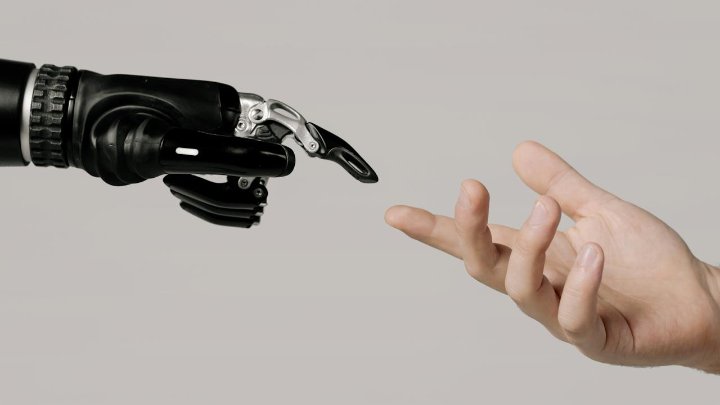
Photo by cottonbro studio: https://www.pexels.com/photo/hand-of-a-person-and-a-bionic-hand-6153343/


Leave a Reply