
• Every Eucharist is a Virtual Eucharist

    Heaven

    Every Eucharist is a virtual Eucharist. Of course it is.

    We know this.

    We experience this.

    We forget this.

    Christianity – at least the bits of Christianity that are worth taking seriously – takes time and space so seriously that it knows that the particular cannot ever express the ultimate. Indeed, time and space are playthings in the hands of the religiously inspired.

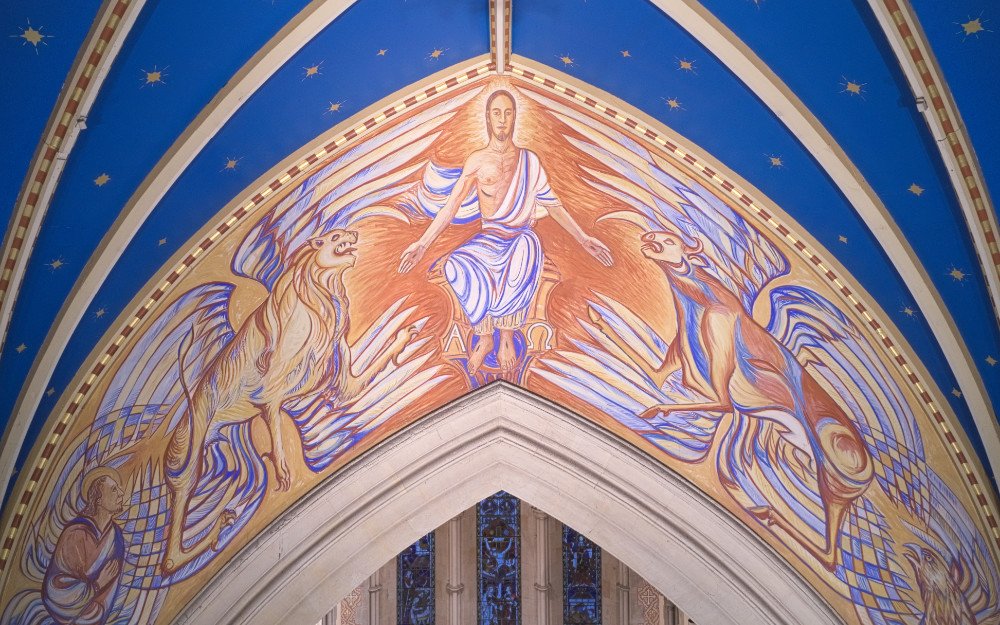
    Over the last few months it hasn’t been possible for my congregation to celebrate the Eucharist together in one space. But when we used to do that, we were never entirely in one space anyway. The very building itself is designed to transport people from the knowledge that they are a few yards from a busy thoroughfare in the Second City of Empire. Taking a few steps inside we find that we are in another place altogether. And in another empire, where the Emperor is servant of all and love is the essense of the law. The conceit that going into church takes you into a divine, heavenly realm is not an idea exclusive to the East. Coming into St Mary’s you are supposed to feel that you are stepping into heaven. It has been built to make you feel that. It has been decorated to make you feel that.  It does make people feel that.

    Whenever I take people into church I almost always hear them express a sense of wonder. We have the wow factor. It has been created by human skill to make you feel that the reality that you experience as you stand in the street is not the only reality that you can experience. It is a space that conveys that love, joy and peace might be possible and it does that without words. It is done with beauty and it takes people a few steps up the stairway to heaven.

    And it is the church playing with reality.

    That experience of going into a holy space and feeling part of something bigger is something common to religions that are divided on all kinds of doctrinal matters. It points to things that are best expressed through virtual reality and religious people are so used to virtual reality that they sometimes forget that it is all around them.

    When people come to the Eucharist in St Mary’s they are at once in Glasgow and simultaneously elsewhere. And elsewhere isn’t even singular either. At the Eucharist in Glasgow we are at one and the same time in an Upper Room in Jerusalem rather a long time ago and at the Wedding Feast of the Lamb at the ultimate consumation of all that is. The Last Supper and the Breakfast at the End of the Universe happen at the same table. At the same time.

    And as we gather at our table, we gather at every table and eat in communion with those who share in the same meal. Our fellowship with them isn’t prevented by circumstance. Our Eucharistic fellowship has never been prevented by circumstance or lack of physical proximity.

    We couldn’t keep the Triduum in Holy Week without virtual reality.

    Without virtual reality it would just be a way of making feet smell less.

    Without virtual reality it would just be a bonfire that would die.

    Christ is the celebrant at every Eucharist no matter which particular celebrant is standing there. Virtual reality becomes interwoven with the reality of the lives that we bring to the table and we are formed and changed and made new. It is how God’s love is expressed.

    This is virtual reality. Every Eucharist is a Virtual Eucharist. Cyberspace is one of the most powerful metaphors for prayer that human beings may ever develop.

    Our bodies are bound by physics.

    God’s love in this world isn’t.

    This is why religious buildings are important. It is also why they are not important.

    Every Eucharist is a Virtual Eucharist.

    Every Eucharist always was a Virtual Eucharist.

    Of course it was.

3 responses to “Brexit – Five First Quick Thoughts”

  1. Rosemary Hannah Avatar
    Rosemary Hannah

    Almost everybody I meet on a regular basis, except my family and one educated friend, were voting out. and that in Scotland. I am shattered but unsurprised. My partner reports that, in her office, those with a degree and under 35 all intended to vote remain, and those without and over 35 to leave.

  2. Ruth Gillett Avatar
    Ruth Gillett

    Some people I know didn’t vote at all because they were annoyed that their ‘first ever in their fairly long lives’ voting experience (Independence) didn’t go the correct way. Strangely two friends who spend half the year living in Europe (and benefit from the reciprocal healthcare arrangements) voted leave and I’m bewildered by a dear friend of 60 years who unexpectedly climbed angrily aboard the anti immigration juggernaut. I’d dared to hope (and ignore the signs online) because everyone else I knew seemed to be voting remain…

  3. Guy Whitehouse Avatar
    Guy Whitehouse

    I fear ultimately that Brexit won in part because the EU became a rather soulless bureaucracy to which people could not emotionally attach. Financial benefit does not always secure attachment on a large-scale and if enough people start to perceive themselves to suffer and not participate in those benefits then the inevitable happens.

    I fear the UK is going the same way but for different reasons. Since the 80s there has been a tendency amongst those seeking power to focus on groups and not the country as a whole; remember election night and the swingometer and the presenter saying things like “such and such an area has gone red but in order to win the Conservatives just need to win over Essex man and Worcester woman….”? Of course Labour did something similar in 1997 and in later elections.

    So any uniting sentiments have been undermined which means that the problem is no longer just with politicians but with the electorates also.

    I liked what Kelvin said in his referendum sermon, and more than ever the churches need to discover their ministry of reconciliation and think about what it means to try to offer everyone a spiritual home. It would be ironic if the church became the main place that differences could be dropped. but I have to confess I’m rather gloomy about even that looking at the way other controversial issues within the church have been dealt with.

Leave a Reply

Your email address will not be published. Required fields are marked *

Previous Posts

  • Generous Episcopacy: The Rt Rev Michael Hare Duke RIP

    I gather from a twitter correspondent that the Rt Rev Michael Hare Duke has died. Bishop Michael was the bishop with whom I first tested my vocation. Having been a bishop since 1969, he saw and influenced the entire modern story of the Scottish Episcopal Church. Where to begin with memories? The time I sat…

  • The Peace and Unity and Order of the Church

    One of the things that I’ve occasionally raised in blog posts is the question of whose responsibility it is to promote the unity of the church. I think this was focused for me particularly at the consecration of the Bishop of St Andrews, Dunkeld and Dunblane just over 9 years ago when the preacher preached…

  • New Statement from College of Bishops

    There’s a new statement from the College of Bishops today about same-sex marriage. It can, and should, be read in full – see here: College of Bishops Guidance re Marriage 2014 I’m appalled by its contents and in particular appalled at the way the Bishops of the Scottish Episcopal Church are treating gay clergy and…