
• Every Eucharist is a Virtual Eucharist

    Heaven

    Every Eucharist is a virtual Eucharist. Of course it is.

    We know this.

    We experience this.

    We forget this.

    Christianity – at least the bits of Christianity that are worth taking seriously – takes time and space so seriously that it knows that the particular cannot ever express the ultimate. Indeed, time and space are playthings in the hands of the religiously inspired.

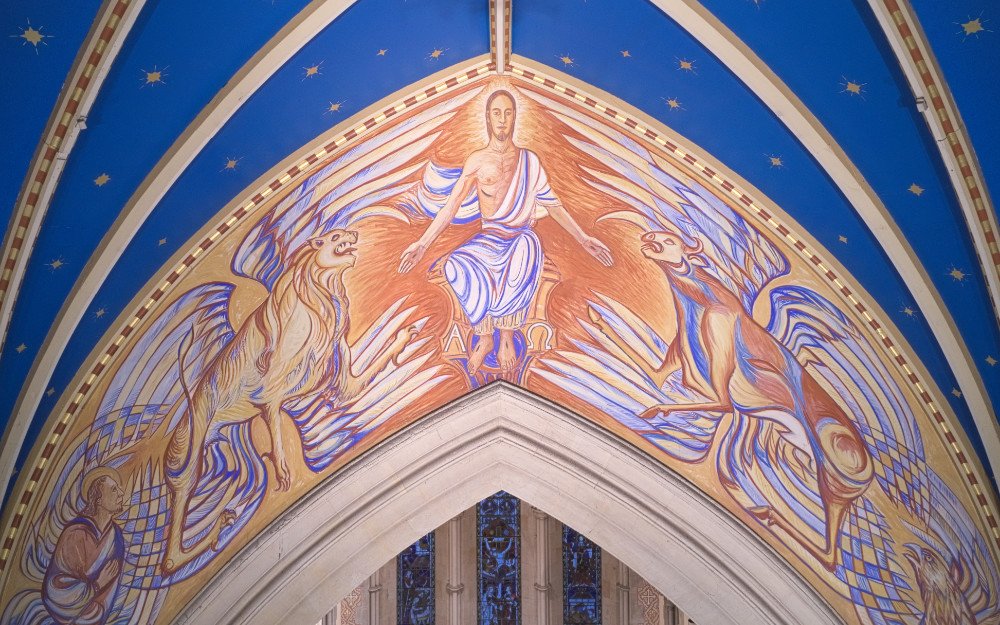
    Over the last few months it hasn’t been possible for my congregation to celebrate the Eucharist together in one space. But when we used to do that, we were never entirely in one space anyway. The very building itself is designed to transport people from the knowledge that they are a few yards from a busy thoroughfare in the Second City of Empire. Taking a few steps inside we find that we are in another place altogether. And in another empire, where the Emperor is servant of all and love is the essense of the law. The conceit that going into church takes you into a divine, heavenly realm is not an idea exclusive to the East. Coming into St Mary’s you are supposed to feel that you are stepping into heaven. It has been built to make you feel that. It has been decorated to make you feel that.  It does make people feel that.

    Whenever I take people into church I almost always hear them express a sense of wonder. We have the wow factor. It has been created by human skill to make you feel that the reality that you experience as you stand in the street is not the only reality that you can experience. It is a space that conveys that love, joy and peace might be possible and it does that without words. It is done with beauty and it takes people a few steps up the stairway to heaven.

    And it is the church playing with reality.

    That experience of going into a holy space and feeling part of something bigger is something common to religions that are divided on all kinds of doctrinal matters. It points to things that are best expressed through virtual reality and religious people are so used to virtual reality that they sometimes forget that it is all around them.

    When people come to the Eucharist in St Mary’s they are at once in Glasgow and simultaneously elsewhere. And elsewhere isn’t even singular either. At the Eucharist in Glasgow we are at one and the same time in an Upper Room in Jerusalem rather a long time ago and at the Wedding Feast of the Lamb at the ultimate consumation of all that is. The Last Supper and the Breakfast at the End of the Universe happen at the same table. At the same time.

    And as we gather at our table, we gather at every table and eat in communion with those who share in the same meal. Our fellowship with them isn’t prevented by circumstance. Our Eucharistic fellowship has never been prevented by circumstance or lack of physical proximity.

    We couldn’t keep the Triduum in Holy Week without virtual reality.

    Without virtual reality it would just be a way of making feet smell less.

    Without virtual reality it would just be a bonfire that would die.

    Christ is the celebrant at every Eucharist no matter which particular celebrant is standing there. Virtual reality becomes interwoven with the reality of the lives that we bring to the table and we are formed and changed and made new. It is how God’s love is expressed.

    This is virtual reality. Every Eucharist is a Virtual Eucharist. Cyberspace is one of the most powerful metaphors for prayer that human beings may ever develop.

    Our bodies are bound by physics.

    God’s love in this world isn’t.

    This is why religious buildings are important. It is also why they are not important.

    Every Eucharist is a Virtual Eucharist.

    Every Eucharist always was a Virtual Eucharist.

    Of course it was.

6 responses to “Back from Sweden”

  1. chris Avatar

    I don’t think so. I’m not a Nat, and I didn’t vote for them – but I’m pretty appalled at the Lib Dem stance on this. If there was a re-run, I’d be tempted to vote SNP just to prove a point. You *can’t* expect the majority party to go back on a manifesto promise – and I don’t think it’s morally on.
    If the Lib Dems had won under the same circs, would you still say this?

  2. Stewart Avatar

    The difficulty I have with the whole situation is that there was multiple adverts, leaflets, etc describing the voting methods. The returning officer at my local council distributed a special leaflet – before all the political leaflets deluged me – setting out the way to vote. I also felt the voting papers were clear in their directions. Even the party literature gave directions on how the voting took place and how to vote for a particular candidate/party.

    I do not think were are in a Florida situation were the voting papers could possibly be misunderstood by the way the place for the holes to be punched were interleaved, and the holes where not always completed punched through.

    On the Scottish Parliament Paper it was clear to me that one cross went in one column and one cross in the other column. The second paper for the local councillers was to rank the candidates in order.

  3. vicky Avatar
    vicky

    I agree with Stewart, but I struggle a bit with Chris’s point. I think that politics by referendum is always problematic and we have a representative democracy for historic reasons (to protect from civil war if you care to go back to the 1640-60s and see why the subsequent Restoration Government worried so much about government by petition, which it is hard not to view an independence referendum as.) For my mind there is no concensus about a referendum and the Lib Dems were right not to sign up to a coalition when such a central issue is on the table. Perhaps a minority government, however, might be a more liberal one any way? (though, it is more likely to descend into a power manipulating fiasco….)

  4. kelvin Avatar
    kelvin

    Chris – I don’t agree. The nature of coalition is trying to make an agreement that you can both agree on. Both Labour and the Lib Dems had to compromise last time and each were unable to implement their manifesto in full. I think that kind of compromise is probably good for Scotland, even though, like anyone involved I would like to be able to implement a manifesto fully that I believe in.

    We are so unused to coalition talks that we don’t know what to do with them. There is no reason why the Nats should not try to govern as a minority government. There would be many measures that the Lib Dems (and even Labour) would support them on. There were times during the last sitting of the parliament when I thought that we would have been better to have a minority Labour government.

    The Lib Dems could no more become a government delivering a referendum when they had said they would not than the Nats could become part of one which didn’t when they said they would. It works both ways. The Nats didn’t have a majority and have no mandate to force through anything. I’m happy with the idea that law is made on the basis of what happens in a parliament rather than what is put in a manifesto.

    Stewart – clearly you understood the process involved. That does not seem to me to cancel out the spoiled ballot papers. We don’t know yet why so many went uncounted, but we do know that it was far, far more than ever before and that they could have affected the result. I’d like to think I would take the same view about the need to rerun the election whatever the result.

    Vicky – I’m also inclined to be suspicious of government by referenda. Big Brother has taughts us, amongst many things, that we could have a vote every evening on any issue of the day. However, governing by plebiscite is governing without either scrutiny or loyal opposition.

  5. David Avatar

    I think that the SNP calling itself Alax Salmond for First Minister party had a lot to blame for the confusion. The voter should have been presented with a column of parties and a column of candidates. What we got were two columns apparently starting with candidates. Think how the brain scans the voting paper – title, first in each column, then the detail.

    It is simply appalling that so many votes were lost. Ideally, we should run the election again, but I really wonder if we collectively can face it. If no FM/PO declared, then we have to do it.

  6. vicky Avatar
    vicky

    As the numbers of spoilt ballot papers rise…I think we have to give in and hold another election….:(

Leave a Reply

Your email address will not be published. Required fields are marked *

Previous Posts

  • Generous Episcopacy: The Rt Rev Michael Hare Duke RIP

    I gather from a twitter correspondent that the Rt Rev Michael Hare Duke has died. Bishop Michael was the bishop with whom I first tested my vocation. Having been a bishop since 1969, he saw and influenced the entire modern story of the Scottish Episcopal Church. Where to begin with memories? The time I sat…

  • The Peace and Unity and Order of the Church

    One of the things that I’ve occasionally raised in blog posts is the question of whose responsibility it is to promote the unity of the church. I think this was focused for me particularly at the consecration of the Bishop of St Andrews, Dunkeld and Dunblane just over 9 years ago when the preacher preached…

  • New Statement from College of Bishops

    There’s a new statement from the College of Bishops today about same-sex marriage. It can, and should, be read in full – see here: College of Bishops Guidance re Marriage 2014 I’m appalled by its contents and in particular appalled at the way the Bishops of the Scottish Episcopal Church are treating gay clergy and…