
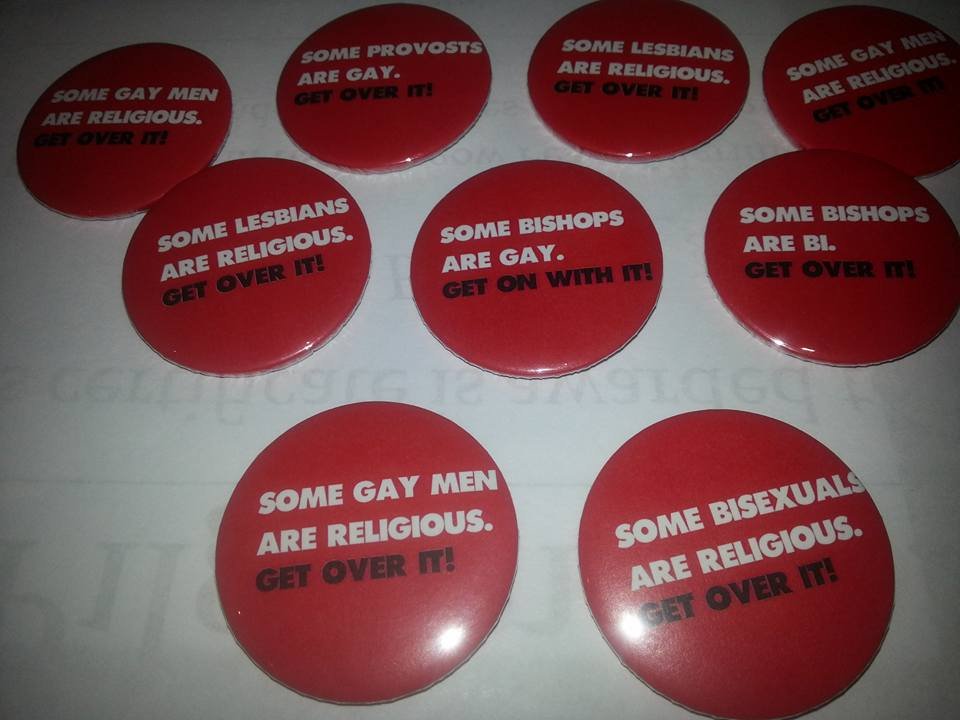
Here’s the talk I recently gave at Greenbelt. In the course of what I was saying, I threw these badges out into the crowd.
The spectre of homophobia stalks the church.
It is, in the language that Jesus would have understood, one of the principalities, one of the very powers of darkness. It is a blight upon the mission of God in the world. It harms God’s children – sometimes harms them to death. It makes getting people to come to church to hear about the joys of heaven even more difficult than it already is. And worse of all, homophobia itself can make church leaders say absurd things in public and make a fool of themselves.
And we all know that church leaders making themselves look foolish in public is the sin against the holy ghost.
Such things should not be.
Dear Straight People – it is only with your help that homophobia can be defeated. Those of us who happen to be gay have been doing our bit to fight it. But the time has come. There is only so far that we can go along the road before we need to turn to those of you who are straight, or who are maybe wondering whether they may in fact be straight. There may be people who are confused about their sexuality and are unable to admit that they are straight.
If that’s the case for you, this is the talk for you.
Dear Straight People. The time has come. How are we going to overcome the powers of homophobic darkness?
Well, we must begin, as all talks that deal with sexuality seem to do with a coming out story.
I’ll tell you my coming out story first, because part of what I want to encourage you to do in time is to come out yourselves.
Not just the gay ones. Everyone.
But here’s where I began on this journey.
It was late spring time in 2003. Seems like a lifetime ago.
There I was on a Saturday night in the rectory. The sermon was done. The cat was biting my feet and all was right with my world.
When suddenly.
Brrring Brrring.
Hello
Hello said a voice at the other end whom I instantly recognised. I knew she was a straight person. (It isn’t that I can tell straight people by the way they talk, it was that I’d married her to her husband just a few weeks before). It wasn’t just that she was straight, she was quite unashamed by it. Public even.
“Kelvin – I’m just ringing to tell you that I’m going to be coming to church tomorrow to read the lessons – I’m on the list. But then at the end of the service, I’m going to say goodbye – I’m not coming any longer.”
“OK”, I said. “Er…What’s up?”
“Well the thing is” she said – “there’s been this story in the news this week about this guy called Jeffrey John. And they’re saying that if he is gay, he can’t be a bishop. And I can’t be part of a church like that. If that’s the way it is, I’m out of here. I like you very much and I like the congregation but I’ve got gay friends and I’ve got to be true to them. I can’t stay in a church that is bad to gay people.”
Ands I said goodnight and put the phone down.
And I sat and thought. I batted the cat away from my ankles and I thought.
And I thought that now was the moment for some truth telling.
The thing is, the congregation (it was my former congregation) didn’t know about a whole part of my life. They didn’t know that I’m a gay man.
I’d kept it fairly quiet until this moment. I was closeted. I was quite solitary. And believe it or not, I was quite shy. I couldn’t really see why that part of me mattered in public.
But there I had an actual straight person on the end of a phone saying that she was leaving the church and that made me think.
I went to bed. I didn’t sleep. I tossed and turned and eventually got up and at 3 am turn the computer back on and wrote the sermon of my life in which I said I didn’t know what it was like to be a woman at a well in the heat of the day (that being the gospel) but I did know about being a gay man in the heat of the disputes of the church.
That was my coming out. It was in the pulpit and it was hugely public.
And my life changed.
Somehow that coming out release a huge burst of energy in me.
Somehow I realised that once and for all, I had to tell the truth.
And it did me good.
I became more creative, more evangelistic and more me.
Something (or maybe more truthfully someone) breathed new life into me that day.
And it was all because of a real live straight person.
And now I want to persuade those of you who think that you might be straight, like her that there’s a lot that you can do in order to bring about the kingdom of justice and joy which I believe to be completely and utterly devoid of homophobia.
Together we can do it.
The things I want to say are that things are changing.
We are nearly at the point that the churches are going to change.
And that everyone has their part to play in bringing it about.
By the way, I’m not here to debate whether or not being gay (or being straight) is OK. My starting point and ending point is that everyone is made in the image and likeness of God.
BADGE – SOME CHRISTIANS ARE GAY GET OVER IT
If you want to debate that, please go to a different tent or a different decade.
You see, things have been changing and they’ve been changing fast.
Social attitudes have changed. I’m meeting someone here whom I last met when I was 21. When I was 21, 74 % of British people believed gay relationships to be mostly or always wrong. 13 % believed them to be rarely or not at all wrong.
Latest figures I’ve seen 2012 show 57% for rarely or always and 28 % for not wrong at all.
The crossover around 2002 – from then on most people were supportive. And that’s just before I got that phone call from my straight antagonist.
And yet. Still not all is well.
Homophobia is one of the principalities and powers of darkness remember. It doesn’t just go away.
Young people still sometimes face homophobic bullying. Sure, Stonewall report that reports of it have fallen 10% in 4 years but still the number of schools saying that homophobic bullying is wrong has risen to only 50%.
In 2014 there was a major survey of 7000 gay people which reported that 44% of LGBT people had considered suicide – the comparison figure for straight people is 21%.
That’s just last year.
And remember, some LGBT people are not around to be asked what they think in surveys because they’ve succeeded in ending their lives.
Dear straight people – this is one of the powers of darkness. Don’t forget that.
I know you didn’t come to Greenbelt expecting to be talked to about the powers of darkness or about spiritual warfare. Well, tough – the gospel is full of surprises.
What are the big defining moments of homophobia in my lifetime apart from the way Jeffrey John was treated? Well, probably Clause 28 (2A in Scotland) of the Local Government Act in 1988 and also the Higton motion of 1987
The General Synod Motion:
‘That this Synod affirms that the biblical and traditional teaching on chastity and fidelity in personal relationships in a response to, and expression of, God’s love for each one of us, and in particular affirms:
1. that sexual intercourse is an act of total commitment which belongs properly within a permanent married relationship;
2. that fornication and adultery are sins against this ideal, and are to be met by a call to repentance and the exercise of compassion;
3. that homosexual genital acts also fall short of this ideal, and are likewise to be met by a call to repentance and the exercise of compassion;
4. that all Christians are called to be exemplary in all spheres of morality, including sexual morality; and that holiness of life is particularly required of Christian leaders.’
This formed the Church of England policy troubles that still persist to this day.
Clause 28, for those who are fortunately too young to remember it was conservative legislation which made illegal for teachers (and others paid by local government) to promote the teaching in any maintained school of the acceptability of homosexuality as a pretended family relationship.
Thank God, it was repealed in 2000 in Scotland and in November 2003 in the rest of the UK – yes, when I had my phonecall it was still in force here.
The history matters – I’m going to get to the future in a bit and also leave time for Q & A.
But first I’m going to talk about the tribes of the church, and, oh yes, the bible and then what we can do to finally bring homophobia in the church to its knees.
But – some badges.
SOME LESBIANS ARE CHRISTIAN
SOME GAY MEN ARE CHRISTIAN
The surprising thing is that despite all that bad recent history, some gay people keep on coming to church. Keep on being called by God. Keep on loving God and showing forth the fruit of the Spirit.
And they continue to do so despite the church having these endless squabbles about their existence or their legitimacy.
God keeps on calling gay people and God keeps on giving straight bishops gay sons and daughters in a way that is almost enough to make me believe in an interventionist God after all.
Lots of people believe God to have a sense of humour. It sometimes seems rather twisted to me.
But where are we?
Lots of people would divide the church into Liberal and Evangelical on these issues.
However, in my experience, this won’t do any more.
The presumption that liberals are supportive of gay people whilst evangelicals are not supportive just doesn’t hold water any more.
To start with, evangelicals seem to me to be entering into a period whereby you just can’t assume that. The non-evangelical parts of the church have become used to there not being a common mind on issues to do with human sexuality. That reality is dawning on a lot of Evangelicals now.
I’m thinking here of a couple of big confident city centre Anglican churches where once upon a time I would have known that they were against me.
I knew for many years that there were two things on a church noticeboard which meant that as a gay man I wasn’t going be welcome. One was the word “family service” and the other was mention of the alpha course.
Now, although neither family services nor alpha are my particular cup of tea, I’ve had to come to terms with the fact that these churches are not united around the question of sexuality any more.
And that shouldn’t surprise me. Why not?
Well, I was an evangelical. I grew up as it happens in the Salvation Army and was baptised by full immersion in an FIEC church and was hugely into the Christian Union whilst I was at college.
God made me gay and made me see that the things I’d heard in some of those places about being gay were not true.
When I say that God’s sense of humour has a bit of an edge to it, I speak with some experience.
I used to think that liberals were supportive and evangelicals were against me.
What I’ve learned in recent years is that whilst many of my opponents are indeed evangelicals, all my enemies in this struggle to kill of homophobia in the church are actually liberals.
Evangelicals who honestly disagree with me are often personable, kind and genuinely interested in me thriving. They are puzzled by what I say but when I say I want to read the bible with them they are often up for it.
My opponents are those who say that they are against me.
All my enemies tell me that they agree with me.
They tell me that they agree with me but that what I want can’t come about yet.
They tell me “maybe after next year’s synod”. Or after the next five years of synods.
They tell me that they wish it could be different but they’ve got their elderly people to think about.
They tell me that they are as opposed to homophobia as I am and good luck to me but I am a dreamer.
And they sometimes tell me, as one bishop did not so long ago as he left a meeting at which he had voted against gay equality that he was on my side really.
My reply that there was no real way of telling that he was on my side, clearly flummoxed him.
But it is true.
My opponents are often evangelicals. My enemies are all liberals.
All people who say – not yet, not yet. Soon Kelvin, soon.
I am impatient for justice. I am impatient for change.
I am impatient for the haughty to be brought down and the meek of the earth to be raised up.
And are we not supposed to be impatient for those things?
God didn’t send us into the world to develop mission action plans. God sent us into the world to bring it good news of love and justice and peace and joy.
And yes, some of the good news I’ve been hearing more and more is that there are evangelicals who are supportive anyway.
Some of those large city based evangelical outfits now seem to be about a third supportive, about a third against and about a third unable to say anything. And that holds true, even if the leadership is loudly against.
It is my belief that the Holy Spirit is at work in those churches and is bringing change.
And if the Holy Spirit can change the church, then we can change the world.
BADGE – SOME EVANGELICALS ARE GAY FRIENDLY
But liberals. Dear liberals. What about them.
The truth is, liberals are good at running churches. Good at holding onto power in churches. And so often they do so by compromising everything that they hold dear. Or at least, everything that I hold dear.
They run homophobic selection and training systems without so much as a blink.
They run homophobic seminaries and training systems without any public objection at all.
They run homophobic disciplinary systems and yes, they try to sort things out behind closed doors but no, they don’t fling wide the gates and speak about what damage homophobic structures in the church cause to a world waiting for good news.
My beef very often is not with people who disagree with me and certainly isn’t with Evangelicals. (Or at least not for those reasons – I may have things to say about evangelicalism at another talk one day that might not be so comfortable).
I guess, evangelicals are those who are most likely to be changing their minds at the moment.
God bless them as that happens.
You know, by the way who it is who claims to be against those of us who are gay having legal recognition. Well, you are more likely to be against if you are older, you are more likely to be against if you don’t know someone who is gay and you are more likely to be against if you go to church. And you are more likely to be against gay relationships the more often you go to church. Our problem is not with Christians – our problem is with the devout.
Here’s a wee aside – three cheers for Roman Catholics. Notwithstanding what the hierarchy says, more Roman Catholics in the pews are supportive of gay marriage than any other large religious group in the UK.
BADGE: MOST CATHOLICS ARE GAY FRIENDLY
Now, the bible.
We have to talk about the bible.
Dear Straight People.
I need to ask you today whether anyone has every talked to you about what the bible says to straight people.
You see, the rules you have to follow are tricky.
All most people have heard about relationships and the bible are either the purity laws of the Hebrew Scriptures or the neopuritanism of the anti-gay voices who scream on and on about the bible talking about sex only being between one man and one woman in a life long marriage.
Here’s my challenge.
Can you give me some examples of positive role models for marriage for straight people from the bible who fit into the One Man and One Woman only having sex inside lifelong marriage.
Well, you can think about this whilst I’m burbling on and then offer me some suggestions when we have some discussion at the end.
We’ve got the Patriarchs with more than one wife and loads of concubines.
We’ve got the Song of Songs celebrating erotic love with no sign of Here Comes the Bride at all.
We’ve got Peter leaving his wife at home and wandering off after Jesus without a by your leave.
We’ve got Paul saying it is only better to marry than to burn.
Dear Straight People. I’m not always sure that the bible is a good book for you to read.
There’s not much that’s negative in the bible about gay people. (And you can find all that there is being discussed at that some other seminar in some other decade that I talked about earlier).
There’s lots in the bible about people who don’t fall into the one man and one woman for life boundary that is so often talked about.
Read the bible and ask questions about what it means for gay people if you must. But don’t come my way with those questions until you have come to an honest realisation that the bible is not a book of relationship counselling for straight people either. The bible is about the way people – diverse people have loved God and been loved by God. It isn’t a morality text book that we can pick up looking for how to behave. It is more interesting, much more interesting than that.
But now, lets talk about what we can do about some of the things I’ve been talking about today.
Homophobia still stalks the church.
Dear Straight people. There are things you can do.
Start by being honest about the bible. It won’t, it honestly won’t give you a blueprint for living any more than it will tell a gay person how to relate to another gay person. The bible is God’s precious gift to inspire us and renew us, to refresh us and delight us. It isn’t there to break us. Not there to break gay people. Not there to break straight people. Not there to break the church.
God sets people free to delight in divine love. The bible has plenty about how that happens.
Dear Straight People – it is time to read the bible anew and afresh.
These are the things that I’ve found that help.
Role models clearly help and we need good straight role models able to be articulate about this as much as we need good gay role models.
And we need to Change actual policies
Ask whether there’s an anti discrimination policies for congregation.
(Dear straight people you can bring that up at your next PCC – ask for it to be put on the agenda)
Ask for Diversity Training
Recognise that Diversity is more than just LGBT people.
People bring young kids to my church because it is LGBT affirming because they want them to grow up in a church worth growing up in.
I’ve been surprised and delighted that we’ve grown ethnically more diverse in my congregation the more we go on about inclusion. (And I’m puzzled by the apparently lack of ethnic diversity here at Greenbelt).
BUT – remember inclusion isn’t inclusion if you presume that because you say you’re inclusive that you’ve achieved it.
When Pride comes around each year and members of my congregation get dressed up in rainbows and go marching in the light of God, people still ask whether we are going to protest against pride. We still have to spell out that we are going there to have a good time.
Oh, and dear straight people, there’s no one place I find the church more welcome than at PRIDE.
But, dear straight people, there’s one thing I need to say to you more than anything else.
If we are going to change the world by changing the church by getting rid of homophobia, you are going to have to come out.
You are going to have to realise that you are not normal, you are straight.
You need to be proud of that, but not so proud of the privileges you have by being straight. Once you realise you are not normal but merely straight, you are free to work for the dignity of all.
Come out. Come out. Come out and be supportive. Whoever you are. Whatever your sexuality. Come out. Support the work of God in ridding this world of prejudice.
Consider this your phonecall.
Thank you.

Leave a Reply