
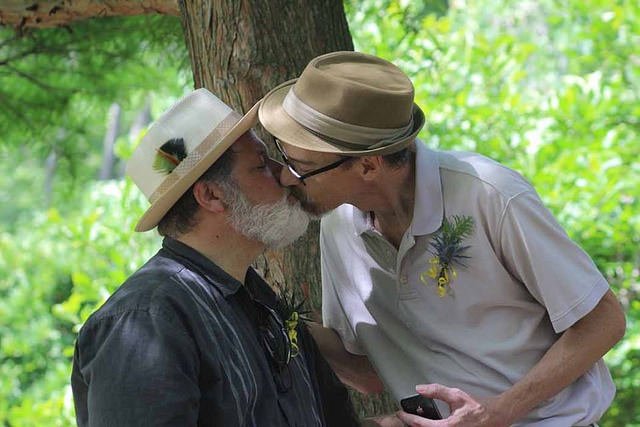
• A kiss is just a kiss

    14574900326_a18671621b_z

    Can it really be that many are happier to see a gay couple marry than give one another a kiss?

    Someone asked me recently whether the time had come to stop campaigning on LGBT issues. After all, he said, the gays have got everything they want now. They can get married and everything.

    Well, leaving aside that the fact that “the gays” can’t get married in Scotland for another month or so and that when they can do so they will not be able to be married according to the same protocols as “the straights”, marriage in church not being an option for most same-sex couples initially, the truth is, the marriage debate is not the end of gay rights but the start of them moving into the mainstream.

    The incredible thing about the campaign to open marriage to same-sex couples is that it wasn’t just same-sex couples who pressed for it to happen. It was a grand coalition of diverse folk – interested people like parents who have gay children, brothers and sisters, workmates and friends as well as gay folk, including gay folk who have no personal interest in marriage for themselves. But it was more than this too – it was a coalition of people who didn’t need to claim a direct interest in the debate. It was a coalition of those who thought that in a modern society the gender of the two people involved is of secondary significance to their love, their hopes for permanence, their promises of fidelity and so on.

    In short, it was a coalition of the decent.

    Now, that kind of statement gets me into trouble. “How can you say that those who were opposed to this are not decent people? Are they not good people, upright people, moral people too? They just didn’t think this was right – how dare you say they are not decent people?”

    Well, the thing is, it isn’t me who is saying that – it represents the huge shift in public opinion that has happened. I’ve helped to shape those changes and am happy to continue to try to do so. Seeing the opinion polls shift so dramatically over the last 10 years is one of the most satisfying things that I’ve ever been involved in.

    What happened is that we changed common perceptions about the kind of values that decent people could be expected to hold.

    That’s why this is so hard for those who have not shifted much themselves. It must feel to them as thought they are on shifting sand. Moral judgements which once were those which good people could be expected to hold, became those which decent people were not expected to hold.

    For some this has been a wonderful seemless recognition that the rights and responsibilities of being human apply to gay and lesbian people just as much as to anyone else. For those outside the big tent it must feel as though something dear has been shattered and broken. I don’t underestimate that, but it isn’t going to get any easier because we’re not done yet.

    I was very struck this week in reading an opinion poll in the USA which indicated that there was strong support for changing the law to allow same-sex couples to get married. However, when the same people were asked what they thought of a gay couple kissing or holding hands in public the support somehow seemed to melt away. And there were different perceptions relating to gender too. It wasn’t so bad seeing women holding hands but gay men kissing in public was something that the decent still were not ready to see.

    Can it really be that it is OK for a couple to get married, with all the support of the expectations of the institution of marriage, but that those who support them still feel squeamish about seeing such a couple display their affection.

    I’ve a feeling this is an issue here.

    When I’m conducting the nuptials of couples here in St Mary’s, I always have a rehearsal and quite often we address the question of whether the couple is going to kiss during the ceremony and at what point. (I think they should do what they feel comfortable with).

    I’m aware that when I ask straight couples that question they can usually answer it easily. When I ask same-sex couples that question there is a big intake of breath as they think about giving their beloved a kiss in public.

    I very occasionally see a same-sex couple coming to church on a Sunday hand in hand. (I see opposite sex couples doing so often enough not to notice). It is worth remembering that there are perhaps only a few hundred yards of the streets of Scotland where they would consider themselves safe to do so and only at particular times. And that’s just holding hands, never mind a wee gay kiss.

    It would appear that we’ve a way to go yet before we get to the point where same-sex couples and opposite sex-couples are treated alike and can expect their affections to be regarded in the same way.

    The campaigning will change in months to come but it is far from over yet.

    I want a world where a kiss is just a kiss. And so much more too.

    [Picture Credit – Ron Frazier Creative Commons attribution license]

5 responses to ““Issues” is no more”

  1. Cedric Avatar
    Cedric

    Oh I well remember the day ‘Issues’ landed with a loud thud through the letter box. I had been ordained for over 10 years by then. And I reeled in reading it.
    Before then the general culture of conversation about sexuality in the Church was ‘don’t ask, don’t tell’. And most bishops acknowledged that among their most able and effective clergy many were gay men, some in relationships, and often deployable in parishes where others would not contemplate living and working.
    But remember the context. This was also a period when AIDS was an international emergency and in Britain the Thatcher government sought to outlaw the ‘promotion’ of homosexuality through section 28 of the Local Government Act. And for sure, ‘Issues’ was a direct consequence of the passing of the amended Tony Higton General Synod private members’ motion declaring all ‘homosexual acts’ as sinful. The consequent noise of the shutting of closet doors was deafening.
    In my diocese the bishop asked one of the archdeacons to convene regular confidential meetings with a few gay clergy to offer them an opportunity to talk about the effects of all this on their lives and ministry. Some would not trust the Church to participate in such enterprises. Understandably. And huge numbers of vocations were thwarted and lost. And are to this day, as the toxic debates continue in the C of E in a social context which has changed beyond imagining.
    So thank you Kelvin, as ever, for your insightful questions.

    1. Beth Avatar
      Beth

      Cedric, I recall you speaking to the LGBT Network at the Cathedral about Issues and that it was reaffirmed by the C of E around about that time too. I wasn’t so aware of it when it was published (being about eight years old at the time and also a Roman Catholic), but I remember so clearly from what you said how devastating it had obviously been and still was. I remember thinking at the time of that reaffirmation, “oh, I can never go home”. It became so clear to me that the Church of England wasn’t somewhere I could feel welcome as long as it was allowed to stand.

  2. Ian Paul Avatar

    Kelvin, I can understand why you are glad that the offensive language of Issues has gone. Ironically, it was actually a statement written by liberals of the day; the main author was Richard Harries.

    And conforming to Issues was never the real question. The real question is conforming to Canons B30 and C26, so that the pattern of life of clergy should reflect the doctrine of the Church ‘according to the teaching of Jesus’. All Issues did was make that clear and unambiguous (though in an unhelpful and obsessive way) with regard to sexual intimacy. Ironically, it was the liberal ‘don’t ask, don’t tell’ policy which cemented Issues in place as a response.

    And of course, with Issues gone, the Canons remain in place, and the demand is the same. The good thing about GPCC is that it sets this one issue in the context of many others, which is much healthier.

    But on the question in hand—nothing has changed. You seem to have missed that.

    1. Kelvin Avatar

      No Ian. It isn’t that I’ve missed that. It is that I don’t believe that.

      Issues was a massively offensive document that coloured absolutely everything the Church of England had to say about sexuality. Changes to Canons will look significantly different in the light of its removal.

      A great deal is changed by its removal.

  3. Mike Burnett Avatar
    Mike Burnett

    Jesus preached love, but he also forgave sins with the instruction ‘to sin no more’.
    Deciding not to sin when the sin in question is something that we enjoy so much that life may feel miserable without it, is a real sacrifice. It really is ‘bearing your cross’ to follow him. But that is what Christians are called to do.
    We may wish to question our translation of the Bible, or quibble over the exact meaning of a phrase we find challenging, but Christianity is not a ‘pick and mix’ faith where we just have to accept the bits we like and can ignore, or condemn, the bits we don’t like. We do not get to negotiate – we must take it or leave it.

Leave a Reply

Your email address will not be published. Required fields are marked *

Previous Posts

  • Winning the War

    Seems like we’ve just lost a battle, but we’re winning the war. So sad to see the Archbishop of York standing up in the House of Lords to fight for the church’s right to discriminate against those who work for it. Extraordinary to see the Bishop of Winchester say that he “should be very surprised…

  • Feast of Change

    Today is the Feast of the Conversion of St Paul. The old joke is of course that its something worth praying for. However, I like to keep it. It reminds me that the most murderous and violent opponent of the early Jesus movement did do a complete turn around on the road to Damascus. Still…

  • Traffic Lights out

    Anyone coming to St Mary’s tomorrow might note that there are temporary traffic lights at the junction of Great Western Road and Napiershall Street. This has been causing some congestion today. Presumably it will not be as bad tomorrow, but forewarned is forearmed, or whatever the expression is.