
• Can you backdate a marriage?

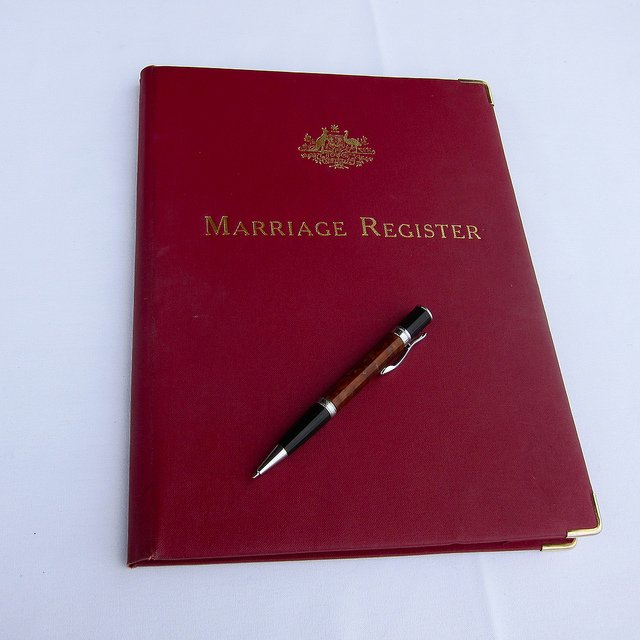
    Marriage Register

    How interesting to learn about the new rules that will govern couples in England and Wales who have been in a Civil Partnership who wish to change (upgrade?) their relationship status to a marriage.

    It seems that they are going to be able to do so easily and will receive a “backdated” marriage certificate which will state that their marriage began when they entered into their Civil Partnership.

    I’ve some reservations about this but I know it will be warmly welcomed by many and it would be churlish to oppose it.

    It is interesting though and there will be pressure now in Scotland for the Scottish Government to do the same.

    Here are some obvious issues.

    • It is quite odd to think that some might find themselves to have been married without their, at the time they entered into their marriage, believing that they wanted to be married.
    • People who have been blessing Civil Partnerships are going to find that they’ve been blessing marriages all along.
    • People will be able, I think, to find themselves married who never went through any ceremony at all – they may simply have signed the papers. (This is a new thing).
    • There’s no doubt going to be some grumpiness from those who trusted the politicians who said that Civil Partnerships were definately not marriages and that it had been invented in order to do something different to marriage.
    • In a sense, it is rewriting history. People are going to have marriage certificates that date from a time when they were not in fact married at all.
    • The Bishops of the Church of England in the House of Lords might feel that the Government has pulled the rug out from under them.
    • I think, that people can end up married whose proposal to marry has never been published either by banns on in a registrar’s office. I’ll be interested to see whether the registrars publish the names of those converting their status. My guess is that they won’t and thus people will end up married in law who have never had their intent to enter marriage advertised to anyone.
    • It is quite odd to think that a status like marriage can be backdated. Is there any comparable status that can be changed like that?

    Personally, I would have preferred the solution to be that people would get new full marriage certificates when they requested to change their relationship status into a marriage. I think this because I think that marriage ought to require a clear statement of consent at the time it is entered into. (Indeed, many of the rules surrounding marriage are about getting unambiguous consent from both parties, freely given).

    Interesting times. Uncomfortable times for the churches, particularly the Church of England.

    Photo Credit – Dale Gillard Copyright: Creative Commons Attribution-NonCommercial-ShareAlike 2.0 Generic (CC BY-NC-SA 2.0)


5 responses to ““Issues” is no more”

  1. Cedric Avatar
    Cedric

    Oh I well remember the day ‘Issues’ landed with a loud thud through the letter box. I had been ordained for over 10 years by then. And I reeled in reading it.
    Before then the general culture of conversation about sexuality in the Church was ‘don’t ask, don’t tell’. And most bishops acknowledged that among their most able and effective clergy many were gay men, some in relationships, and often deployable in parishes where others would not contemplate living and working.
    But remember the context. This was also a period when AIDS was an international emergency and in Britain the Thatcher government sought to outlaw the ‘promotion’ of homosexuality through section 28 of the Local Government Act. And for sure, ‘Issues’ was a direct consequence of the passing of the amended Tony Higton General Synod private members’ motion declaring all ‘homosexual acts’ as sinful. The consequent noise of the shutting of closet doors was deafening.
    In my diocese the bishop asked one of the archdeacons to convene regular confidential meetings with a few gay clergy to offer them an opportunity to talk about the effects of all this on their lives and ministry. Some would not trust the Church to participate in such enterprises. Understandably. And huge numbers of vocations were thwarted and lost. And are to this day, as the toxic debates continue in the C of E in a social context which has changed beyond imagining.
    So thank you Kelvin, as ever, for your insightful questions.

    1. Beth Avatar
      Beth

      Cedric, I recall you speaking to the LGBT Network at the Cathedral about Issues and that it was reaffirmed by the C of E around about that time too. I wasn’t so aware of it when it was published (being about eight years old at the time and also a Roman Catholic), but I remember so clearly from what you said how devastating it had obviously been and still was. I remember thinking at the time of that reaffirmation, “oh, I can never go home”. It became so clear to me that the Church of England wasn’t somewhere I could feel welcome as long as it was allowed to stand.

  2. Ian Paul Avatar

    Kelvin, I can understand why you are glad that the offensive language of Issues has gone. Ironically, it was actually a statement written by liberals of the day; the main author was Richard Harries.

    And conforming to Issues was never the real question. The real question is conforming to Canons B30 and C26, so that the pattern of life of clergy should reflect the doctrine of the Church ‘according to the teaching of Jesus’. All Issues did was make that clear and unambiguous (though in an unhelpful and obsessive way) with regard to sexual intimacy. Ironically, it was the liberal ‘don’t ask, don’t tell’ policy which cemented Issues in place as a response.

    And of course, with Issues gone, the Canons remain in place, and the demand is the same. The good thing about GPCC is that it sets this one issue in the context of many others, which is much healthier.

    But on the question in hand—nothing has changed. You seem to have missed that.

    1. Kelvin Avatar

      No Ian. It isn’t that I’ve missed that. It is that I don’t believe that.

      Issues was a massively offensive document that coloured absolutely everything the Church of England had to say about sexuality. Changes to Canons will look significantly different in the light of its removal.

      A great deal is changed by its removal.

  3. Mike Burnett Avatar
    Mike Burnett

    Jesus preached love, but he also forgave sins with the instruction ‘to sin no more’.
    Deciding not to sin when the sin in question is something that we enjoy so much that life may feel miserable without it, is a real sacrifice. It really is ‘bearing your cross’ to follow him. But that is what Christians are called to do.
    We may wish to question our translation of the Bible, or quibble over the exact meaning of a phrase we find challenging, but Christianity is not a ‘pick and mix’ faith where we just have to accept the bits we like and can ignore, or condemn, the bits we don’t like. We do not get to negotiate – we must take it or leave it.

Leave a Reply

Your email address will not be published. Required fields are marked *

Previous Posts

  • Hey, Bishop Mark is blogging

    I hadn’t noticed until I looked at the new Moray, Ross and Caithness website, that Bishop Mark is blogging. read it all here He hasn’t turned commenting on, so you can’t yet leave him a comment telling him how good it is to see him online.

  • Extra Sunshine

    Unless I take steps to cope with it, I’m someone who is inclined to get the winter blues. I realised a number of years ago after returning to Scotland from London that I was tending to get very run down in the autumn. Couldn’t shake of infections and generally felt a bit limp. At the…

  • Book recommendations

    I received an off blog message from someone asking me to recommend books. This was the question. Can you recommend any books that might help me understand your understanding of our faith – it seems so attractive, so open, compassionate and real. Oddly enough, I find that quite a tricky question. Even though I review…

  • Sermon – 11 October 2009 – Job

    Here is this morning’s sermon. There is a short hiatus near the beginning whilst microphones were sorted out. Fortunately one member of the congregation decided that she did want to hear me preach rather than just see me preach and waved her arms until it was sorted out. Many thanks Peggy. In the name of…