
• A Scottish Kalendar

    Once upon a time, many years ago, by which we mean up until the 1990s, the Scottish Episcopal Church used to publish an annual Kalendar which listed, for every day of the year, a set of bible readings for devotional reading, what saint’s day might happen to fall on that day and the liturgical colour for the day.

    It was immensely useful but was immensely difficult for someone to compile.

    At some point a decision was made to stop publishing it and instead to publish a comprehensive lectionary which listed all the possible combinations of bible readings that you could ever encounter along with a guide to the lectionary that was produced each year. The lectionary and guide are available on the Scottish Episcopal Church webpage here: http://www.scotland.anglican.org/who-we-are/publications/liturgies/calendar-and-lectionary/

    The trouble is, people find the lectionary very difficult to use. You can’t just open it up and see what bible readings you might read on any one day as you need to know which year you are in (1 or 2 for daily readings, A, B or C for the Sunday readings in church). You need to know whether you want readings for Daily Prayer or for a Eucharist. And you need to check in the guide which form of Daily Prayer you should be using that week if you are doing that and you need to check whether it is a feast day which might alter what you are doing and the way in which it might change what you are supposed to be doing.

    In short, checking the readings became something  that you needed to learn how to do rather than something you could just read from the Kalendar for every day of the year. And I think this has had quite an impact. It was much easier to give people copies of the Kalendar by way of supplying daily bible readings than it is to tell people to download the lectionary and guide and teach them how to use it.

    At the time that this change happened, I lamented somewhat.

    However, I also thought about it. For it seemed to me that this was a task that a half-decent computer programmer could get a computer to do.

    Reader, I am that computer programmer, albeit only one who is half-decent.

    Anyway, I started to write some routines to calculate the Kalendar about 19 years ago thinking it wouldn’t take me long to complete.

    Every year before Advent Sunday I’ve tinkered with it and had a go at producing a Kalendar. Each year I’ve failed dismally and got on with my life and muttered into my decaffeinated tea about why this is such a difficult task.

    In the mean time, other offerings have appeared, notably, that outstanding digital calendar that Gareth Saunders produces each year and distributes at no cost on http://www.seccalendar.co.uk/ Gareth’s offering gives you all you might want in a form that can be uploaded into a digital calendar, for example, a google calendar. It thus means that you have the readings at hand wherever you have a digital calendar.

    However, I’ve always hankered after something physical – something that you could leave lying around in the oratory in the cathedral where we gather for daily prayer that would have all the readings in a format that was easy to use. Something that you could leave by the bed or in the holy corner at home which gave you the same readings for use easily and practically when at home.

    I’ve always rather regretted the fact that the church didn’t produce this as it seems to me to be the most obvious way of getting people to read the bible every day. People love lists of daily bible readings. Many people just don’t know where to start with the bible without such suggestions.

    Anyway, this year was no different to any other year in that I had a tinker with the program I started to write 19 years ago. It was not particularly easy as I had chosen to write in an unpleasant computer language called Visual Basic for Applications simply because I had the lectionary tables available in Access. (Everything is a database problem as we know from our Computer Science degrees, right?). The trouble is, I’ve never learned Visual Basic and had to keep looking up the syntax just about every line I wrote.

    I reached the usual muttering into my tea stage early this year, about a week before Advent Sunday. I retired to bed in a very grumpy mood. And I slept. And as I slept, I must have dreamed. For on waking, I immediately went and found a piece of paper and wrote out an algorithm for solving the problem – for putting all the right readings and all the right saints’ days on all the right days of the year.

    And lo – I’ve managed to produce a new Kalendar in a similar format to that which was produced all those years ago.

    Thus, this week looks like this:
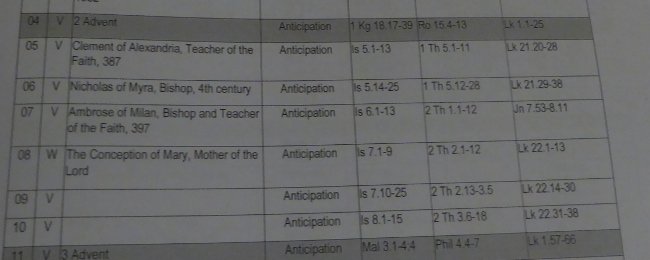
    And there’s even an easy explanation of how it works like this:

    Now, having produced it for myself, as an intellectual exercise if nothing else, it being the first time I’ve really used my programming skills since graduating in 1989, what to do with it?

    It seemed to me that this might be something that people in St Mary’s would like, not least those who have just completed the Vice Provost’s challenge to read the bible in a year.

    I printed some copies off and sold them on the Sunday morning and they went like hotcakes.

    Bishop Gregor has suggested that I should make them more widely available and, having checked with the chair of the Liturgy Committee that I wasn’t stepping on any toes by doing so, am now able to do so.

    Copies are available from me in church for the sum of £3 or are available to purchase on this website here:

    http://thurible.net/product/scottish-kalendar-2017/

    There’s a hefty discount for anyone wanting to buy in bulk for a bible study group maybe or for a church stall.

    For those wondering, the spelling Kalendar is a traditional spelling for a calendar kept by the church.

    This one runs from Advent Sunday 2016 until the end of 2017.

    I’d be happy to answer any other questions about this here. At this stage, I’m not going to be publishing a pdf – this is only available in physical form.

56 responses to “Six things I have learned about anti-semitism and the church”

  1. Jacqui Norman Avatar
    Jacqui Norman

    Dear Kevin,
    I am sure that some Jews would be offended, and this is very sad on every level. Just as it would be sad for Christians to object to non Christians celebrating Christmas or Resurrection Day.
    In your piece you said yourself, that some Jewish people invite Christian people to join them for the meals. This demonstrates that the offence to Gentiles celebrating with their Jewish brothers and sisters is not universal in the faith.
    Blessings.

    1. Kelvin Avatar

      No Jacqui. It is considered a blessing in Judaism to include others in the ritual of passover. This does not justify Christians copying it without Jews being present, appropriating the ceremony to make it something entirely Christian and in doing so causing offence. It is not the same in any way as Christians objecting or not to non-Christians celebrating Christmas.

      If you wish to follow the line of saying that Christian Passovers are not offensive to all Jewish people, then can I ask what proportion of Jewish people you think it is legitimate for Christians to be offensive to? How many is OK?

      1. Jacqui Norman Avatar
        Jacqui Norman

        Of course one would not wish to offend anybody.
        I feel we must graciously agree to disagree, I see no difference to the Christmas/Resurrection Day comparison… We disagree on this one point from your piece.
        God bless you.

        1. Kelvin Avatar

          > We disagree on this one point from your piece.

          So what you’re saying is that anti-semitic things that other people do are wrong but things that you do can’t be anti-semitic because you do them with good intent in your heart?

          Isn’t that what the problem is?

          1. Jacqui Norman Avatar
            Jacqui Norman

            WOW what a leap!
            No, of course it is not what I am saying… It is the opposite!
            Your opinion is that Christians should not engage with the Old Testament. Mine is that it is divisive NOT to. As you said Jesus is Jewish, we are his body …
            I have never had a conversation with a Jew who has expressed your opinion about this matter.
            I asked you politely about this aspect of your opinion, and you have made a personal attack at me(whom you do not know) and called me an anti Semite when nothing could be further from the truth. Now, that kind of thing IS where the problem lies.
            Blessings to you.

          2. Kelvin Avatar

            Don’t be ridiculous, Jacqui. My opinion is not that Christians should not engage with the Old Testament.

            If you can’t post things truthfully then I’ll not allow further comment.

      2. Martin Reynolds Avatar
        Martin Reynolds

        I would ask the opposite question.
        How many need to be offended?
        Just one?

        This argument seems to be in the mode of
        “Christians shouldn’t practice yoga.” school of thought.

        1. Kelvin Avatar

          There’s a difference isn’t there? Most people wanting to stop Christians practicing yoga think that they should take that view because it will harm Christian souls rather because it will harm Hindu feelings.

          1. Martin Reynolds Avatar
            Martin Reynolds

            It depends which Hindu you talk to.

          2. Kelvin Avatar

            Can you point me to an argument coming from someone in the Hindu community who believes that Christians and non-Hindus should refrain from practising yoga? I’m genuinely interested.

        2. Martin Reynolds Avatar
          Martin Reynolds

          I will try and point you in the right direction.

  2. Alexander Hamilton Avatar
    Alexander Hamilton

    Wel now that was a jolly good read. Thank you to all contributers, some thought provoking matters raised, with of course no conclusion, and properly so. So much is a matter of personal belief and practise, no matter how bedecked and caparisoned the chuch one attends. I find myself sayng, ‘What would Jesus say?’ when watching the next best thing to pantomime at some services.

    1. Jacqui Norman Avatar
      Jacqui Norman

      Amen

  3. Jacqui Norman Avatar
    Jacqui Norman

    Ps, In my opinion, the fact that “Passover is not important to most Christians ” is due to a lack of good teaching on the subject. It is not possible to fully appreciate the work of Jesus, (who in you picture, notably does not have the “Jewish nose” – very much enforcing your point that people do not appreciate that Jesus was (is!) a Jew, and with which I wholeheartedly agree with you) without first understanding the Old Testament story in its fullness.

    I would also like to emphasise that this is the only one of your points with which I disagree 🙂

  4. Jacqui Norman Avatar
    Jacqui Norman

    From the homepage:

    Disclaimer
    The views published here are my own and do not necessarily represent the views of St Mary’s Catheral nor the Scottish Episcopal Church.

    Nor do they represent what I’ll think forever.

    I change my mind sometimes – especially when persuaded of something by someone in debate.

    Try me and see.

    Maybe that should read “Try me and get called ridiculous ”

    Very sad.

    1. Kelvin Avatar

      Jacqui – this is my blog space. You don’t get to post untruthful things about me on it.

      Whether you like that or not doesn’t really matter to me it is the way it is.

      No further comments from you.

  5. Dion Smythe Avatar
    Dion Smythe

    Christian “seders” are comparable to Jewish [re]appropriation of the Eurcharistic texts and reciting them [with some notable omissions] at Kiddush after the Sabbath morning service….

    1. Meg Rosenfeld Avatar
      Meg Rosenfeld

      As a Christian who once visited a conservative synagogue where they did this, I was surprised and pleased to find this activity that was so much like ours, taking place. It seemed home-like. My daughter, then a teen-ager, had the same reaction. We were both thinking “Now I see where this part of our ritual comes from.” After all, Jesus (a Jew) was probably following very familiar tradition when he, as we say, instituted the Eucharist; he just said some new and startling things.

      1. Dion Smythe Avatar
        Dion Smythe

        Meg, I think you’ll find that what you witnesses at a conservative Jewish synagogue was the standard Kiddush after the Sabbath morning service — blessings over wine and bread and then the sharing of the same. What I was suggesting was that these Christian “Seders” would be comparable to Jewish congregations celebrating Christian Eucharists but with the important words left out [or indeed maybe even not] rather than the comparison between Christian “Seders” and Jews [or other non Christians] celebrating or marking the celebrations of Christmas or Easter, but not going so far as to have a parody of the Christian Eucharist.

        1. Meg Rosenfeld Avatar
          Meg Rosenfeld

          Hmm. since I’ve never seen the sort of thing you’re describing, I can’t really make an intelligent comment. It’s difficult to think of a literal parody of a Christian ritual (except maybe in the case of a group of kids “playing church”) other than the secular Santa-centered goings-on which seem to be increasingly taking over the holy day commonly known as Christmas . . .

  6. Meg Rosenfeld Avatar
    Meg Rosenfeld

    Back to St. John, sometimes I can’t help wondering what Jesus would say if he heard some of John’s more convoluted pronouncements. What’s the Aramaic for “Huh?”

  7. James Byron Avatar
    James Byron

    Regarding offensiveness: surely Christianity’s central claim, that Jesus of Nazareth was God in human form, is deeply offensive to Judaism.

    Further, offense isn’t a knockdown argument. It just means that someone strongly objects to something. Many evangelicals find gay relationships offensive; many Calvinists find Arminianism offensive, and so on. Such feelings say nothing for the merits of the view.

    The key question isn’t whether X is offensive, but whether the objections are reasonable and compelling enough to justify ending it.

    1. Dennis Avatar
      Dennis

      Once again, we have a problem with most of western society having forgotten the difference between disagreeing with and being offended by. Offensiveness is most certainly not just when someone strongly objects to something. Calvinists don’t or shouldn’t find Armenianism offensive, though they disagree with it. It is merely a competing theory that divides evangelicals. But a play or novel that presented John Calvin as pimp who ran a brothel on the side and committed sex crimes with little boys would be offensive because it would be a false characterization meant to belittle and demean. So-called Christian seders are more like the sex-crime pimp John Calvin example than the disgreement with non-predestinationist types example – and would therefore be offensive.

  8. Bernard Randall Avatar
    Bernard Randall

    At the risk of re-opening a can of worms, it seems to me a mistake to suggest that passover is not important to Christians. The death of the firstborn Son, the crossing of the people through the waters etc – the whole Exodus narrative – are deeply part of Christian theology. It’s an inescapable background to much in the New Testament (Sermon on the Mount as reflecting Moses on Sinai, or Jesus (in John’s Gospel) being crucified at the same time as the Passover lambs are sacrificed, anyone?).
    So to take just a few liturgical examples, in “Common Worship” material for Easter season, the introduction to confessional starts “Christ our Passover lamb has been sacrificed for us …”; the Eucharistic prefaces say “he is the true paschal lamb” or “in the joy of this Passover”; and the invitation to Communion is “Alleluia. Christ our Passover is sacrificed for us. Therefore let us keep the feast. Alleluia.”
    Fine, that’s Church of England, not everyone will be saying those particular words, but the theology is front and centre.
    To this extent the passover story belongs just as much to Christianity as to Rabbinic Judaism. But the passover story in the Bible is not the same as the Passover religious observance/festival of modern Judaism.
    Indeed I thoroughly object to Christians celebrating a Seder meal, because it isn’t what Jesus did – both because the Seder as we have it is a later development, and because the Last Supper quite likely wasn’t a Passover meal. A “Christian Seder” doesn’t connect us to anything historically, while we have the Eucharist (and Maundy foot washing) to connect theologically to what Jesus did at the Last Supper.
    I don’t think that being offensive alone is a reason not do something with another more positive purpose, but in the case of a “Christian Seder” the offense is caused to no good purpose and so the case against is fatal. It ought not to be done.

Leave a Reply

Your email address will not be published. Required fields are marked *

Previous Posts

  • Overseas Links – some questions

    Lots of churches have overseas links. Individual churches, dioceses, even whole provinces of the Anglican Communion often have links to places far afield. They are sometimes successful, sometimes not. But they are often built on the curious last century notions that relationship depends upon physical contact and that travel is easier than communication. Of course,…

  • Another day, another new ministry now begins

    I was at the installation of a new rector at St John’s, Shaughnessy the other night. It was an extraordinary event – the arrival of a new priest to minister in a place which has been greatly fought over. It is one of the congregations where significant numbers of people left the Anglican Communion rather…