
• Rigoletto Review – Scottish Opera 18 October 2018 – ***

    Scottish Opera has chosen to begin its season of main stage operas this year with a revival – the production of Director Matthew Richardson’s Rigoletto which was first seen in 2011.

    If anything the passage of time makes both the opera itself and this particular production all the more relevant. This is a piece that has #metoo written all over it and this production very successfully illuminates and condemns a world of male violence and privilege.

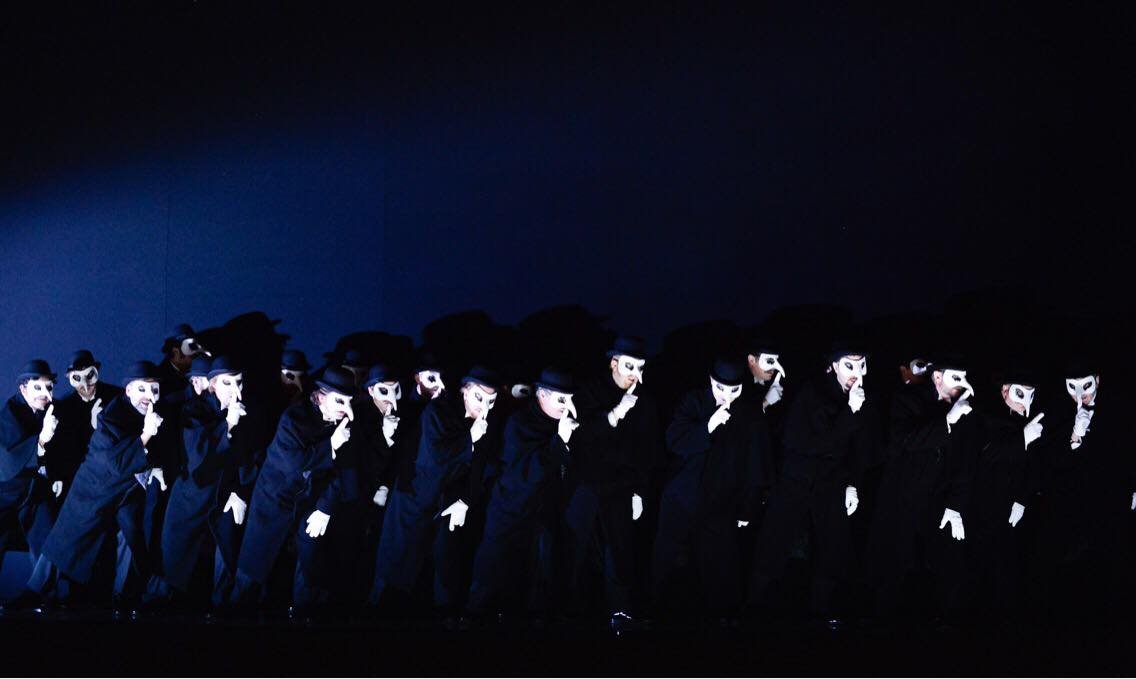
    This always was a stylish show too. There is much to like about Jon Morrell’s design and the whole thing is fabulously lit throughout by Tony Rabbit. Significant parts of the action are played before strong sidelights which cast enormous shadows and it very cleverly begins to seem as though the shadows behind the characters are where the real business lies.

    So far, so dark and that fits perfectly with the plot, but what was it like? Well, there is much to appreciate and there is no doubt that this is an enjoyable night. I happened to take a friend who had never been to an opera before and this is perfect first opera territory. The story is told clearly and with some elegance. The music is glorious and of course, you come out singing that tune, having been made very much aware that despite it appearing in TV advertisements and as background music everywhere, La Donna e mobile is as nasty a piece of misogyny as you will find in any repertoire.

    However, there is a problem with this outing of this production and it is a simple one. Anyone who remembers seeing it in 2011 may well remember that the singing was simply better than the singing this time around.

    Aris Argiris in the title role, we were informed before the curtain went up, was suffering from a cold. Certainly, that did not seem to have any effect on the power of his voice. However, its strength worked much better expressing Rigoletto’s rage than his tenderness. His acting is very fine and he dominated the stage. His Rigoletto very clearly bullies his daughter, as he is being bullied by members of the Duke’s court.  Lina Johnson gives a very touching portrayal of Gilda, Rigoletto’s daughter though their duets lacked a little in emotional depth. Alas, the problem with Adam Smith’s Duke of Matua was that he had the apect more of a student portraying a duke than a duke dressing up to win the affections of Gilda as a student. He was delightful but I’d have believed him more if we’d seen more much menace.

    The high vocal point in the whole production was the quartet Bella figlia dell’amore involving, Argiris, Smith, Johnson and Sioned Gwen Davies as Maddelena. This was a delight. It was also beautifully accompanied. Rumon Gamba kept the orchestra firmly in order throughout and tended towards the tender, which suited the singing completely.

    The all-male chorus sing beautifully, look menacing and do obscene things with female mannequins. One could scarcely ask for more.

    There is much to like and respect in this production. The story is told with grace, simplicity and style. Musically it is lovely, though excellence, sadly, eludes it.

    This review appeared first in the pages of Scene Alba.

    Rating: ★★★☆☆

6 responses to “Here or there?”

  1. Gary Avatar

    Up there. High altar. No doubt.

  2. Tom Allen Avatar

    I am very much with Richard Giles on this one – there should liturgically only be one main altar – ideally this is achieved by romoving the former High altar and dedicating that space to some other purpose – where that is not possible as in historic cathedrals then it should be left dormant (covered in a simple cloth perhaps) and only the altar which is being used for worship should be dressed since this is in fact THE altar.

    Despite all the reservations about removing former altars in the end it solves long-term problems, and provides a single visual focus for Eucharistic worship. At times when a high altar is needed then the new altar can moved there.

    This kind of fuzziness illustrates that our liturgical practice has become dominated by hertiage criteria.

    I am about to replace our main altar with something moveable and aesthetically more appropriate, but am facing a Registrars ruling that the current altar (and former eastward facing number more recently provided with wheels and moved to the chancel!) must be burnt, and that the wood frontal cannot be used for a screen.

    Dont’ we get ourselves tied up in knots!
    Tom

  3. Stewart Avatar

    A thought came to my mind this afternoon. At the Creed we all face east. This results in the choir turning their back on the Nave Altar and in most cases put the High Altar in their sight.

    Considering Tom’s comments, another thought thinking about some English Cathedrals which have multiple altars around the building, it is not usually possible to see more than one at a time. Some have a chapel behind the High Altar – behind a screen.

    Turning back to St Mary’s – all the action at the 10:30 service is centred and focused around the Nave Altar. However there is still the High Altar, the Pheobe Traquair Reredos and Gwyneth Leach mural of Our Lady at the East End. To my mind their presence enhances the worship around the Nave Altar and does not detract from it.

  4. Andrew Avatar
    Andrew

    The Altar is a table, where we commemorate a meal together. Clearly (to my mind) we should all be sitting round it, as we do (more or less) at present. The table reminds me that Jesus instituted the Last Supper when he was among us (HERE), not somewhere else (THERE).

    I very much hope that the Altar in St. Mary’s can be left where it is.

  5. kelvin Avatar
    kelvin

    It seems to me curious that the practice that I inherited was to light and dress the high altar whilst using the nave altar. It makes no sense, except perhaps to highlight St Mary’s puzzling parallel worlds of deep conservatism mingled with radical liberalism.

    Whist tending to agree with Andrew’s sentiments, it is worth remembering that the nave altar could hardly be said to have stayed in one place these last 20 years.

  6. Elizabeth Avatar
    Elizabeth

    Here. Both. Loving the paradox.

    But maybe I only say that beccause the only church I’ve regularly worshiped in where there are clearly two visible altars is St Mary’s and that’s what I’m used to. I’ve never found it distracting that the high altar is dressed and lit, even though the nave altar is where the action is, so to speak. But then, would I notice if the high altar wasn’t dressed and lit? Probably not.

    I do love the nave altar, peripatetic as it is!

Leave a Reply

Your email address will not be published. Required fields are marked *

Previous Posts

  • It’s Time for a Vote

    This week we get to a significant point in the campaign for more equal marriage law in Scotland. On Wednesday there will be a vote in the parliament at Holyrood. Whilst there has been a lot of pre-scrutiny of the legislation and a long political process already, this is the first time that members of…

  • The Christian Year and Social Media

    I do love the way that the Christian Year is becoming more important to Christians because of social media. When I check my facebook and twitter feeds in a morning I can be pretty sure that there will be something there which relates to what season or more likely what day we have got to…

  • Samuel Seabury Day – God Bless America

    When I walked into Grace Cathedral in San Francisco last year to begin a three week visit as part of my sabbatical, I was hugely struck by this scene that was one of the large murals on the right hand wall of the nave. It is a scene that takes place in Scotland – the…

  • Keep the Cone

    I’m firmly cone positive and this video goes some way to demonstrating why. (For those out of town, see here: http://www.bbc.co.uk/news/uk-scotland-glasgow-west-24907190)