
• Can you backdate a marriage?

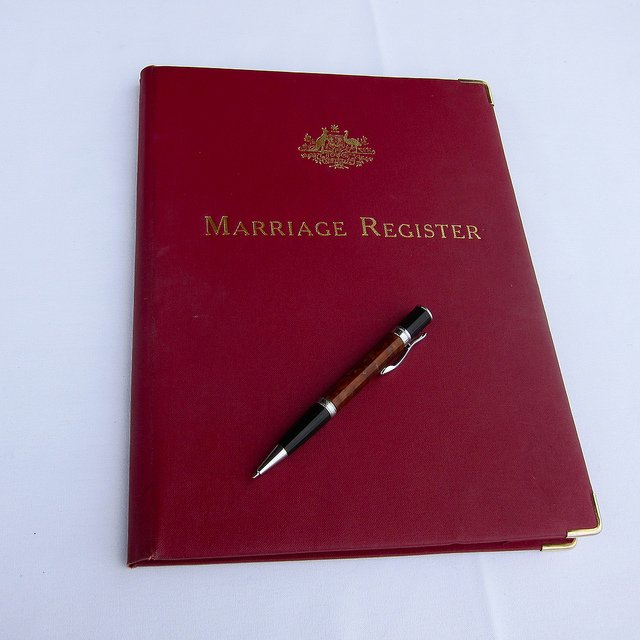
    Marriage Register

    How interesting to learn about the new rules that will govern couples in England and Wales who have been in a Civil Partnership who wish to change (upgrade?) their relationship status to a marriage.

    It seems that they are going to be able to do so easily and will receive a “backdated” marriage certificate which will state that their marriage began when they entered into their Civil Partnership.

    I’ve some reservations about this but I know it will be warmly welcomed by many and it would be churlish to oppose it.

    It is interesting though and there will be pressure now in Scotland for the Scottish Government to do the same.

    Here are some obvious issues.

    • It is quite odd to think that some might find themselves to have been married without their, at the time they entered into their marriage, believing that they wanted to be married.
    • People who have been blessing Civil Partnerships are going to find that they’ve been blessing marriages all along.
    • People will be able, I think, to find themselves married who never went through any ceremony at all – they may simply have signed the papers. (This is a new thing).
    • There’s no doubt going to be some grumpiness from those who trusted the politicians who said that Civil Partnerships were definately not marriages and that it had been invented in order to do something different to marriage.
    • In a sense, it is rewriting history. People are going to have marriage certificates that date from a time when they were not in fact married at all.
    • The Bishops of the Church of England in the House of Lords might feel that the Government has pulled the rug out from under them.
    • I think, that people can end up married whose proposal to marry has never been published either by banns on in a registrar’s office. I’ll be interested to see whether the registrars publish the names of those converting their status. My guess is that they won’t and thus people will end up married in law who have never had their intent to enter marriage advertised to anyone.
    • It is quite odd to think that a status like marriage can be backdated. Is there any comparable status that can be changed like that?

    Personally, I would have preferred the solution to be that people would get new full marriage certificates when they requested to change their relationship status into a marriage. I think this because I think that marriage ought to require a clear statement of consent at the time it is entered into. (Indeed, many of the rules surrounding marriage are about getting unambiguous consent from both parties, freely given).

    Interesting times. Uncomfortable times for the churches, particularly the Church of England.

    Photo Credit – Dale Gillard Copyright: Creative Commons Attribution-NonCommercial-ShareAlike 2.0 Generic (CC BY-NC-SA 2.0)


6 responses to “Here or there?”

  1. Gary Avatar

    Up there. High altar. No doubt.

  2. Tom Allen Avatar

    I am very much with Richard Giles on this one – there should liturgically only be one main altar – ideally this is achieved by romoving the former High altar and dedicating that space to some other purpose – where that is not possible as in historic cathedrals then it should be left dormant (covered in a simple cloth perhaps) and only the altar which is being used for worship should be dressed since this is in fact THE altar.

    Despite all the reservations about removing former altars in the end it solves long-term problems, and provides a single visual focus for Eucharistic worship. At times when a high altar is needed then the new altar can moved there.

    This kind of fuzziness illustrates that our liturgical practice has become dominated by hertiage criteria.

    I am about to replace our main altar with something moveable and aesthetically more appropriate, but am facing a Registrars ruling that the current altar (and former eastward facing number more recently provided with wheels and moved to the chancel!) must be burnt, and that the wood frontal cannot be used for a screen.

    Dont’ we get ourselves tied up in knots!
    Tom

  3. Stewart Avatar

    A thought came to my mind this afternoon. At the Creed we all face east. This results in the choir turning their back on the Nave Altar and in most cases put the High Altar in their sight.

    Considering Tom’s comments, another thought thinking about some English Cathedrals which have multiple altars around the building, it is not usually possible to see more than one at a time. Some have a chapel behind the High Altar – behind a screen.

    Turning back to St Mary’s – all the action at the 10:30 service is centred and focused around the Nave Altar. However there is still the High Altar, the Pheobe Traquair Reredos and Gwyneth Leach mural of Our Lady at the East End. To my mind their presence enhances the worship around the Nave Altar and does not detract from it.

  4. Andrew Avatar
    Andrew

    The Altar is a table, where we commemorate a meal together. Clearly (to my mind) we should all be sitting round it, as we do (more or less) at present. The table reminds me that Jesus instituted the Last Supper when he was among us (HERE), not somewhere else (THERE).

    I very much hope that the Altar in St. Mary’s can be left where it is.

  5. kelvin Avatar
    kelvin

    It seems to me curious that the practice that I inherited was to light and dress the high altar whilst using the nave altar. It makes no sense, except perhaps to highlight St Mary’s puzzling parallel worlds of deep conservatism mingled with radical liberalism.

    Whist tending to agree with Andrew’s sentiments, it is worth remembering that the nave altar could hardly be said to have stayed in one place these last 20 years.

  6. Elizabeth Avatar
    Elizabeth

    Here. Both. Loving the paradox.

    But maybe I only say that beccause the only church I’ve regularly worshiped in where there are clearly two visible altars is St Mary’s and that’s what I’m used to. I’ve never found it distracting that the high altar is dressed and lit, even though the nave altar is where the action is, so to speak. But then, would I notice if the high altar wasn’t dressed and lit? Probably not.

    I do love the nave altar, peripatetic as it is!

Leave a Reply

Your email address will not be published. Required fields are marked *

Previous Posts

  • Sermon – 11 October 2009 – Job

    Here is this morning’s sermon. There is a short hiatus near the beginning whilst microphones were sorted out. Fortunately one member of the congregation decided that she did want to hear me preach rather than just see me preach and waved her arms until it was sorted out. Many thanks Peggy. In the name of…

  • Sermon for St Francis 4 October 2009

    Here is the sermon preached yesterday for St Francis That Gospel reading is our jumping off point this week because it was a jumping off point for St Francis himself. It was on hearing this gospel that his manner of life was changed. He heard it and believed it was a call directly to him…

  • Here is a sermon I prepared earlier

    Preached in St Mary’s on 6 September 2009. I can’t remember why I didn’t put it online ealier. This morning I want to talk about the Syrophoenician woman whom we have just heard about in the gospel reading. This woman, whose name is unknown, is an intriguing character. She was an outsider for a number…

  • Twenty Years On

    It is funny how anniversaries creep up on you. It is twenty years ago this week since I went to read theology at the University of St Andrews. I can remember Freshers’ Week very clearly all these years later. Inevitably, some of those whom I met in the first few days there, I have lost…