
• Husbands and Wifes

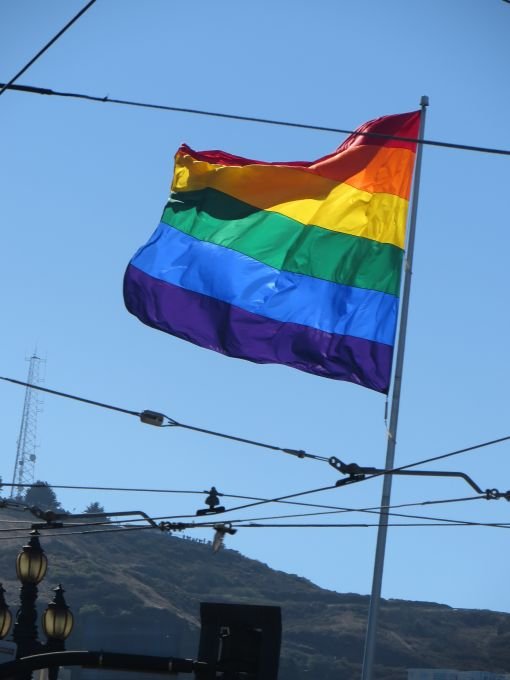
    flag over castro

    Yesterday I heard the news that the House of Lords has given a third reading to the new legislation which will allow gay couples to get married in England and Wales. It should get the nod from the House of Commons today and then go to the Queen for Royal Assent by the end of the week. The first marriages under this legislation will take place sometime next year once registrars have been re-trained and new forms printed.

    I expect we will have a period where all kinds of other institutions will have to re-write their forms and policies too. One can imagine married same-sex couples getting grumpy when they try to fill in an insurance form or try to join a social network and they are offered wife or husband when they want to be offered a box to tick for the opposite.

    It is only fairly recently that I’ve heard same-sex couples who were married speaking freely of their husband or wife. We have one same-sex couple connected to St Mary’s who are married, having been hitched in South Africa. When I was in Canada and the USA I was hearing the use of husband by some married gay men and wife by some of the lesbian couples I met. It was by no means universal but it was becoming common and rather ordinary though no doubt that takes a little time.

    Part of me remembers that I once was against same-sex marriage and that it was partly because I thought that gender-neutrality had something to offer. Were gay couples not leading the world by insisting on having partners rather than the somewhat possessive alternative nouns?

    I think I was wrong about that. What was needed was equality and some people need to use just such possessive language to describe their relationships in the same way that straight married couples sometimes reject it and use the partner language.

    Inevitably there is now going to be a period of reflection and consultation whilst the government tries to decide whether to open Civil Partnership up to straight couples. I expect that will happen though I’m not that keen. It seems to me that the right way forward was simply to incorporate Civil Partnership with Civil Marriage. However, I suspect that though I’ve been on the winning side of most arguments about changes in marriage law, that is not one that I’m likely to win now.

    Very many churches have proclaimed themselves to be against same-sex marriage as it will somehow undermine and threaten the institution of marriage itself.

    I don’t think that is true. I do think that retaining Civil Partnership and opening it up to straight couples does undermine the institution of marriage though. Had the churches engaged in these arguments in more constructive ways than most of them did then they might have had an influence which strengthened marriage. Instead, I suspect that in the long term they will have weakened it.

    Still, we’ll not worry about that today. We will simply fly a rainbow flag in celebration for all those soon to be married couples in England and Wales. And recognise that the last battles still have to be won in Scotland.

    Alleluia for England!

    And once more unto the breach.

6 responses to “Here or there?”

  1. Gary Avatar

    Up there. High altar. No doubt.

  2. Tom Allen Avatar

    I am very much with Richard Giles on this one – there should liturgically only be one main altar – ideally this is achieved by romoving the former High altar and dedicating that space to some other purpose – where that is not possible as in historic cathedrals then it should be left dormant (covered in a simple cloth perhaps) and only the altar which is being used for worship should be dressed since this is in fact THE altar.

    Despite all the reservations about removing former altars in the end it solves long-term problems, and provides a single visual focus for Eucharistic worship. At times when a high altar is needed then the new altar can moved there.

    This kind of fuzziness illustrates that our liturgical practice has become dominated by hertiage criteria.

    I am about to replace our main altar with something moveable and aesthetically more appropriate, but am facing a Registrars ruling that the current altar (and former eastward facing number more recently provided with wheels and moved to the chancel!) must be burnt, and that the wood frontal cannot be used for a screen.

    Dont’ we get ourselves tied up in knots!
    Tom

  3. Stewart Avatar

    A thought came to my mind this afternoon. At the Creed we all face east. This results in the choir turning their back on the Nave Altar and in most cases put the High Altar in their sight.

    Considering Tom’s comments, another thought thinking about some English Cathedrals which have multiple altars around the building, it is not usually possible to see more than one at a time. Some have a chapel behind the High Altar – behind a screen.

    Turning back to St Mary’s – all the action at the 10:30 service is centred and focused around the Nave Altar. However there is still the High Altar, the Pheobe Traquair Reredos and Gwyneth Leach mural of Our Lady at the East End. To my mind their presence enhances the worship around the Nave Altar and does not detract from it.

  4. Andrew Avatar
    Andrew

    The Altar is a table, where we commemorate a meal together. Clearly (to my mind) we should all be sitting round it, as we do (more or less) at present. The table reminds me that Jesus instituted the Last Supper when he was among us (HERE), not somewhere else (THERE).

    I very much hope that the Altar in St. Mary’s can be left where it is.

  5. kelvin Avatar
    kelvin

    It seems to me curious that the practice that I inherited was to light and dress the high altar whilst using the nave altar. It makes no sense, except perhaps to highlight St Mary’s puzzling parallel worlds of deep conservatism mingled with radical liberalism.

    Whist tending to agree with Andrew’s sentiments, it is worth remembering that the nave altar could hardly be said to have stayed in one place these last 20 years.

  6. Elizabeth Avatar
    Elizabeth

    Here. Both. Loving the paradox.

    But maybe I only say that beccause the only church I’ve regularly worshiped in where there are clearly two visible altars is St Mary’s and that’s what I’m used to. I’ve never found it distracting that the high altar is dressed and lit, even though the nave altar is where the action is, so to speak. But then, would I notice if the high altar wasn’t dressed and lit? Probably not.

    I do love the nave altar, peripatetic as it is!

Leave a Reply

Your email address will not be published. Required fields are marked *

Previous Posts

  • Ian Ansdell is blogging

    Ian Ansdell has been keeping a personal blog for a couple of months and I’ve only just found it – another one to add to the list.I met Ian in Glasgow recently at the Diocesan Synod Eucharist. He is the person behind the incredibly comprehensive www.scottishchristian.com site/news blog. Anyway, his more personal (and rather elegant) blog…

  • Enough, enough

    Enough already. I need no more e-mails telling me that there is only one way to wear a biretta. No more diagrams and pictures showing me how. No more tips. No more hints. No more, no more.It was a flippant remark and I will not make it again. How on earth has the Anglican Communion…

  • More than one way

    I found myself yesterday using this turn of phrase, "…oh, there is more than one way to wear a biretta…"It seemed a metaphor likely to be regarded as kinder to the more feline amongst us than the usual one. However, it has got me wondering.Is there? 

  • To the City

    Going to the city today (Edinburgh) to rearrange chairs.Amazing what one has to do for God’s kingdom sometimes.