
• Fake Pope Quote Posts

    One of the more bizarre developments in social media has been the rise in fake quotes from popes appearing online.

    One might think that Roman Catholics would be particularly at the forefront of this kind of activity, but that’s not necessarily the case. Anglicans seem to love a good fake pope quote. I’ve seen them posted by an incredible number of people including several senior clerics.

    I am bewildered as to why people post things and in doing so say something like “Isn’t it amazing that we’ve got a pope who said…?” and don’t pause for a moment to ask whether it might be the case that someone has just made it up. Incredulity might well be a pathway to common sense.

    The sad thing is that there’s plenty of profound things that popes do say that are worth repeating. It seems a terrible shame that Pope Francis might be remembered not for his genius in addressing the Climate Crisis in Laudato Si’ but for a series of invented platitudes about hospital walls.

    Particularly puzzling are those, and again, I have senior clerics in my mind, who post these things and then when told that they are not by the pope in question respond by saying that they are going to leave the post up on social media because it sounds like something the pope might have said or that they agree with the sentiments anyway.

    I can’t think of a clearer example of bearing false witness than leaving something published that you have claimed to be written by someone when you know that in fact it was not.

    But anyway, I have a more entertaining response to this from today than just outraged spluttering on other people’s facebook posts, which is to suggest to anyone desperate for a fake pope quote to post online that they ask ChatGPT to come up with a new one rather than recycling someone else’s.

    Here’s how it goes. You open up ChatGPT and you give it this kind of prompt:

    write a fake quote from Pope Leo XIV that is about 450 words long. Make it sound vaguely plausible but the message is the everyone is welcome in the church, even those who think they are not. Use the kind of language of the self-help and empowerment movement to suggest that the pope wants to change the church and that he alone has a vision to do this.

    And bless it, ChatGPT churns it out beautifully.

    There are many who believe the Church is not for them. They whisper to themselves, ‘Surely not me—not with my past, not with my doubts, not with my wounds.’ But I say to you today: the doors of the Church are not narrow—they are wide. They are not guarded by perfection—they are held open by grace.
    We must move beyond the old habit of exclusion cloaked in the language of tradition. We must stop drawing lines where Christ drew none. The Church is not a sanctuary for the flawless; it is a refuge for the broken, the confused, the seekers, the scarred. If you feel lost, unsure, uncertain of your worth—you are precisely who Christ called. You belong here.
    This is not a time for silence or shadows. It is a time for awakening. Too long have we accepted a Church that feels distant, judgmental, fearful of difference. But the Gospel was never about fear. It was always about radical welcome. About the love that does not check credentials at the door.
    I envision a Church reborn—not in doctrine, but in posture. A Church that speaks less about rules and more about renewal. A Church where questions are not threats but invitations. A Church where you do not have to hide who you are to be loved as you are.
    This vision is not shared by all. Some will say it is too soft, too open, too modern. But I say it is simply faithful—to the Jesus who touched the unclean, who ate with sinners, who forgave before they asked, and who never once said, ‘Come to me, but only if you’ve already cleaned yourself up.’
    I do not seek to dismantle the Church—I seek to return it to its heart. That heart is mercy. That heart is hospitality. That heart is Christ.
    If you are gay, divorced, disillusioned, poor, angry, unsure if you even believe anymore—come. If you have been hurt by the Church, forgotten by the Church, judged by the Church—come. If you are full of joy or full of rage—come.
    You will not find a perfect community. But you will find a people trying—trying to be more like Christ, one small, stumbling step at a time. That is all any of us can do.
    The future of the Church is not behind us in stone and ritual. It is ahead of us—in compassion, in courage, and in the willingness to welcome those who thought there was no place left for them. I have seen this future. And I believe it begins now.”
     
    Isn’t that genius? “Not a time for silence or shadows” – completely meaningless and yet exactly the kind of thing that people love posting. I just love “The future of the Church is not behind us in stone and ritual…”. No pope would ever say that. Priests do tend to like a bit of ritual after all and if any pope got near saying that then I’m sure that they could count on those that surround them to prevent them making a fool of themselves and alienating all their clergy.
     
    “I envision a Church reborn—not in doctrine, but in posture.” Can you imagine anyone other than perhaps a C of E bishop commenting on the latest draft of Prayers of Love and Faith ever saying anything so absurd? Yet I’ve seen plenty of even sillier fake pope quotes purporting to be the real deal.
     
    People do love this kind of thing. And that’s exactly the kind of post that I’ve seen posted and liked and reposted dozens of times in the last few weeks.
     
    Might I suggest that we put a stop to it? For as the medieval pope Kelvinius the First said in 1524…
     
    Let not thine idle hands inscribe falsehoods in the name of the Holy See, for to speak a lie in the voice of Peter is to forge chains for thine own soul. Be on guard for the truth. For the truth shall set you ChatGPTFree.
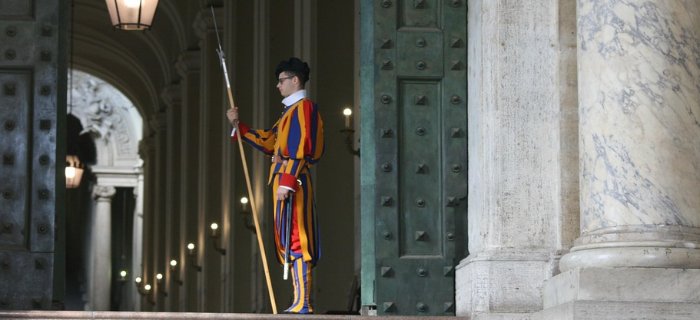
     
     
    Picture of a Swiss Guard on guard.

5 responses to “Tanzania”

  1. Raspberry Rabbit Avatar

    A bit picky, yes. Idris will no doubt correct them when he’s there.

  2. Simon Sarmiento Avatar

    Umm. So Northern Ireland is part of Britain is it?
    Four churches in the UK maybe.

  3. kelvin Avatar
    kelvin

    Well Simon, you are correct in your assumption that I was thinking of the Church of Ireland in Northern Ireland, rather than perhaps the Church of Rockall.

    People who are being picky deserve to be picked up for slack talk. However, speaking as I do from the Second City of Empire, I hide behind this quote on the website for Number 10 Downing Street:

    http://www.number-10.gov.uk/output/Page823.asp

    “The United Kingdom is made up of four countries: England, Scotland, Wales and Northern Ireland. Its full name is the United Kingdom of Great Britain and Northern Ireland.

    Great Britain, however, comprises only England, Scotland and Wales. Great Britain is the largest island of the British Isles. Northern Ireland and the Irish Republic form the second largest island.

    The UK is just under 1,000 km long from the south coast of England to the extreme north of Scotland, and is 500 km across at its widest point. It shares a single land border with the Irish Republic. Despite its relatively small size the UK boasts incredibly varied and often very beautiful scenery.

    The Isle of Man and the Channel Islands are not part of the United Kingdom. They are largely self-governing with their own legislative assemblies and systems of law. But the British Government is responsible for their defence and international relations.

    On this site the term ‘Britain’ is used informally to mean the United Kingdom of Great Britain and Northern Ireland.”

    I’d also refer interested parties to the Wikipedia page on http://en.wikipedia.org/wiki/British_Isles_naming_dispute

    I offer this topic as a free gift to Bishop David.

  4. Bishop David Avatar
    Bishop David

    As you would expect, I am all knotted up on this one. I am a citizen of Ireland – or the Irish Republic – or the Republic of Ireland. Nor Eire – or, as many of my parishioners in Portadown would have called it [never having moved on from 1922], the ‘Free State’. Meanwhile President Mary MacAleese is often termed President of Ireland which seems to me to be as notable a piece of ‘overlooking’ as when Ian Paisley refers to the ‘people of Ulster’ [which means some of the Protestant/Unionist population of Northern Ireland] and Gerry Adams refers to the ‘Irish People’ [which means not the Protestant/Unionist population of Northern Ireland]. I like Wiki’s rather coy description of Ireland as ‘currently split’ – meaning just the most recent 85 years. Which in the context of thousands of years of British misrule in Ireland is but a blink. And finally one comes to the interesting use of the term ‘mainland’ …

  5. steg Avatar
    steg

    Must admit when I saw you were writing about primates in Tanzania I thought your blog was going to be about ape conservation………………….

    In my experience people from outwith the UK confuse Britain and England a lot. And they have a point. Do you always refer to the Netherlands or sometimes to Holland even when you are refering to the non Holland bits of the Netherlands? And how do you think that makes the Friesian’s feel? And so on.

Leave a Reply

Your email address will not be published. Required fields are marked *

Previous Posts

  • The English Heresy

    A long time ago and in a land far away, by which I mean Fife, I was a theological student. It was a good time in my life. By and large I was in the company of clever people, learning clever things from clever people. Theological education can be exciting and that was an exciting…

  • Turning Up and Being Counted

    I’m currently going through a strange time. I’m away from my congregation on sabbatical. It is a good thing to do and I’m having a great time, meeting fantastic people and learning a thing or two by stopping for a while to breathe. There’s always things that you miss when you are away from the…

  • 12 Things I’ve Learned About Preaching

    At the moment, I’m on sabbatical and am not preaching regularly. However, I recently had the opportunity to preach to a congregation largely made up of apprentice preachers – those who are training for ordained and lay ministries in the church in the future. A number of them have asked me to share some wisdom…

  • It was 30 years ago today…

    It seems extraordinary to me that it is thirty years since I stood with others in Deans Yard in London outside the meeting of the General Synod of the Church of England waiting for news. It was a long day and one that many had worked towards tirelessly, for many years. It was the day…