
• All Souls

    All Souls Day is a rehearsal for my own funeral.

    I realised this a few years ago when someone commented that the All Souls Requiem at St Mary’s seemed to be a particularly important time of the year and was appealing to more people than it used to. When I sat and thought about it, I realised that what I was doing each year in preparing for it was preparing for my own funeral and that at some level, part of what gives me life and energy at St Mary’s is building a community that would know exactly what to do if I dropped down dead.

    Some people might think that rather morbid but it isn’t. I don’t think that much about death. Keeping All Souls is actually a way of helping ourselves let the dead be dead without fixating constantly about them. After last night’s Requiem for All Souls it simply felt to me that all was as it should be. Those whom we care for had been commended to God’s love, we had prayed alongside one another in our remembering and we had done so in the most beautiful way we could do.

    There are many things about All Souls which touch me. One is the use of the Eucharistic prayer for Easter. That’s what we do whenever there’s a funeral that is a Eucharist too. When someone dies there’s a snatch of Easter Day about the proceedings. In the first light of Easter, glory broke from the tomb, after all.

    Last night’s requiem was sublime. The simple tunes of Rutter’s Requiem taking us on a pastoral journey. We saw that death is real. We saw that grief is raw. And we knew that God is love. The music was incredible – the choir literally singing to raise the dead.

    At least, that’s how it was for me.

    The double Feast of All Saints and All Souls is one that always takes my mind abroad too. I was in Sweden for it one year, the year before I was ordained. My memory is of people going to the graveyards and lighting candles on the graves. A little of the first snow of winter had fallen and there was mist swirling around the graveyard trees as people wandered the quiet pathways thinking about those who had died.

    I remember someone telling me that they always lit candles for their parents and then crossed the graveyard to light another one on the grave of Dag Hammarskjöld – All Saints and All Souls always mingle.

    And then three years ago I was in America at this time of year.

    It seems to me that Hallowe’en has suffered rather at lot in its return trip back across the Atlantic to these shores. It seems now to be an excuse for very poor fancy dress bought from cheap outfitters by people who want to get drunk looking like a pirate or Wonderwoman.

    Rather more interesting in the US these days is the set of traditions that the Latino people bring to this time of year. Some of the solemnity that northern Europeans cultivate when thinking about the dead is challenged by those who want to celebrate their dead with an enormous party.

    This is what this time of year looks like in one of the churches that I visited during my sabbatical – All Saints’ Church in Chicago – a place which knows how to party.
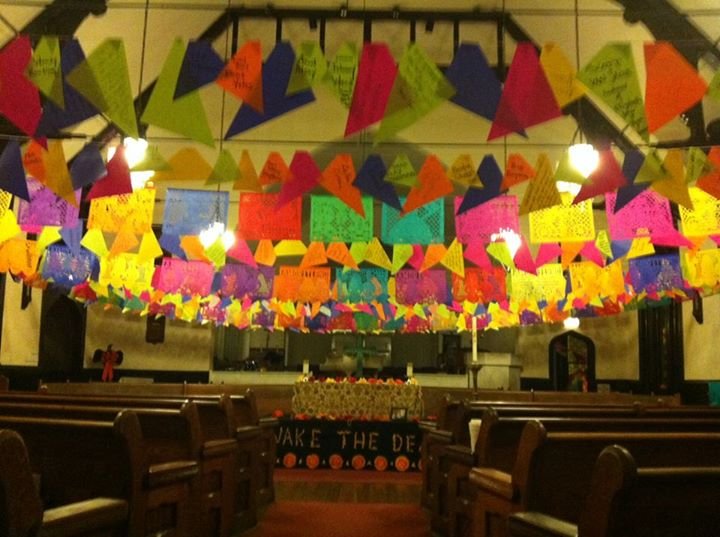
    All Saints Chicago

    In the midst of life we are in death.

    And vice versa.

10 responses to “Blogging”

  1. Lisa Avatar

    First, let me argue that Bishop Paul Marshall — who wrote that letter you cite — is not one of the great liberals of the Episcopal Church in the U.S. He is widely respected and regarded as a moderate. What he wrote in that letter is a frustration that many of us share: Why can the Archbishop meet privately with the most extreme conservatives of the Episcopal Church in the U.S., but consistently refuses to meet with our bishops assembled? I think that is a fair and valid question. I would urge folks to read Bishop Marshall’s whole letter and not just Ruth Gledhill’s biased “gloss” on it.

    I agree the overall tenor of dialogue on U.S. Episcopalians’ blogs is worrisome. But I do not believe it’s the “liberals” that have gone out of bounds. If you want to read true venom, go to Virtue Online or StandFirm.

  2. David Avatar

    It would be great to have a meet up and blether!

  3. kelvin Avatar
    kelvin

    Thanks for the comments

    Lisa – it was precisely standfirm and virtueonline that I had in mind.

    You’re presuming that I don’t have sympathy for Paul Marshall. I have a great deal of sympathy for his position. I think he is angry. And I think he is right to be angry. I deliberately linked directly to his piece rather than Ruth Gledhill’s stuff about it, which people can find for themselves.

    Perhaps if I had written “Those of us with strong liberal convictions…” my own position would have been clearer.

  4. Tim Avatar

    Sociability good. (And arguably good for online interactions too – there are several notable folks whose adventures I read, whom I could happily put in a room together with a football and lock the door 😉

  5. Frank Avatar
    Frank

    There comes a time to toss convention and start communicating. I have a tea party in mind.

    cheers

  6. Raspberry Rabbit Avatar

    Kelvin, I think the whole blogging machine on the right in the U.S. has been set up for a good long while now. They’ve become proficient at it – the ‘blog storm’ if you like which sees itself quite self consciously as ‘generating’ public opinion for particular ends. The amount of support which ‘social conservatives’ will lend to religious conservatives as ‘deserving cousins’ allows those involved in the present TEC dispute access to an immense network.

    I agree with the first comment about Bishop Marshall being middle of the road and not particularly liberal.

  7. Raspberry Rabbit Avatar

    Oh and with respect to SEC bloggers. A meeting might be a good idea

  8. Dennis Avatar
    Dennis

    Kevin: Just discovered your blog through MadPriest’s blog. I’ll add you to my regular visits.

    It is exciting for me, an American far away from the Episcopal Church of Scotland, since I was confirmed at St Mary’s Glasgow back on Pentecost Sunday in 1988 – your church is where I became an Episcopalian – Fr John Turner was the chaplain at GU. Fr Malcolm was provost.

    How exciting. Glad to find your blog.

    Dennis

    The world of political blogs in the US isn’t really that bad. The most important blog in the US for political progressives is DailyKos (www.dailykos.com) – I’m over there quite a lot – worth watching – it has a lot of voice and influence in the US Democratic party for supporting and raising money for underdog candidates last year who happened to win.

  9. Dennis Avatar
    Dennis

    make that Kelvin, not Kevin. sorry about that!

  10. Lisa Avatar

    I’ve corresponded privately with Kelvin about this, but let me make a few comments here in public.

    I usually have to do my reading and writing on “things Anglican” after a full day at work. I regret to say that means I am sometimes too tired, and I miss the nuances. Which clearly happened in my public reply here. I apologize for that, and I apologize for making unwarranted assumptions about Kelvin’s stance.

    One of the things I am realizing is that we in the Anglican Communion really do not understand enough about each other’s cultures and ethos. Over here in the U.S., we are very much hoping that the churches in the U.K. (and a few other provinces) will allow us to “work out our salvation with fear and trembling,” as St. Paul urged. I fear that our colonial past [of which most U.S. Episcopalians repent most sincerely] is working against us. We do not want to “export” our positions to others in the Communion; we don’t want to tell others they must do as we have done. We simply want the space in which to walk the path that seems right to us — and that path already has a 30-year history of prayerful discernment, both about the place of women in ordained ministry and about the place of gay men and lesbians in the Church and ordination.

    Unfortunately, in the larger U.S. culture now, both “liberal” and “moderate” are anathema. A very scary conservativism (verging on — dare I use the term? — fascism) is taking hold.

    When folks say the Episcopal Church is “bowing to popular culture,” they could not possibly be more wrong. “Popular culture” now in the U.S. is strongly capitalist, imperialist, nationalist, sexist, and anti-gay. Our church is “bucking” that tide, and we are paying a great price for what we truly believe to be a Spirit-led, prophetic witness.

    It remains to be seen whether others in the Anglican Communion will trust us to continue in this time of discernment.

    These are very, very hard times for all of us. And I hate how the positions are being polarized.

    At our church’s General Convention [Do you call it a synod?], several people spoke about how the “diverse center” had spoken. I hope and pray that the “diverse center” will find their voices in Tanzania.

Leave a Reply

Your email address will not be published. Required fields are marked *

Previous Posts

  • Friendly and Welcoming Churches in Edinburgh

    Time for a quick round-up of churches which welcome and affirm gay folk over in Edinburgh. I made a plea for information last week which was forthcoming, so it is only fair to list the results. Old St Paul’s has a statement on the page of its XYmonday group which says it is “inclusive group…

  • Human Rights Petition

    There is a growing and unfortunate clamour for a roll-back on human rights commitments. These included some unfortunate comments from the Prime Minister over the weekend to the effect that he thought that human rights legislation had gone too far. Personally I don’t think it has gone nearly far enough. One of the major goals…

  • Gifts and Skills

    One of the themes that I'm wanting to pick up on at St Mary's if that of Gifts and Skills. We're hoping to be running some kind of course or retreat or series of workshops in the autumn which focus on the idea of discerning your gifts and skills. The sermon this morning that Akma…

  • Are there any gay friendly Episcopal churches in Edinburgh?

    Someone said something to me earlier this week which quite shocked me. They said there was no Episcopal congregation in Edinburgh which was welcoming to LGBT people. By this, they did not mean that there was an absence of any Episcopal congregations with happy gay people in them. That is clearly not so. The question…