
I’ll be heading off to join in with Pride Scotia this weekend. It is the Pride march that takes place in Edinburgh.
Whilst looking for some pics of Pride to illustrate the facebook event invitation for Episcopalians at Pride, I came upon this picture.
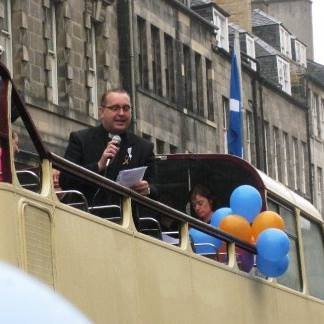
It is a picture of me standing in the rain addressing the Pride Scotia crowd. I remember how wet I was and I remember very clearly what I was saying. I’d been invited to speak about the idea of campaigning in favour of equal marriage though in fact at the time, we didn’t use the term equal marriage.
In the course of my speech, I said something like this:
The passing of the hate crimes legislation is a huge milestone. It is great news.
But what I want to say today is that we want more.
The hate crimes legislation means that people will be dealt with more severely if their crimes are motivated by homophobia. That will make Scotland safer for us all. It is great news. But it isn’t enough yet. We must not rest until every street in Scotland is safe for every member of our community. We will not have achieved what we want until every street is a safe place. And we need every workplace to be a safe place for gay people. And we need every school to be a safe place for gay kids and gay teachers. And we need every church and faith community to be a safe place for gay people too. Those are the things that we need to make homophobia unthinkable.
This afternoon, the LGBT Network and the Equality network are urging people to sign a petition to the Scottish Parliament to change the law even more. Before you go today, make sure you sign the petition calling on the Scottish Parliament to allow gay and lesbian couples to get married. It is one of the next steps we are campaigning for.
I want every gay couple to be able to walk down the street holding hands if they want to do so.
And I want every gay couple to be able to walk down the aisle holding hands if they want to too.
We can make that happen. We can get our parliamentarians to change the law.
When you go past the parliament today, make as much noise as you can. Whistle and yell and cheer for all that has been accomplished in making Scotland a better place for LGBT people. And whistle and yell and shout for more. It is time to say, Separate is not Equal. Our relationships are as passionate and loving as anyone else’s. We have the same potential for commitment as anyone else does. We deserve the same rights as anyone else has.
There are two things which strike me today as I think back to that speech.
Firstly it is the memory of people heckling. Secondly it is the date on which that photograph was taken.
Those few of us who were campaigning for equal marriage in those days didn’t really have a clue whether the people who might benefit from the change in the law that we hoped for would actually back us. No-one knew.
As I stood on top of that bus, there were some people in the crowd making mischief and heckling. (Not that I always mind a good-natured but slightly grumpy crowd – in some ways that is my natural habitat). But the thing I realised as I shouted away into an inadequate loudspeaker system was that most people were not making fun at all. Most people were thinking about it. Most people who heard me speak that day had not really given the idea much thought and it was clear that people were making up their minds.
As I often have to remind people, I used to be against the change that I’ve argued for. As someone who was once an evangelical Christian I had once been against the idea of gay people coupling up at all. Then after coming out myself I thought that gay people simply didn’t need marriage and might be better to be free from the conventions and expectations of marriage. On both counts I was wrong and I only found that out by listening to the expectations and hopes of gay couples who were celebrating their relationships alongside listening to the expectations and hopes of straight couples planning weddings and realising that they were pretty much the same. And the point is, if I can change my mind, anyone can change their mind. One of the reasons that gay equality is taking a long time to achieve in churches is that many leaders simply cut themselves off from providing pastoral care to gay members of their flocks and didn’t hear their stories. Such cruel and ignorant behaviour has diminished the ability of the churches to proclaim God’s love in the UK and in other countries. The churches’ proclamation of the great message of Love has been harmed and diminished in the process.
What I saw the day I spoke at Pride Scotia was that though some people were not interested, the bulk of the crowd were very interested. They believed their loves were as good as anyone else’s loves. In theological terms, I realised that I believed they were as blessed as anyone else.
I went to Pride that day trying to change the minds of the marchers as much as changing the mind of anyone else.
I’d become fed up with the lack of progress in the church over gay rights. Rather than battling on it seemed right to put my energies into bringing about change in society rather than just turning people off from the message of justice and joy that I was hoping they would receive.
I rather think that was a good call.
It is obvious to me this year that we are getting there. Oh, I still want all streets to be safe and all churches to be safe for LGBT folk. We’re still a long way off achieving either of those aims but we are much further along the road than we were.
I was proud of my church last week – at every stage of a long, tortuously complex decision-making process, we voted by convincing majorities in favour of equality.
But the real shocker is not to think about how much has changed since the photograph above was taken. It is to think about its date. It was taken only in 2009 – just six years ago.
My world has changed in those six years. Every gay person in the UK has seen the world change before their eyes in those six years.
My ambition is neither satisfied nor static. I don’t just want gay couples to be safe walking down the Royal Mile – I want such couples to be safe walking down the street in Kampala. I want gay couples to be safe in Lagos as much as I want them to be safe in Linlithgow or Livingston.
But I’m proud of what we’ve achieved.
And by me, I don’t just mean the usual suspects. I don’t just mean the few souls who believed marriage had to changed before they could imagine how to get that change to happen. And I certainly don’t just mean the LGBT folk who can now benefit from the change in the law.
I mean everyone straight, gay, powerful or apparently powerless who helped make change come about.
And I ask everyone who has been a part of this to ask just one question as I set off to Pride this year…
If we can do that in six years – what shall we do next?


Leave a Reply