
• Same-sex Marriage Date for Scotland – 31 December 2014

    SONY DSC

    Exciting news this morning – we have a date for the first same-sex marriages in Scotland. The date is within this year – just. The first day on which most couples will be able to get married will be 31 December 2014, the day known in Scotland as Hogmanay. There’s going to be some parties north of the border that night, I can tell you.

    The law will actually change in mid-December, as expected but the Scottish Government has delayed its proposal to increase the notice period to 28 days. Thus, same-sex marriage becomes legal on 16 December 2014. If a couple have been married in another jurisdiction (eg England) then they will be regarded in Scotland as being in a Civil Partnership until midnight on 15 December and regarded as a married couple on 16 December. Couples can give notice to marry on that day and a couple of weeks later can get married on 31 December 2014.

    From 16 December 2014 a couple in extenuating circumstances will be able to apply to be able to get married more quickly – this usually applies if one partner is near to death. It is entirely possible that such a couple may be the first to be married but the big celebrations will come right at the turn of the year.

    From 16 December, trans people can get gender recognition without having to be divorced.

    Couples who have entered a Civil Partnership will be able to apply to a Registrar to convert that to a marriage from 16 December 2014 and it will be free to do so for the first year. (You pay for the marriage certificate just like anyone else but there is no processing fee). Alternatively, couples may pay the usual fees for a marriage ceremony. Couples will be able to be married in a Register Office or by religious or humanist celebrants in certain circumstances.

    Couples will be able to be married in the Scottish Episcopal Church with the permission of the House of Bishops, the House of Clergy and the House of Laity meeting in General Synod.

    Any couple who has entered into a Civil Partnership who converts it to a marriage is welcome if they wish to bring the certificate to St Mary’s where it can be laid on the altar at a Eucharist in thanksgiving for the partnership and for this change in the law.

    Civil Partnerships will continue to be available to same-sex couples (but not to straight couples) and I am more than willing to go on blessing such couples.

    I’m also willing to bless all couples who have married by a Registrar, using the Service of Benediction that I drew people’s attention to earlier.

    Here’s the prayer I will be using to bless couples in church:
    God the Father,
    God the Son,
    God the Holy Spirit,
    bless, preserve and keep you;
    the Lord look upon you with favour and mercy
    and so fill you with all spiritual benediction and grace,
    that you may so live together in this life
    that in the world to come you may have life everlasting.
    Amen

    Straight couples marrying who wish to express solidarity with gay couples who wish to get married in Scottish Episcopal Churches should get married in a Register Office and come to church for the Benediction of their marriage just like anyone else wanting to get married.

    I’ve yet to decide whether or not to continue to perform legal marriages for straight couples in church after 31 December 2014.

    Congratulations are in order not only to those who will be getting married soon but also to all those campaigners who worked to change the law, to parliamentarians who voted for it and civil servants who have been working on it. The brilliant campaigning of the Equality Network has been a powerful force in bringing about change. And inevitably, my mind turns in awe to the members of St Mary’s Cathedral, particularly those belonging to the LGBT group who went out collecting signatures to bring in petition to the Scottish Parliament long before the big campaigns got going.

    We changed the world.


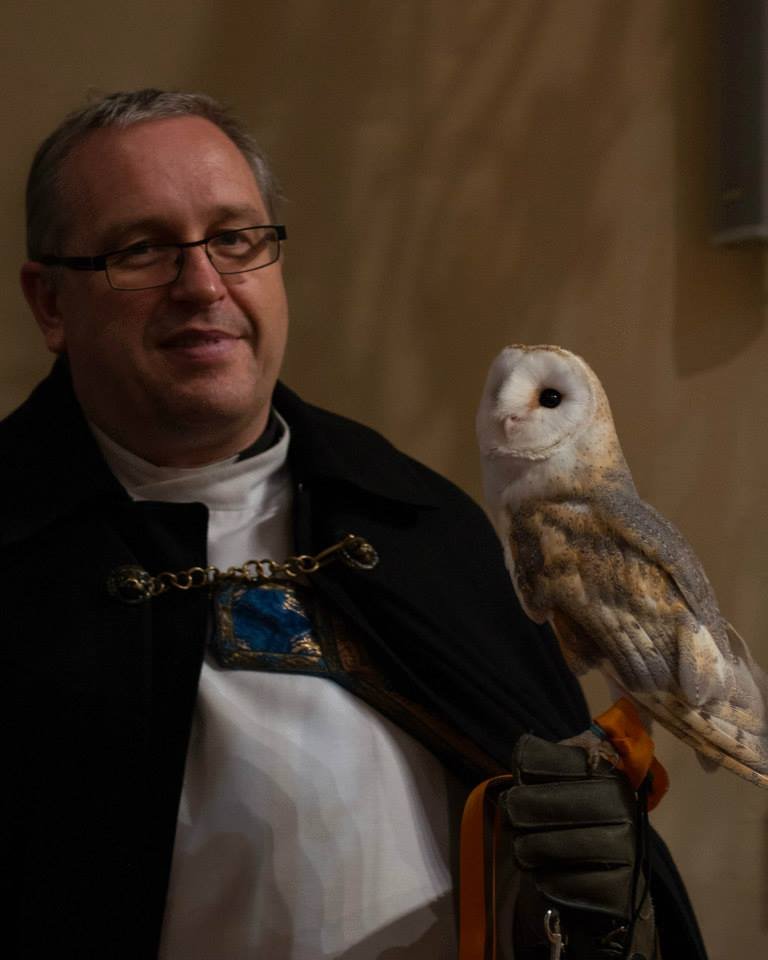
    Picture Credit – Peter Kolkman Copyright – Creative Commons Some Rights Reserved

7 responses to “The BA Cross Story”

  1. Tim Avatar

    Hmmm. You’re the first person I’ve seen to view it this way around.

    Different, and I agree about “witnessing to the passengers” (I don’t particularly want proselytising, least of all on a plane) but I’m not sure I agree with your conclusion.
    A cross need not be particularly outlandish; many people wear them, some of whom don’t even regard themselves as christian (heirloom, etc), and who’s going to ask their motives before declaring it still a religious symbol?

    It’s unfortunate that this has come about with someone who sees the cross as her witness, but if this stands, companies will be allowed to have discriminatory uniform policies, and it doesn’t matter who the parties are, it’s just discrimination whichever way I cut it; all the more so when it leads to *a society* in which one hides from others rather than embracing them.

  2. kelvin Avatar
    kelvin

    As I understand it, the BA uniform policy has applied to all jewelry hanging around someone’s neck. It would not be fun to get one’s Cross, Crescent, Star of David or string of pearls caught in the check-in machinery.

    It is interesting that the principle sign of Christian membership in most parts of the various churches is essentially ephemeral – baptism by its very nature is invisible in material form once performed.

    When I was in Egypt, I was quite impressed with the tattoos that many Christians had done in order to identify themselves to one another. At more than one Christian gathering I went to, the locals were vetted at the door by showing their tattoos – the presumption being that no member of any group that the Church people were frightened of would ever have a cross tattooed on their skin.

  3.  Avatar
    Anonymous

    Yes, you’re quite right. A uniform is a uniform. If one absolutely wanted to wear something other than a uniform at work, then joining the Army mightn’t be the best place for me.

    Similarly, if joining the BA ranks implies wearing a uniform, and I insist on wearing some additional contraption, then , patently, possibly a position without a uniform would be better. Possibly as a clergy person?! That is if I were a compulsive proselytiser.

    Anent compulsive proselytising. There is this church building on the facade of which a sign threatens one and all with everlasting hell fire. No doubt those of that congregation consider it to be their loving duty so to do. However, to my mind, it is a most egregious assault on the urban landscape … and myself, every time I have cause to walk by.

    Yes. Yours is a most refreshing viewpoint. All the more so as it comes from within the ranks of the clergy. Possibly a reason why I’ve kept on coming back to this your blog…

    All the very best,

    Clyde Lad

  4. Alex Avatar
    Alex

    The real problem is that BA’s policy is inconsistent: turbans are allowed, hijabs are allowed and apparently Hindu bangles are allowed.

    For a uniform policy to be reasonable I think it either has to allow all, or allow none. I’m not fussed which they choose, but consistency is important.

  5. Ali Avatar
    Ali

    I think the difference between turbans, hajibs and bangles are the difference between a requirement of following a particular faith (or, rather, a conservative branch of a particular faith as with the hajob and the bangle), or a desire because of one’s faith. A cross is worn out of choice, rather than a requirement of orthodoxy.

    I talked a little about this in the sermon this morning – on a day where the church celebrates the feast of Christ the King, surely a greater sign of being a member of that Kingdom, or a follower of Christ, is the way in which we treat this planet given into our care and all who inhabit it, rather than becoming sidetracked in petty bickering about which poppy is the most Christian or the “right” to wear a cross at work regardless of uniform policy.

  6. Alex Avatar
    Alex

    “A cross is worn out of choice, rather than a requirement of orthodoxy.”

    I’m not sure that this is a difference that removes the inconsistency from BA’s uniform policy. Whether or not the turban, hijab or bangle is perceived as a ‘requirement’ of membership of a faith, it is still my choice whether or not to observe it.

    This is not to say that I think Ms Ewelda has taken the best course of action. My personal view is that she has made a mistake – instead of a greater witness, she has contributed to the perception of Christians as petty and whinging. I may have my differences with Paul(!) but I think his “Greek to the Greek, Jew to the Jew” approach has a lot to be said for it.

    But our disagreement with her position on how crucial to the Christian life is the wearing of the cross doesn’t change the fact that the policy applied treats her differently from members of other faiths.

  7. Mysterious stranger Avatar
    Mysterious stranger

    I am with you on this one.I do not like all the badges,ribbons,bands etc with uniforms.I also felt extremely uncomfortable with yesterdays interview.She has been offered the right to wear the cross on her lapel not round her neck.She can wear it inside her uniform and go with the lapel badge.

    Her fundamentalism grated.Sorry.

Leave a Reply

Your email address will not be published. Required fields are marked *

Previous Posts

  • Sermon – preached on 15 Nov 2009

    Here is this morning’s sermon: It is quite difficult to get our minds inside the kind of readings that we get at this time of the year in church. We tend to get readings (and this will go on for a week or two) which emphasis quite tricky topics. In particular, we get lots of…

  • What people are looking for

    The following searches have recently resulted in people finding themselves directed to this blog: virgin mary knitting church fudge nun black coat brown shoes clerical tartans, tartans associated with clergy aberdeen and orkney synod head of john the baptist relic making oils potions and powders color of candles for advent wreath 2009 lgbt ethics women’s…

  • Are bishops above the law?

    There was an excellent adjournment debate in the House of Commons this week. Not attended by many and not reported that widely either. It was secured by Robert Key MP, the member for Salisbury, whom I remember meeting earlier in the year, when I was preaching in Salisbury Cathedral. The question that he was raising…

  • To the East

    Off last night to one of the East End churches to celebrate a mid-week communion. Its very rare indeed that I celebrate anywhere other than St Mary’s Cathedral. Indeed, I’m not sure whether I can remember doing so since I came here. Bishops (and I suspect Deans) must spend all their time dotting around celebrating…