
So far as I can tell, most Christians believe that right at the centre of the public square there grows a tall tree called Christians Ethics. And Christians think that they sit up in its gentle branches presiding over the moral dilemmas of this world greatly blessed by what the good Lord has given unto them.
Christians tend to think that they hold a privileged position when it comes to moral decision making.
And Christians are wrong.
And this isn’t just limited to Christians either. It applies to other faith groups and even to non-believers, who sometimes seem to presume that the Tree of Atheist Goodness is nudging just a little higher than everyone else’s tree and that this means that the privileges of Being In Charge of morality should naturally cross over to them.
They are wrong too. And mostly for the same reasons.
Ten years ago I was a candidate in a General Election for the Liberal Democrats at a time when being a Lib Dem was both more popular and more respectable than it is today. (I’m no longer a member of the party as it happens, and didn’t vote Lib Dem at the last election).
When you are a candidate in an election, you have to be prepared for people asking you questions before they cast their vote. For a relatively small number of people will chose how to vote directly on the basis of their interaction with candidates over questions which they care about. You have to be ready with an answer about taxation, abortion, nuclear weapons and so on. Political parties tend to help out with answering these questions – when you sign up for a party ticket you sign up to represent a particular manifesto of positions after all. However, manifestos don’t cover everything and in any case, some people want to interact with a candidate directly.
The most difficult question that I had when I was a candidate came from a couple who were obviously thinking very deeply about how they would cast their vote. Their question was along these lines: “We are disposed to vote for a liberal candidate but we hesitate to vote for you because we know from your profession that you are a Christian. To be honest we are worried about the values that you hold and we presume that your values are not our values. We don’t think Christian values are particularly nice values. Can you reassure us that if elected you will conduct yourself as a Liberal rather than according to a Christian agenda?”
It was a great question and made me think a lot. I did engage with the couple and in the end they told me that they did indeed intend to vote for me.
I was lucky in being able to talk to them about the issues they were concerned about and put my own position over which in the end was not that different from their own. There was no alternative but to go through things issue by issue. As it happened, being able to talk at first hand about being a gay member of the clergy did give them some reassurance.
But the point is, they had come to the view that Christians have a considerably more unpleasant ethical position than decent people in society.
And I fear that this is increasingly the case and that most Christians neither believe that others hold this view nor care about it either. After all, they are still up in their tree.
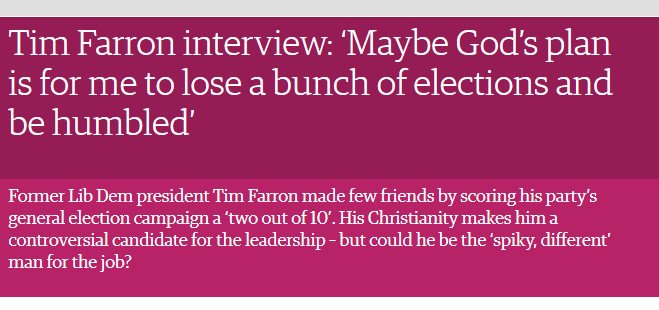
Today there is a new interview with Tim Farron that has been published and it bears some reflection. Tim is likely to be elected as the Leader of the Liberal Democrats over the next couple of weeks. It is a car crash of an interview and heralds the fact that the decimation of the liberal cause in British political life is not yet complete. Its likely new leader seems intent on finishing off a liberal tradition that is already gasping for breath.
First we’ve the headline: “Maybe God’s plan is for me to lose a bunch of elections and be humbled”
Then we’ve the content which shows that the headline is lifted out of a quote of jaw-dropping stupidity both politically and theologically.
Farron believes that everyone will go to either heaven or hell. “I think the Bible is clear. Everybody has something coming after.” As a non-believer, will I go to hell? “Well, it’s not for me to make that judgement. It’s a real cop-out, this one, but Abraham says: ‘Will not the judge of all things do right?’ And at the end, no one will disagree with the justice of what God has done.”
I ask if he consulted God when considering whether to stand for the party leadership. “Of course you do, of course you do. Obviously you ask for His guidance.” Does he think God has a plan for him? “I think He has a plan for everybody.” I’m not sure what that means. “Well, God is sovereign. Dreadful things happen in this world, but that reminds us that we need a saviour. I don’t go round fixating that God has some major plan for me. Maybe his plan is for me to lose a bunch of elections and be humbled. God’s plan could be that some pretty brutal things happen to you. But the one thing I fall back on is that God’s overall plan is good.”
One wonders where to begin. It seems to me that what we’ve got from Tim Farron here is bad politics and even worse theology.
Let us presume for a moment that God is in the business of direct meddling in human politics. (I don’t think that God is in that business, but let us presume that it is true). Might we not think that God in her wisdom might have more on her mind than whether Tim Farron or someone else leads a political party which is likely to be locked out of power for years? We might also draw breath at the idea that if God wants Farron to lose a bunch of elections and be humbled then “God’s plan” might be for the Tories to be in power. Is someone really as capable of giving such a crass quote to the newspapers really going to lead a political party in the UK?
Incidentally, the “Will not the judge of all things do right?” quote comes from Genesis Chapter 18 and Tim Farron seems to have been reading the Living Bible paraphrase. What you need to know is this – it comes straight out of the Sodom and Gomorrah story. It is interesting that given the controversy surrounding Tim Farron’s voting record on gay rights that he lifts a quote from scripture right out of that particular ancient saga. It is also interesting that he chooses a portion of scripture where many liberals reading it might well say that the human being (Abraham) in the story had a more secure grasp of justice, righteousness, compassion and fairness than the God depicted there, who is indeed said to rain down arbitrary terror upon people.
A lot of the trouble here comes from the idea that God has an overall plan. Tim Farron believes it but I don’t – or at least not in that way. If God has a plan then it is not unreasonable to ask why God is hanging about and not implementing it more quickly than God does. Providence gives us a God to blame for the way things are rather than giving us a prompt to take responsibility as autonomous subjects both for being honest about our past and in driving the future forward towards justice.
I tend to believe much more in vocation than in providence. I’d be happy to hear from any political leader about how their religious views (Christian, Muslim Buddhist, Atheist or whatever) give them a drive to bring about a better world. I believe in people being in touch with an inner calling to put the world to rights.
However, I’m very suspicious of people believing God to be on their side and believing that they are in the business of implementing God’s plan for the world.
Tim Farron seems to me to be unfit to lead the Liberal Democrat party and I say that as one of the very few who predicted the near wipe-out of Liberal Democrat seats that took place at the General Election.
I’ve been troubled by the attitude of Lib Dem friends to his voting record on LGBT issues. Farron famously voted in favour of giving registrars the “right” to opt out of dealing with gay couples. This has been dismissed as a side issue by Tim’s supporters. The trouble is, these are not side issues, these are my rights.
The election of Tim Farron will show that the party has learned nothing at all from the Tuition Fees debacle. At the time of that disaster, the party chose pragmatism over party policy. Choosing cheeky-chappy Tim Farron as leader because he has a good record in winning elections despite the fact that he has an illiberal voting record on key touchstone issues seems to me to be remarkably similar.
The trouble is, choosing good policy over pragmatism is exactly what liberalism actually is.


Leave a Reply