
• Every Eucharist is a Virtual Eucharist

    Heaven

    Every Eucharist is a virtual Eucharist. Of course it is.

    We know this.

    We experience this.

    We forget this.

    Christianity – at least the bits of Christianity that are worth taking seriously – takes time and space so seriously that it knows that the particular cannot ever express the ultimate. Indeed, time and space are playthings in the hands of the religiously inspired.

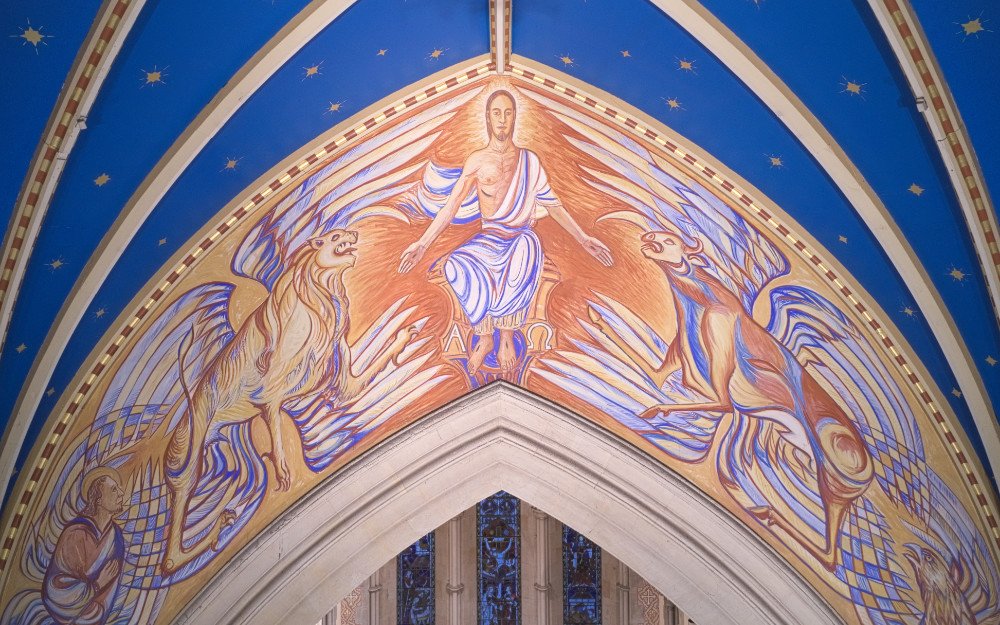
    Over the last few months it hasn’t been possible for my congregation to celebrate the Eucharist together in one space. But when we used to do that, we were never entirely in one space anyway. The very building itself is designed to transport people from the knowledge that they are a few yards from a busy thoroughfare in the Second City of Empire. Taking a few steps inside we find that we are in another place altogether. And in another empire, where the Emperor is servant of all and love is the essense of the law. The conceit that going into church takes you into a divine, heavenly realm is not an idea exclusive to the East. Coming into St Mary’s you are supposed to feel that you are stepping into heaven. It has been built to make you feel that. It has been decorated to make you feel that.  It does make people feel that.

    Whenever I take people into church I almost always hear them express a sense of wonder. We have the wow factor. It has been created by human skill to make you feel that the reality that you experience as you stand in the street is not the only reality that you can experience. It is a space that conveys that love, joy and peace might be possible and it does that without words. It is done with beauty and it takes people a few steps up the stairway to heaven.

    And it is the church playing with reality.

    That experience of going into a holy space and feeling part of something bigger is something common to religions that are divided on all kinds of doctrinal matters. It points to things that are best expressed through virtual reality and religious people are so used to virtual reality that they sometimes forget that it is all around them.

    When people come to the Eucharist in St Mary’s they are at once in Glasgow and simultaneously elsewhere. And elsewhere isn’t even singular either. At the Eucharist in Glasgow we are at one and the same time in an Upper Room in Jerusalem rather a long time ago and at the Wedding Feast of the Lamb at the ultimate consumation of all that is. The Last Supper and the Breakfast at the End of the Universe happen at the same table. At the same time.

    And as we gather at our table, we gather at every table and eat in communion with those who share in the same meal. Our fellowship with them isn’t prevented by circumstance. Our Eucharistic fellowship has never been prevented by circumstance or lack of physical proximity.

    We couldn’t keep the Triduum in Holy Week without virtual reality.

    Without virtual reality it would just be a way of making feet smell less.

    Without virtual reality it would just be a bonfire that would die.

    Christ is the celebrant at every Eucharist no matter which particular celebrant is standing there. Virtual reality becomes interwoven with the reality of the lives that we bring to the table and we are formed and changed and made new. It is how God’s love is expressed.

    This is virtual reality. Every Eucharist is a Virtual Eucharist. Cyberspace is one of the most powerful metaphors for prayer that human beings may ever develop.

    Our bodies are bound by physics.

    God’s love in this world isn’t.

    This is why religious buildings are important. It is also why they are not important.

    Every Eucharist is a Virtual Eucharist.

    Every Eucharist always was a Virtual Eucharist.

    Of course it was.

8 responses to “Questions for Ordinands #2”

  1.  Avatar
    Kelvin

    Re: Questions for Ordinands #2
    But what is a cyberspace?

  2.  Avatar
    Anonymous

    Re: Questions for Ordinands #2
    “Unlike most computer terms, “cyberspace” does not have a standard, objective definition. Instead, it is generally used to describe the virtual world of computers. For example, an object in cyberspace is a block of data floating around on some computer system or network. With the advent of the Internet, cyberspace is now also used to refer to the global network of computers. So, after sending an e-mail to your friend, you could say you sent the message to her through cyberspace. However, use this term sparingly, as it is a popular newbie term and is already well overused.”

    A term coined by William Gibson in his SF novel Neuromancer (1984) to describe the interconnected “world” of computers and the society that gathers around them.

  3.  Avatar
    Kelvin

    Re: Questions for Ordinands #2
    Was it not coined in his short story “Burning Chrome” in 1982?

    Anyway, the original question implies a knowledge of “cyberspace”. Or are we supposed to compare the uncertain definition of the term with the concept of prayer?

  4.  Avatar
    Anonymous

    Re: Questions for Ordinands #2
    I never thought this question would become so literary.

    In Burning Chrome, I think that Gibson actually says:

    “It was hot, the night we burned Chrome. Out in the malls and plazas, moths were batting themselves to death against the neon, but in Bobby’s loft the only light came from a monitor screen and the green and red LEDs on the face of the matrix simulator. I knew every chip in Bobby’s simulator by heart; it looked like your workaday Ono-Sendai VII. the “Cyberspace Seven,” but I’d rebuilt it so many time that you’d have had a hard time finding a square millimeter of factory cir- cuitry in all that silicon.”

    My own feeling is that the use of the word cyberspace in this context does not in fact imply the meaning of cyberspace that we have come to recognise subsequently.

    As a working definition, to bring us back to the prayer question, perhaps we could agree that a cyberspace is a venue for virtual reality.

  5.  Avatar
    Kelvin

    Re: Questions for Ordinands #2

    “Prayer is a venue for virtual reality”?

    There is a lot of discussion in that, agreed.

    Interestingly, before Gibson's use of “cyberspace”, the term “cybernetics” was in common usage. It originally referred inter alia to the comparisons which could be made between man made “intelligences” (computers and machines) and biological systems. I believe this derives from the Greek verb kubernan, to steer or control. Some philosophers refer to cyberspace in anthropological terms. With regard to the original question, I suspect an answer can o­nly be relativistic.

  6.  Avatar
    Anonymous

    Re: Questions for Ordinands #2
    I agree that it might be so that an answer can only be relativistic. However, I suspect that many people would prefer to say that an answer to this question can only be relational.

  7.  Avatar
    Kelvin

    Re: Questions for Ordinands #2
    Perhaps we can agree that those who prefer to think of it as relational have some form of “faith”.

    It is probably on a practical basis very similar to people who rely on email or textual communication and relationships for part of their social interaction, which is one area where the original question can lead us to (those communications constituting “cyberspace” relationships). The difficulty with the analopgy is that without faith these cyberspace interactions can allow us to destroy relationships if not used carefully and judiciously. With prayer, one is guided by faith to realise that any inadvertant misunderstanding will be forgiven. This is not the case in cyberspace.

  8.  Avatar
    Kelvin

    Re: Questions for Ordinands #2
    What?

Leave a Reply

Your email address will not be published. Required fields are marked *

Previous Posts

  • Generous Episcopacy: The Rt Rev Michael Hare Duke RIP

    I gather from a twitter correspondent that the Rt Rev Michael Hare Duke has died. Bishop Michael was the bishop with whom I first tested my vocation. Having been a bishop since 1969, he saw and influenced the entire modern story of the Scottish Episcopal Church. Where to begin with memories? The time I sat…

  • The Peace and Unity and Order of the Church

    One of the things that I’ve occasionally raised in blog posts is the question of whose responsibility it is to promote the unity of the church. I think this was focused for me particularly at the consecration of the Bishop of St Andrews, Dunkeld and Dunblane just over 9 years ago when the preacher preached…

  • New Statement from College of Bishops

    There’s a new statement from the College of Bishops today about same-sex marriage. It can, and should, be read in full – see here: College of Bishops Guidance re Marriage 2014 I’m appalled by its contents and in particular appalled at the way the Bishops of the Scottish Episcopal Church are treating gay clergy and…