
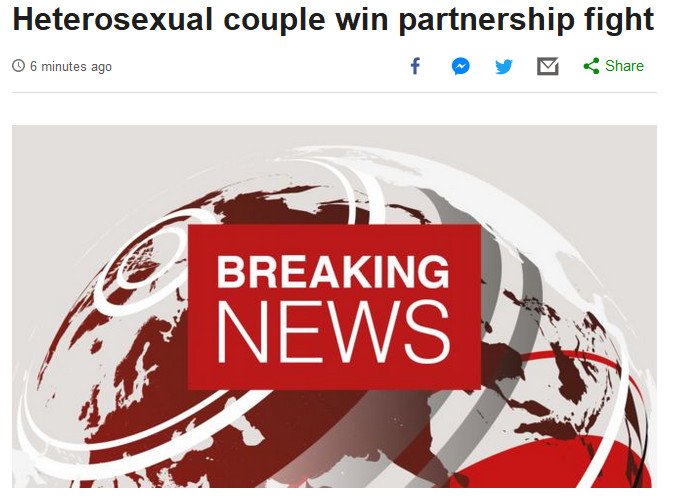
 It has just been announced that a man and a woman have won their fight to enable them to register a Civil Partnership.
At first sight, it will seem only just and right to most people. If same-sex couples can enter either a marriage or a civil partnership then why shouldn’t an opposite-sex couple?
Put like that, it is a matter of simple justice and it is unsurprising that the Supreme Court has found as it has done.
However, if I’m honest, though I believe that same-sex couples and opposite-sex couples should be treated in the same way, I don’t think that this was the best solution.
It seems to me now to be inevitable that we will have two statuses of partnership open to all couples – marriage and civil partnership. One gives fewer benefits than the other. Get married and you are far more likely to be treated as married when you travel than if you enter into a civil partnership. The benefits here in the UK are almost exactly the same. (I use the word almost even though I can’t now think of any differences at all apart from the name and the manner in which one can enter a civil partnership). The benefits when travelling the world will differ significantly. We fought for same-sex couples to be able to access marriage which conveys more benefits whilst now an opposite sex couple has fought for the right to be treated less well than married people.
Why people would want to fight to be legally partnered in a system which was once discriminatory to gay couples is complex but it usually is justified by the phrase “Well, Civil Partnership doesn’t carry the patriarchal baggage of marriage”.
Those who make this claim are denying all the work done over the last century to remove the patriarchal baggage around marriage. They are claiming that marriage hasn’t changed and are denying reality.
Personally, I would have preferred the Civil Partnership system to have come to an end once same-sex couples were allowed to get married. I’d have allowed those in Civil Partnerships to remain in them but not allowed any new ones to be registered.
This opinion sometimes leads to loud howls of protest from people who think (entirely wrongly) that marriage is inherently a religious institution. Anyone thinking it to be so simply doesn’t comprehend either the law of the land nor the history of marriage. (Marriage was around before the church – no, really it was). This confusion is even promoted by the likes of the BBC which claimed today that “Civil Partnership is free of the religious connotations of marriage” as though entering marriage though a civil ceremony is a fraud.
The odd thing is that those who howl most loudly about this are people that I know to have rejoiced most loudly at the Irish marriage referendum which resulted in the Irish state doing exactly what I’d have wished for here – closing the Civil Partnership system and allowing all couples access to marriage.
I suspect that “the patriarchal baggage of marriage” is in fact a euphemism for stigma about divorce, which a good many righteous people have made worse over the years. (Yes, you know exactly to whom I am referring). And anyway, whilst we can argue about whether marriage carries patriarchal baggage there’s no argument about civil partnerships – they very certainly carry the baggage of inequality and oppression.
I think it may still be legally possible for the governments within the UK to resolve this as I’d have hoped it to be resolved though I suspect that the momentum is with so-called “straight civil partnerships” now and politically their creation is inevitable.
But never mind what I think, what about the churches?
Interestingly, there was a proposal put forward to the Scottish Episcopal Church to allow Civil Partnerships (between same-sex couples) to be registered in churches. A number of us argued successfully against this in the General Synod three years ago, to the considerable surprise of some liberal friends who just presumed that the gays wanted everything offered to them. Th gays, so to speak, could see this coming over the horizon and had a fair idea that the church would end up in a terrible mess if we proceeded in that way. Firstly it would have lessened the case for allowing the marriage of same-sex couples in the Scottish Episcopal Church and secondly it would have led sooner or later to decisions about whether or not to allow opposite sex couples to do something in church that looked like marriage but which wasn’t marriage. And so, I joined others in arguing against it and that vote was comprehensively lost.
(As a side note, it is worth remembering that if those who might be characterised as being opponents of same-sex marriage had come forward with support for civil partnerships in church 10 years ago then I’d probably have bitten their hands off and I don’t think we would be anywhere near marrying same-sex couples now).
But back to the churches.
Where now for those who thought that Civil Partnership was a tidy hiding hole for the unfortunate people who feel the need to enter into gay coupledom who are not really fully human but can’t really help themselves? (The Church of England, I’m talking about you, though not you alone). Seems to me that this judgement puts you even deeper into the mire.
Here are the obvious questions:
- Will a man and a woman remain in good standing with a church if they enter a Civil Partnership?
- In the Church of England will they remain in good standing only if they enter into a Civil Partnership but promise their bishop they won’t have sex?
- Will anyone in a Civil Partnership be able to become ordained without the need of getting married?
- Can a bishop (or archbishop) be in a Civil Partnership only if he or she is part of a same-sex couple?
- How long will it be before there are liturgical resources for recognising Civil Partnerships in churches?
- Will pro-gay campaigners, particularly in the Church of England now realise the absurdity of campaigning for anything that falls short of marriage?
- Will those advocating the church recognise Civil Partnership continue to do so now if it is open to opposite sex couples?
- What is the difference between a Civil Partnership and a Marriage?
- Do the churches care about the fact that the number of marriages will now inevitably decline?
- Will the churches see marriage as a better institution for opposite-sex couples than Civil Partnership and what will this say about their current and previous policy towards God’s beloved gay children?
- Which churches will regard children born in a civil partnership differently from children born in a marriage?
- Will this lead to greater equality in churches or less equality in churches?
- Is the Church of England going to find itself in the absurd position of supporting Civil Partnerships for opposite sex couples in order to retain them for same-sex couples so as to deny marriage to same-sex couples? And what will the Global South make of that?
Leave a Reply