
• All Souls

    All Souls Day is a rehearsal for my own funeral.

    I realised this a few years ago when someone commented that the All Souls Requiem at St Mary’s seemed to be a particularly important time of the year and was appealing to more people than it used to. When I sat and thought about it, I realised that what I was doing each year in preparing for it was preparing for my own funeral and that at some level, part of what gives me life and energy at St Mary’s is building a community that would know exactly what to do if I dropped down dead.

    Some people might think that rather morbid but it isn’t. I don’t think that much about death. Keeping All Souls is actually a way of helping ourselves let the dead be dead without fixating constantly about them. After last night’s Requiem for All Souls it simply felt to me that all was as it should be. Those whom we care for had been commended to God’s love, we had prayed alongside one another in our remembering and we had done so in the most beautiful way we could do.

    There are many things about All Souls which touch me. One is the use of the Eucharistic prayer for Easter. That’s what we do whenever there’s a funeral that is a Eucharist too. When someone dies there’s a snatch of Easter Day about the proceedings. In the first light of Easter, glory broke from the tomb, after all.

    Last night’s requiem was sublime. The simple tunes of Rutter’s Requiem taking us on a pastoral journey. We saw that death is real. We saw that grief is raw. And we knew that God is love. The music was incredible – the choir literally singing to raise the dead.

    At least, that’s how it was for me.

    The double Feast of All Saints and All Souls is one that always takes my mind abroad too. I was in Sweden for it one year, the year before I was ordained. My memory is of people going to the graveyards and lighting candles on the graves. A little of the first snow of winter had fallen and there was mist swirling around the graveyard trees as people wandered the quiet pathways thinking about those who had died.

    I remember someone telling me that they always lit candles for their parents and then crossed the graveyard to light another one on the grave of Dag Hammarskjöld – All Saints and All Souls always mingle.

    And then three years ago I was in America at this time of year.

    It seems to me that Hallowe’en has suffered rather at lot in its return trip back across the Atlantic to these shores. It seems now to be an excuse for very poor fancy dress bought from cheap outfitters by people who want to get drunk looking like a pirate or Wonderwoman.

    Rather more interesting in the US these days is the set of traditions that the Latino people bring to this time of year. Some of the solemnity that northern Europeans cultivate when thinking about the dead is challenged by those who want to celebrate their dead with an enormous party.

    This is what this time of year looks like in one of the churches that I visited during my sabbatical – All Saints’ Church in Chicago – a place which knows how to party.
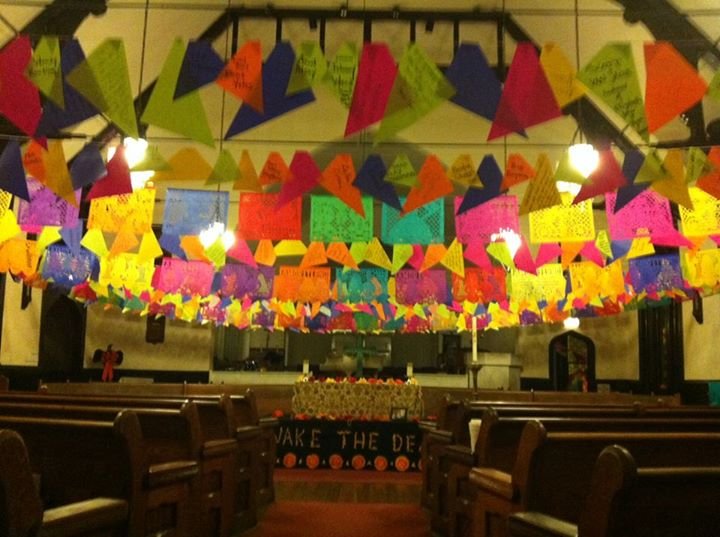
    All Saints Chicago

    In the midst of life we are in death.

    And vice versa.

11 responses to “We should be wary of declaring martyrs”

  1. Eamonn Avatar

    Agree totally. I find myself in a comparable position vis-à-vis the mass canonisations of the ‘martyrs’ of the Spanish Civil War, which assume that all those worthy of commemoration were on the same side.

  2. Michael Russell Avatar

    Anyone killed for professing their faith is a martyr. ISIS is an equal opportunity martyring machine. The various faith communities targeted, including Islamic ones, should build common ground to dismember ISIS. I simply fail to see the point in quibbling about who is a real martyr and who is not.

    1. Kelvin Avatar

      Is it your view that someone is a martyr for Christianity because they cannot recite a verse from the Qur’an?

      It seems to me that whilst some men and women of violence are being claimed to be martyrs if they should be shot by law enforcement agencies whilst pursuing paths of terror that there’s a huge amount to be gained by determining who is a martyr and who isn’t.

      1. Bro David Avatar
        Bro David

        Not being able to explain a quranic verse was merely a way of discerning if someone was not Muslim. However, is it not just as great a presumption to think they weren’t martyrs, as to think that they were.

        The early church seemed to accept that all who were crucified or sent to the lions for their Christianity were martyrs. Perhaps not all did so as a statement of faith, but were nominal Christians caught up with the rest. But the church didn’t seem obliged to footnote who didn’t qualify.

        I’m not sure that I understand why your are hesitant. It seems a quibble. I don’t think anyone is leaning toward canonization here, just speaking of them as a whole.

  3. Jo Avatar
    Jo

    The SEC still keeps the feast of Charles, King and Martyr. I don’t think we get to be too narrow in defining who is or isn’t a martyr.

    1. Kelvin Avatar

      Actually, Jo – that’s not quite right. The SEC keeps the commemoration of “Charles I, King, 1649”

      There’s no mention of him being a martyr in the calendar (and the current calendar superseded and replaced the one in the prayer book). There are plenty of people who are named as martyrs such as Agnes the week before Charles or indeed “Charles Mackenzie of Central Africa, Bishop, Missionary, Martyr, 1862” the very day after Charles.

      It would appear that rather careful thought was given to whether to describe Charles as a martyr and though he is included in the calendar (not least for founding one of our dioceses) any notion of martyrdom is absent.

      1. Jo Avatar
        Jo

        Thanks for the correction, I hadn’t realised there was that detail of difference between the SEC and CofE.

  4. Father David Avatar
    Father David

    Of course, King Charles was a Martyr and is commemorated as such on January 31st each year. The trouble is that Anglicans have no real mechanism for declaring people to be saints or martyrs. Having referred to two recent horrific incidents on the African continent where Christians were slaughtered simply for being Christians, I wonder what the Provost of Glasgow thinks about the Ugandan Martyrs of the 19th century and would you personally regard them to be martyrs? As you know 23 Anglicans and 22 Roman Catholics were killed by the Kabaka for refusing to submit to King Mwanga’s corporal intimacies. The Roman Catholics were beatified in 1920 and canonised in 1964 but what of our Anglican Ugandan brothers – where they equally to be regarded as martyrs, or would you deny them that honorific title?

    1. Kelvin Avatar

      The Scottish Episcopal Calendar is again very clear: “Charles Lwanga and his companions, 1886, Janani Luwum, Bishop, 1977, Martyrs of Uganda”

      I have no idea why anyone would say that the SEC has no means of declaring someone to be a martyr. Not only do we have such a mechanism, we use it.

  5. Father David Avatar
    Father David

    It would be interesting to know how this mechanism works in the SEC in deciding who is eligible to join the noble army of martyrs? Bishop Edward King of Lincoln is widely regarded as a saint South of the Border. I think it was Archbishop Lang who was asked how it was decided that Bishop King had reached sainthood status and the answer was that he was given a Collect, Epistle and Gospel to commemorate his saint’s day – 8th March, the day of his Heavenly Birthday.

  6. Harry Campbell Avatar
    Harry Campbell

    “We strongly condemn such atrocities, whether they are Ethiopians are not,” the Ethiopian communications minister Redwan Hussein told AFP.
    http://www.theguardian.com/world/2015/apr/19/isis-video-purports-to-show-massacre-of-two-groups-of-ethiopian-christians

    What a shame the Archbishop couldn’t have said something similarly inclusive about the victims of the Kenyan massacre, and all such massacres, without caring about what their religion affiliation may or may not have been.

Leave a Reply

Your email address will not be published. Required fields are marked *

Previous Posts

  • Friendly and Welcoming Churches in Edinburgh

    Time for a quick round-up of churches which welcome and affirm gay folk over in Edinburgh. I made a plea for information last week which was forthcoming, so it is only fair to list the results. Old St Paul’s has a statement on the page of its XYmonday group which says it is “inclusive group…

  • Human Rights Petition

    There is a growing and unfortunate clamour for a roll-back on human rights commitments. These included some unfortunate comments from the Prime Minister over the weekend to the effect that he thought that human rights legislation had gone too far. Personally I don’t think it has gone nearly far enough. One of the major goals…

  • Gifts and Skills

    One of the themes that I'm wanting to pick up on at St Mary's if that of Gifts and Skills. We're hoping to be running some kind of course or retreat or series of workshops in the autumn which focus on the idea of discerning your gifts and skills. The sermon this morning that Akma…

  • Are there any gay friendly Episcopal churches in Edinburgh?

    Someone said something to me earlier this week which quite shocked me. They said there was no Episcopal congregation in Edinburgh which was welcoming to LGBT people. By this, they did not mean that there was an absence of any Episcopal congregations with happy gay people in them. That is clearly not so. The question…