
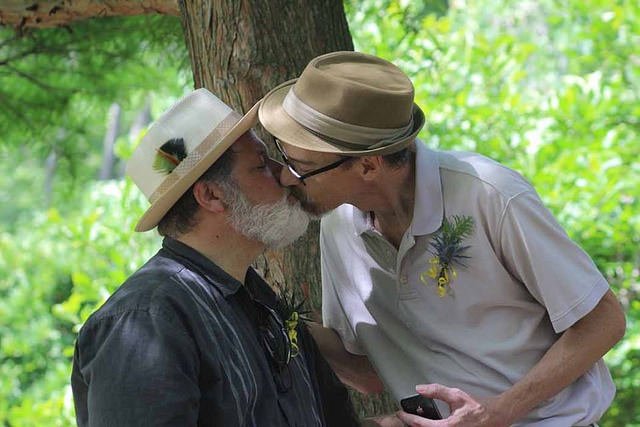
• A kiss is just a kiss

    14574900326_a18671621b_z

    Can it really be that many are happier to see a gay couple marry than give one another a kiss?

    Someone asked me recently whether the time had come to stop campaigning on LGBT issues. After all, he said, the gays have got everything they want now. They can get married and everything.

    Well, leaving aside that the fact that “the gays” can’t get married in Scotland for another month or so and that when they can do so they will not be able to be married according to the same protocols as “the straights”, marriage in church not being an option for most same-sex couples initially, the truth is, the marriage debate is not the end of gay rights but the start of them moving into the mainstream.

    The incredible thing about the campaign to open marriage to same-sex couples is that it wasn’t just same-sex couples who pressed for it to happen. It was a grand coalition of diverse folk – interested people like parents who have gay children, brothers and sisters, workmates and friends as well as gay folk, including gay folk who have no personal interest in marriage for themselves. But it was more than this too – it was a coalition of people who didn’t need to claim a direct interest in the debate. It was a coalition of those who thought that in a modern society the gender of the two people involved is of secondary significance to their love, their hopes for permanence, their promises of fidelity and so on.

    In short, it was a coalition of the decent.

    Now, that kind of statement gets me into trouble. “How can you say that those who were opposed to this are not decent people? Are they not good people, upright people, moral people too? They just didn’t think this was right – how dare you say they are not decent people?”

    Well, the thing is, it isn’t me who is saying that – it represents the huge shift in public opinion that has happened. I’ve helped to shape those changes and am happy to continue to try to do so. Seeing the opinion polls shift so dramatically over the last 10 years is one of the most satisfying things that I’ve ever been involved in.

    What happened is that we changed common perceptions about the kind of values that decent people could be expected to hold.

    That’s why this is so hard for those who have not shifted much themselves. It must feel to them as thought they are on shifting sand. Moral judgements which once were those which good people could be expected to hold, became those which decent people were not expected to hold.

    For some this has been a wonderful seemless recognition that the rights and responsibilities of being human apply to gay and lesbian people just as much as to anyone else. For those outside the big tent it must feel as though something dear has been shattered and broken. I don’t underestimate that, but it isn’t going to get any easier because we’re not done yet.

    I was very struck this week in reading an opinion poll in the USA which indicated that there was strong support for changing the law to allow same-sex couples to get married. However, when the same people were asked what they thought of a gay couple kissing or holding hands in public the support somehow seemed to melt away. And there were different perceptions relating to gender too. It wasn’t so bad seeing women holding hands but gay men kissing in public was something that the decent still were not ready to see.

    Can it really be that it is OK for a couple to get married, with all the support of the expectations of the institution of marriage, but that those who support them still feel squeamish about seeing such a couple display their affection.

    I’ve a feeling this is an issue here.

    When I’m conducting the nuptials of couples here in St Mary’s, I always have a rehearsal and quite often we address the question of whether the couple is going to kiss during the ceremony and at what point. (I think they should do what they feel comfortable with).

    I’m aware that when I ask straight couples that question they can usually answer it easily. When I ask same-sex couples that question there is a big intake of breath as they think about giving their beloved a kiss in public.

    I very occasionally see a same-sex couple coming to church on a Sunday hand in hand. (I see opposite sex couples doing so often enough not to notice). It is worth remembering that there are perhaps only a few hundred yards of the streets of Scotland where they would consider themselves safe to do so and only at particular times. And that’s just holding hands, never mind a wee gay kiss.

    It would appear that we’ve a way to go yet before we get to the point where same-sex couples and opposite sex-couples are treated alike and can expect their affections to be regarded in the same way.

    The campaigning will change in months to come but it is far from over yet.

    I want a world where a kiss is just a kiss. And so much more too.

    [Picture Credit – Ron Frazier Creative Commons attribution license]

11 responses to “We should be wary of declaring martyrs”

  1. Eamonn Avatar

    Agree totally. I find myself in a comparable position vis-à-vis the mass canonisations of the ‘martyrs’ of the Spanish Civil War, which assume that all those worthy of commemoration were on the same side.

  2. Michael Russell Avatar

    Anyone killed for professing their faith is a martyr. ISIS is an equal opportunity martyring machine. The various faith communities targeted, including Islamic ones, should build common ground to dismember ISIS. I simply fail to see the point in quibbling about who is a real martyr and who is not.

    1. Kelvin Avatar

      Is it your view that someone is a martyr for Christianity because they cannot recite a verse from the Qur’an?

      It seems to me that whilst some men and women of violence are being claimed to be martyrs if they should be shot by law enforcement agencies whilst pursuing paths of terror that there’s a huge amount to be gained by determining who is a martyr and who isn’t.

      1. Bro David Avatar
        Bro David

        Not being able to explain a quranic verse was merely a way of discerning if someone was not Muslim. However, is it not just as great a presumption to think they weren’t martyrs, as to think that they were.

        The early church seemed to accept that all who were crucified or sent to the lions for their Christianity were martyrs. Perhaps not all did so as a statement of faith, but were nominal Christians caught up with the rest. But the church didn’t seem obliged to footnote who didn’t qualify.

        I’m not sure that I understand why your are hesitant. It seems a quibble. I don’t think anyone is leaning toward canonization here, just speaking of them as a whole.

  3. Jo Avatar
    Jo

    The SEC still keeps the feast of Charles, King and Martyr. I don’t think we get to be too narrow in defining who is or isn’t a martyr.

    1. Kelvin Avatar

      Actually, Jo – that’s not quite right. The SEC keeps the commemoration of “Charles I, King, 1649”

      There’s no mention of him being a martyr in the calendar (and the current calendar superseded and replaced the one in the prayer book). There are plenty of people who are named as martyrs such as Agnes the week before Charles or indeed “Charles Mackenzie of Central Africa, Bishop, Missionary, Martyr, 1862” the very day after Charles.

      It would appear that rather careful thought was given to whether to describe Charles as a martyr and though he is included in the calendar (not least for founding one of our dioceses) any notion of martyrdom is absent.

      1. Jo Avatar
        Jo

        Thanks for the correction, I hadn’t realised there was that detail of difference between the SEC and CofE.

  4. Father David Avatar
    Father David

    Of course, King Charles was a Martyr and is commemorated as such on January 31st each year. The trouble is that Anglicans have no real mechanism for declaring people to be saints or martyrs. Having referred to two recent horrific incidents on the African continent where Christians were slaughtered simply for being Christians, I wonder what the Provost of Glasgow thinks about the Ugandan Martyrs of the 19th century and would you personally regard them to be martyrs? As you know 23 Anglicans and 22 Roman Catholics were killed by the Kabaka for refusing to submit to King Mwanga’s corporal intimacies. The Roman Catholics were beatified in 1920 and canonised in 1964 but what of our Anglican Ugandan brothers – where they equally to be regarded as martyrs, or would you deny them that honorific title?

    1. Kelvin Avatar

      The Scottish Episcopal Calendar is again very clear: “Charles Lwanga and his companions, 1886, Janani Luwum, Bishop, 1977, Martyrs of Uganda”

      I have no idea why anyone would say that the SEC has no means of declaring someone to be a martyr. Not only do we have such a mechanism, we use it.

  5. Father David Avatar
    Father David

    It would be interesting to know how this mechanism works in the SEC in deciding who is eligible to join the noble army of martyrs? Bishop Edward King of Lincoln is widely regarded as a saint South of the Border. I think it was Archbishop Lang who was asked how it was decided that Bishop King had reached sainthood status and the answer was that he was given a Collect, Epistle and Gospel to commemorate his saint’s day – 8th March, the day of his Heavenly Birthday.

  6. Harry Campbell Avatar
    Harry Campbell

    “We strongly condemn such atrocities, whether they are Ethiopians are not,” the Ethiopian communications minister Redwan Hussein told AFP.
    http://www.theguardian.com/world/2015/apr/19/isis-video-purports-to-show-massacre-of-two-groups-of-ethiopian-christians

    What a shame the Archbishop couldn’t have said something similarly inclusive about the victims of the Kenyan massacre, and all such massacres, without caring about what their religion affiliation may or may not have been.

Leave a Reply

Your email address will not be published. Required fields are marked *

Previous Posts

  • Traffic Lights out

    Anyone coming to St Mary’s tomorrow might note that there are temporary traffic lights at the junction of Great Western Road and Napiershall Street. This has been causing some congestion today. Presumably it will not be as bad tomorrow, but forewarned is forearmed, or whatever the expression is.

  • Prayer for the Day – Script 6

    And here is the final one of the batch of Prayer for the Day scripts that have been going out on Radio 4 every day this week: Good Morning Someone asked me the other day what is the first memory that I have. I was able to tell them and to date it exactly. I’m…

  • Prayer for the Day – Script 5

    Here’s what I said to the nation this morning on Radio 4 at 0543: Good Morning It is fifty-one years ago today since the death of Cecil B DeMille – film producer extraordinaire, showman and master of monumental movie experiences. Cecil B DeMille was responsible for giving us epic expectations in the cinema and epic…

  • More on the election

    I note that that so-called “Christian Institute”, has a report on the Episcopal election. Apart from the fact that the headline seem unable to recognise the priesthood of (at least) one of the candidates, it begins, “The Scottish Episcopal Church has voted against electing Britain’s first female Bishop.” That statement is not true. The Scottish…