
• Can you backdate a marriage?

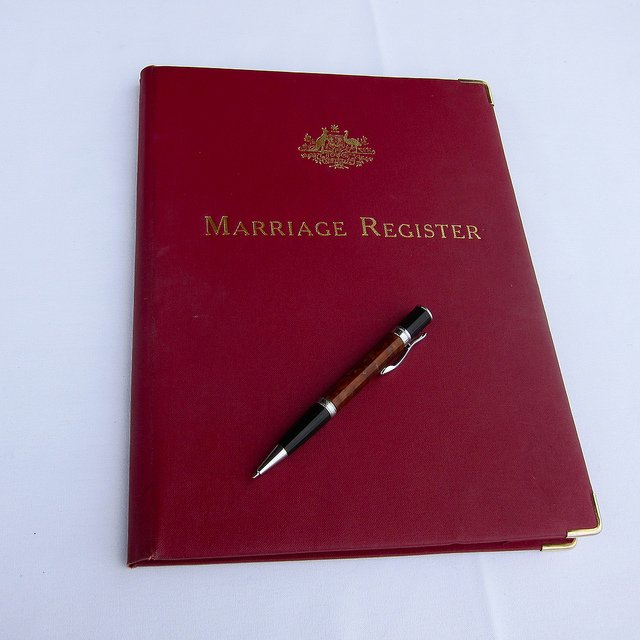
    Marriage Register

    How interesting to learn about the new rules that will govern couples in England and Wales who have been in a Civil Partnership who wish to change (upgrade?) their relationship status to a marriage.

    It seems that they are going to be able to do so easily and will receive a “backdated” marriage certificate which will state that their marriage began when they entered into their Civil Partnership.

    I’ve some reservations about this but I know it will be warmly welcomed by many and it would be churlish to oppose it.

    It is interesting though and there will be pressure now in Scotland for the Scottish Government to do the same.

    Here are some obvious issues.

    • It is quite odd to think that some might find themselves to have been married without their, at the time they entered into their marriage, believing that they wanted to be married.
    • People who have been blessing Civil Partnerships are going to find that they’ve been blessing marriages all along.
    • People will be able, I think, to find themselves married who never went through any ceremony at all – they may simply have signed the papers. (This is a new thing).
    • There’s no doubt going to be some grumpiness from those who trusted the politicians who said that Civil Partnerships were definately not marriages and that it had been invented in order to do something different to marriage.
    • In a sense, it is rewriting history. People are going to have marriage certificates that date from a time when they were not in fact married at all.
    • The Bishops of the Church of England in the House of Lords might feel that the Government has pulled the rug out from under them.
    • I think, that people can end up married whose proposal to marry has never been published either by banns on in a registrar’s office. I’ll be interested to see whether the registrars publish the names of those converting their status. My guess is that they won’t and thus people will end up married in law who have never had their intent to enter marriage advertised to anyone.
    • It is quite odd to think that a status like marriage can be backdated. Is there any comparable status that can be changed like that?

    Personally, I would have preferred the solution to be that people would get new full marriage certificates when they requested to change their relationship status into a marriage. I think this because I think that marriage ought to require a clear statement of consent at the time it is entered into. (Indeed, many of the rules surrounding marriage are about getting unambiguous consent from both parties, freely given).

    Interesting times. Uncomfortable times for the churches, particularly the Church of England.

    Photo Credit – Dale Gillard Copyright: Creative Commons Attribution-NonCommercial-ShareAlike 2.0 Generic (CC BY-NC-SA 2.0)


11 responses to “We should be wary of declaring martyrs”

  1. Eamonn Avatar

    Agree totally. I find myself in a comparable position vis-à-vis the mass canonisations of the ‘martyrs’ of the Spanish Civil War, which assume that all those worthy of commemoration were on the same side.

  2. Michael Russell Avatar

    Anyone killed for professing their faith is a martyr. ISIS is an equal opportunity martyring machine. The various faith communities targeted, including Islamic ones, should build common ground to dismember ISIS. I simply fail to see the point in quibbling about who is a real martyr and who is not.

    1. Kelvin Avatar

      Is it your view that someone is a martyr for Christianity because they cannot recite a verse from the Qur’an?

      It seems to me that whilst some men and women of violence are being claimed to be martyrs if they should be shot by law enforcement agencies whilst pursuing paths of terror that there’s a huge amount to be gained by determining who is a martyr and who isn’t.

      1. Bro David Avatar
        Bro David

        Not being able to explain a quranic verse was merely a way of discerning if someone was not Muslim. However, is it not just as great a presumption to think they weren’t martyrs, as to think that they were.

        The early church seemed to accept that all who were crucified or sent to the lions for their Christianity were martyrs. Perhaps not all did so as a statement of faith, but were nominal Christians caught up with the rest. But the church didn’t seem obliged to footnote who didn’t qualify.

        I’m not sure that I understand why your are hesitant. It seems a quibble. I don’t think anyone is leaning toward canonization here, just speaking of them as a whole.

  3. Jo Avatar
    Jo

    The SEC still keeps the feast of Charles, King and Martyr. I don’t think we get to be too narrow in defining who is or isn’t a martyr.

    1. Kelvin Avatar

      Actually, Jo – that’s not quite right. The SEC keeps the commemoration of “Charles I, King, 1649”

      There’s no mention of him being a martyr in the calendar (and the current calendar superseded and replaced the one in the prayer book). There are plenty of people who are named as martyrs such as Agnes the week before Charles or indeed “Charles Mackenzie of Central Africa, Bishop, Missionary, Martyr, 1862” the very day after Charles.

      It would appear that rather careful thought was given to whether to describe Charles as a martyr and though he is included in the calendar (not least for founding one of our dioceses) any notion of martyrdom is absent.

      1. Jo Avatar
        Jo

        Thanks for the correction, I hadn’t realised there was that detail of difference between the SEC and CofE.

  4. Father David Avatar
    Father David

    Of course, King Charles was a Martyr and is commemorated as such on January 31st each year. The trouble is that Anglicans have no real mechanism for declaring people to be saints or martyrs. Having referred to two recent horrific incidents on the African continent where Christians were slaughtered simply for being Christians, I wonder what the Provost of Glasgow thinks about the Ugandan Martyrs of the 19th century and would you personally regard them to be martyrs? As you know 23 Anglicans and 22 Roman Catholics were killed by the Kabaka for refusing to submit to King Mwanga’s corporal intimacies. The Roman Catholics were beatified in 1920 and canonised in 1964 but what of our Anglican Ugandan brothers – where they equally to be regarded as martyrs, or would you deny them that honorific title?

    1. Kelvin Avatar

      The Scottish Episcopal Calendar is again very clear: “Charles Lwanga and his companions, 1886, Janani Luwum, Bishop, 1977, Martyrs of Uganda”

      I have no idea why anyone would say that the SEC has no means of declaring someone to be a martyr. Not only do we have such a mechanism, we use it.

  5. Father David Avatar
    Father David

    It would be interesting to know how this mechanism works in the SEC in deciding who is eligible to join the noble army of martyrs? Bishop Edward King of Lincoln is widely regarded as a saint South of the Border. I think it was Archbishop Lang who was asked how it was decided that Bishop King had reached sainthood status and the answer was that he was given a Collect, Epistle and Gospel to commemorate his saint’s day – 8th March, the day of his Heavenly Birthday.

  6. Harry Campbell Avatar
    Harry Campbell

    “We strongly condemn such atrocities, whether they are Ethiopians are not,” the Ethiopian communications minister Redwan Hussein told AFP.
    http://www.theguardian.com/world/2015/apr/19/isis-video-purports-to-show-massacre-of-two-groups-of-ethiopian-christians

    What a shame the Archbishop couldn’t have said something similarly inclusive about the victims of the Kenyan massacre, and all such massacres, without caring about what their religion affiliation may or may not have been.

Leave a Reply

Your email address will not be published. Required fields are marked *

Previous Posts

  • Sermon – 11 October 2009 – Job

    Here is this morning’s sermon. There is a short hiatus near the beginning whilst microphones were sorted out. Fortunately one member of the congregation decided that she did want to hear me preach rather than just see me preach and waved her arms until it was sorted out. Many thanks Peggy. In the name of…

  • Sermon for St Francis 4 October 2009

    Here is the sermon preached yesterday for St Francis That Gospel reading is our jumping off point this week because it was a jumping off point for St Francis himself. It was on hearing this gospel that his manner of life was changed. He heard it and believed it was a call directly to him…

  • Here is a sermon I prepared earlier

    Preached in St Mary’s on 6 September 2009. I can’t remember why I didn’t put it online ealier. This morning I want to talk about the Syrophoenician woman whom we have just heard about in the gospel reading. This woman, whose name is unknown, is an intriguing character. She was an outsider for a number…

  • Twenty Years On

    It is funny how anniversaries creep up on you. It is twenty years ago this week since I went to read theology at the University of St Andrews. I can remember Freshers’ Week very clearly all these years later. Inevitably, some of those whom I met in the first few days there, I have lost…