
• Husbands and Wifes

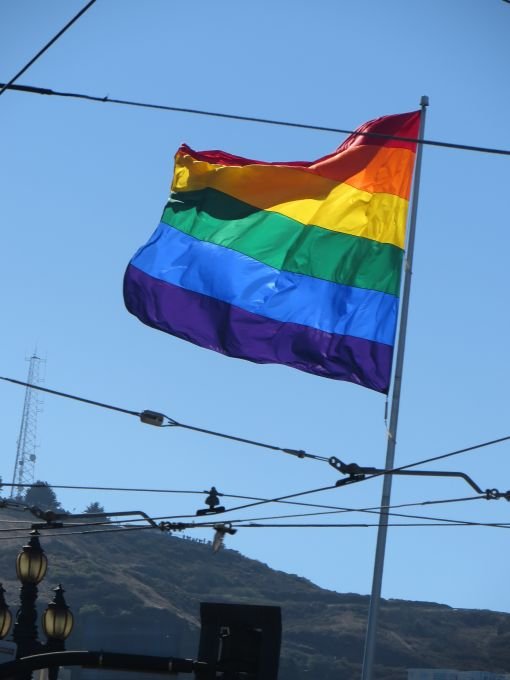
    flag over castro

    Yesterday I heard the news that the House of Lords has given a third reading to the new legislation which will allow gay couples to get married in England and Wales. It should get the nod from the House of Commons today and then go to the Queen for Royal Assent by the end of the week. The first marriages under this legislation will take place sometime next year once registrars have been re-trained and new forms printed.

    I expect we will have a period where all kinds of other institutions will have to re-write their forms and policies too. One can imagine married same-sex couples getting grumpy when they try to fill in an insurance form or try to join a social network and they are offered wife or husband when they want to be offered a box to tick for the opposite.

    It is only fairly recently that I’ve heard same-sex couples who were married speaking freely of their husband or wife. We have one same-sex couple connected to St Mary’s who are married, having been hitched in South Africa. When I was in Canada and the USA I was hearing the use of husband by some married gay men and wife by some of the lesbian couples I met. It was by no means universal but it was becoming common and rather ordinary though no doubt that takes a little time.

    Part of me remembers that I once was against same-sex marriage and that it was partly because I thought that gender-neutrality had something to offer. Were gay couples not leading the world by insisting on having partners rather than the somewhat possessive alternative nouns?

    I think I was wrong about that. What was needed was equality and some people need to use just such possessive language to describe their relationships in the same way that straight married couples sometimes reject it and use the partner language.

    Inevitably there is now going to be a period of reflection and consultation whilst the government tries to decide whether to open Civil Partnership up to straight couples. I expect that will happen though I’m not that keen. It seems to me that the right way forward was simply to incorporate Civil Partnership with Civil Marriage. However, I suspect that though I’ve been on the winning side of most arguments about changes in marriage law, that is not one that I’m likely to win now.

    Very many churches have proclaimed themselves to be against same-sex marriage as it will somehow undermine and threaten the institution of marriage itself.

    I don’t think that is true. I do think that retaining Civil Partnership and opening it up to straight couples does undermine the institution of marriage though. Had the churches engaged in these arguments in more constructive ways than most of them did then they might have had an influence which strengthened marriage. Instead, I suspect that in the long term they will have weakened it.

    Still, we’ll not worry about that today. We will simply fly a rainbow flag in celebration for all those soon to be married couples in England and Wales. And recognise that the last battles still have to be won in Scotland.

    Alleluia for England!

    And once more unto the breach.

11 responses to “We should be wary of declaring martyrs”

  1. Eamonn Avatar

    Agree totally. I find myself in a comparable position vis-à-vis the mass canonisations of the ‘martyrs’ of the Spanish Civil War, which assume that all those worthy of commemoration were on the same side.

  2. Michael Russell Avatar

    Anyone killed for professing their faith is a martyr. ISIS is an equal opportunity martyring machine. The various faith communities targeted, including Islamic ones, should build common ground to dismember ISIS. I simply fail to see the point in quibbling about who is a real martyr and who is not.

    1. Kelvin Avatar

      Is it your view that someone is a martyr for Christianity because they cannot recite a verse from the Qur’an?

      It seems to me that whilst some men and women of violence are being claimed to be martyrs if they should be shot by law enforcement agencies whilst pursuing paths of terror that there’s a huge amount to be gained by determining who is a martyr and who isn’t.

      1. Bro David Avatar
        Bro David

        Not being able to explain a quranic verse was merely a way of discerning if someone was not Muslim. However, is it not just as great a presumption to think they weren’t martyrs, as to think that they were.

        The early church seemed to accept that all who were crucified or sent to the lions for their Christianity were martyrs. Perhaps not all did so as a statement of faith, but were nominal Christians caught up with the rest. But the church didn’t seem obliged to footnote who didn’t qualify.

        I’m not sure that I understand why your are hesitant. It seems a quibble. I don’t think anyone is leaning toward canonization here, just speaking of them as a whole.

  3. Jo Avatar
    Jo

    The SEC still keeps the feast of Charles, King and Martyr. I don’t think we get to be too narrow in defining who is or isn’t a martyr.

    1. Kelvin Avatar

      Actually, Jo – that’s not quite right. The SEC keeps the commemoration of “Charles I, King, 1649”

      There’s no mention of him being a martyr in the calendar (and the current calendar superseded and replaced the one in the prayer book). There are plenty of people who are named as martyrs such as Agnes the week before Charles or indeed “Charles Mackenzie of Central Africa, Bishop, Missionary, Martyr, 1862” the very day after Charles.

      It would appear that rather careful thought was given to whether to describe Charles as a martyr and though he is included in the calendar (not least for founding one of our dioceses) any notion of martyrdom is absent.

      1. Jo Avatar
        Jo

        Thanks for the correction, I hadn’t realised there was that detail of difference between the SEC and CofE.

  4. Father David Avatar
    Father David

    Of course, King Charles was a Martyr and is commemorated as such on January 31st each year. The trouble is that Anglicans have no real mechanism for declaring people to be saints or martyrs. Having referred to two recent horrific incidents on the African continent where Christians were slaughtered simply for being Christians, I wonder what the Provost of Glasgow thinks about the Ugandan Martyrs of the 19th century and would you personally regard them to be martyrs? As you know 23 Anglicans and 22 Roman Catholics were killed by the Kabaka for refusing to submit to King Mwanga’s corporal intimacies. The Roman Catholics were beatified in 1920 and canonised in 1964 but what of our Anglican Ugandan brothers – where they equally to be regarded as martyrs, or would you deny them that honorific title?

    1. Kelvin Avatar

      The Scottish Episcopal Calendar is again very clear: “Charles Lwanga and his companions, 1886, Janani Luwum, Bishop, 1977, Martyrs of Uganda”

      I have no idea why anyone would say that the SEC has no means of declaring someone to be a martyr. Not only do we have such a mechanism, we use it.

  5. Father David Avatar
    Father David

    It would be interesting to know how this mechanism works in the SEC in deciding who is eligible to join the noble army of martyrs? Bishop Edward King of Lincoln is widely regarded as a saint South of the Border. I think it was Archbishop Lang who was asked how it was decided that Bishop King had reached sainthood status and the answer was that he was given a Collect, Epistle and Gospel to commemorate his saint’s day – 8th March, the day of his Heavenly Birthday.

  6. Harry Campbell Avatar
    Harry Campbell

    “We strongly condemn such atrocities, whether they are Ethiopians are not,” the Ethiopian communications minister Redwan Hussein told AFP.
    http://www.theguardian.com/world/2015/apr/19/isis-video-purports-to-show-massacre-of-two-groups-of-ethiopian-christians

    What a shame the Archbishop couldn’t have said something similarly inclusive about the victims of the Kenyan massacre, and all such massacres, without caring about what their religion affiliation may or may not have been.

Leave a Reply

Your email address will not be published. Required fields are marked *

Previous Posts

  • Ian Ansdell is blogging

    Ian Ansdell has been keeping a personal blog for a couple of months and I’ve only just found it – another one to add to the list.I met Ian in Glasgow recently at the Diocesan Synod Eucharist. He is the person behind the incredibly comprehensive www.scottishchristian.com site/news blog. Anyway, his more personal (and rather elegant) blog…

  • Enough, enough

    Enough already. I need no more e-mails telling me that there is only one way to wear a biretta. No more diagrams and pictures showing me how. No more tips. No more hints. No more, no more.It was a flippant remark and I will not make it again. How on earth has the Anglican Communion…

  • More than one way

    I found myself yesterday using this turn of phrase, "…oh, there is more than one way to wear a biretta…"It seemed a metaphor likely to be regarded as kinder to the more feline amongst us than the usual one. However, it has got me wondering.Is there? 

  • To the City

    Going to the city today (Edinburgh) to rearrange chairs.Amazing what one has to do for God’s kingdom sometimes.