
• A Scottish Kalendar

    Once upon a time, many years ago, by which we mean up until the 1990s, the Scottish Episcopal Church used to publish an annual Kalendar which listed, for every day of the year, a set of bible readings for devotional reading, what saint’s day might happen to fall on that day and the liturgical colour for the day.

    It was immensely useful but was immensely difficult for someone to compile.

    At some point a decision was made to stop publishing it and instead to publish a comprehensive lectionary which listed all the possible combinations of bible readings that you could ever encounter along with a guide to the lectionary that was produced each year. The lectionary and guide are available on the Scottish Episcopal Church webpage here: http://www.scotland.anglican.org/who-we-are/publications/liturgies/calendar-and-lectionary/

    The trouble is, people find the lectionary very difficult to use. You can’t just open it up and see what bible readings you might read on any one day as you need to know which year you are in (1 or 2 for daily readings, A, B or C for the Sunday readings in church). You need to know whether you want readings for Daily Prayer or for a Eucharist. And you need to check in the guide which form of Daily Prayer you should be using that week if you are doing that and you need to check whether it is a feast day which might alter what you are doing and the way in which it might change what you are supposed to be doing.

    In short, checking the readings became something  that you needed to learn how to do rather than something you could just read from the Kalendar for every day of the year. And I think this has had quite an impact. It was much easier to give people copies of the Kalendar by way of supplying daily bible readings than it is to tell people to download the lectionary and guide and teach them how to use it.

    At the time that this change happened, I lamented somewhat.

    However, I also thought about it. For it seemed to me that this was a task that a half-decent computer programmer could get a computer to do.

    Reader, I am that computer programmer, albeit only one who is half-decent.

    Anyway, I started to write some routines to calculate the Kalendar about 19 years ago thinking it wouldn’t take me long to complete.

    Every year before Advent Sunday I’ve tinkered with it and had a go at producing a Kalendar. Each year I’ve failed dismally and got on with my life and muttered into my decaffeinated tea about why this is such a difficult task.

    In the mean time, other offerings have appeared, notably, that outstanding digital calendar that Gareth Saunders produces each year and distributes at no cost on http://www.seccalendar.co.uk/ Gareth’s offering gives you all you might want in a form that can be uploaded into a digital calendar, for example, a google calendar. It thus means that you have the readings at hand wherever you have a digital calendar.

    However, I’ve always hankered after something physical – something that you could leave lying around in the oratory in the cathedral where we gather for daily prayer that would have all the readings in a format that was easy to use. Something that you could leave by the bed or in the holy corner at home which gave you the same readings for use easily and practically when at home.

    I’ve always rather regretted the fact that the church didn’t produce this as it seems to me to be the most obvious way of getting people to read the bible every day. People love lists of daily bible readings. Many people just don’t know where to start with the bible without such suggestions.

    Anyway, this year was no different to any other year in that I had a tinker with the program I started to write 19 years ago. It was not particularly easy as I had chosen to write in an unpleasant computer language called Visual Basic for Applications simply because I had the lectionary tables available in Access. (Everything is a database problem as we know from our Computer Science degrees, right?). The trouble is, I’ve never learned Visual Basic and had to keep looking up the syntax just about every line I wrote.

    I reached the usual muttering into my tea stage early this year, about a week before Advent Sunday. I retired to bed in a very grumpy mood. And I slept. And as I slept, I must have dreamed. For on waking, I immediately went and found a piece of paper and wrote out an algorithm for solving the problem – for putting all the right readings and all the right saints’ days on all the right days of the year.

    And lo – I’ve managed to produce a new Kalendar in a similar format to that which was produced all those years ago.

    Thus, this week looks like this:
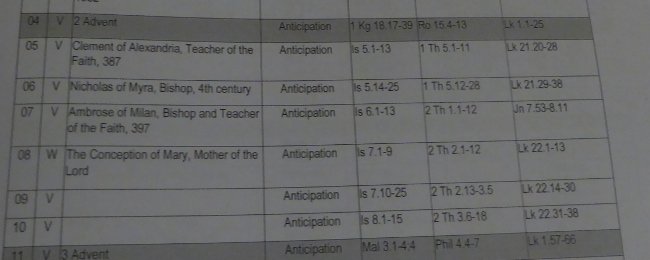
    And there’s even an easy explanation of how it works like this:

    Now, having produced it for myself, as an intellectual exercise if nothing else, it being the first time I’ve really used my programming skills since graduating in 1989, what to do with it?

    It seemed to me that this might be something that people in St Mary’s would like, not least those who have just completed the Vice Provost’s challenge to read the bible in a year.

    I printed some copies off and sold them on the Sunday morning and they went like hotcakes.

    Bishop Gregor has suggested that I should make them more widely available and, having checked with the chair of the Liturgy Committee that I wasn’t stepping on any toes by doing so, am now able to do so.

    Copies are available from me in church for the sum of £3 or are available to purchase on this website here:

    http://thurible.net/product/scottish-kalendar-2017/

    There’s a hefty discount for anyone wanting to buy in bulk for a bible study group maybe or for a church stall.

    For those wondering, the spelling Kalendar is a traditional spelling for a calendar kept by the church.

    This one runs from Advent Sunday 2016 until the end of 2017.

    I’d be happy to answer any other questions about this here. At this stage, I’m not going to be publishing a pdf – this is only available in physical form.

10 responses to “Sermon for Christ the King 2014”

  1. Julie Mansfield Avatar
    Julie Mansfield

    Kelvin, I follow your blog and I often find your conversations on facebook a lot of fun. But often, too, I don’t really understand what you are saying – such as your last paragraph there; ‘Like love. Like compassion. Like truth. Like hope. Like justice. Like joy. Like peace. Like the Way. Like the very essence of life itself.’ It sounds wonderful but what does it actually mean? Are you saying that the word, ‘God’ is a synonym for other worthwhile words which already have meanings I do understand?

    1. Kelvin Avatar

      What a good question.

      No, I’m not saying that, or at least not quite. I would say that we can’t describe what God is like in language, but one of the closest ways we can come near to talking about God is to talk by analogy – to talk about what God is like.

      The bible is full of times when people use analogy and metaphor to describe the reality of God which we can never completely comprehend.

      In this sermon I’m saying that whilst God may be like a king, God is also like a lot of things that one doesn’t immediately associate with kingship and monarchy. That string of words that you picked out in the sermon are all ways that the bible uses to speak of God. I was using them to do the same.

      Does any metaphor contain or enclose or sum up what we can say or know of God. The answer is always no.

  2. Joy Jones Avatar
    Joy Jones

    I loved your sermon. And have subscribed to your blog.

    No, I have not met the Queen, but I have met the King! And continue to get to know Him more and more every day. His love, peace joy, truth, etc.

    Our priest in North Carolina, said on Sunday, that
    it was hard to tell the difference between sheep and goats.
    Since you live in Scotland, you see a lot of sheep and goats….why did Jesus picked those animals?

    1. Kelvin Avatar

      Thanks for your comments, Joy.

      Actually, I don’t see that many sheep and goats in Great Western Road in the middle of Glasgow. I do see sheep when I drive in the countryside but very rarely goats.

      I think that it is the case that in the Middle East, sheep and goats are pastured together and do sometimes need sorting out. Here in Scotland, sheep and goats (especially wild goats) look very different. However I think in the Middle East, that’s less true.

  3. Julie Mansfield Avatar
    Julie Mansfield

    Kelvin, I’ve only just found your reply! Thanks so much for bothering. I really mean it. I thought you must have just ignored it. Yes, I see what you are saying but… I would say that all those meaningful words in the Bible about what God is like only make sense in the context of understanding who God is. ( i.e. that He came into being as the personification of the worldview of the marginalised Hebrew people, later taken up by Jesus, just as all of the other communities of the ancient Near East had gods representing their worldviews. I study with this bloke here http://www.bibleincartoons.co.uk. ) What I am trying – !! – to say is that God obviously cannot be everyone’s ‘truth’, ‘joy’, ‘justice’ etc because in society there are contradictory ideas about what these things are.

    1. Kelvin Avatar

      Are there contradictory ideas about truth, joy and justice?

      I’m not so sure. Surely we can still speak of these things as though they had some commonly understood meanings.

      1. Julie Mansfield Avatar
        Julie Mansfield

        oh absolutely there are, Kelvin. Just one of many examples: these immigrants in the Mediterranean Sea. Their truth and joy and justice is to be allowed to come and live here. Many folk here get their truth, joy and justice in seeking to put in controls. Whose truth, joy and justice is right? As I see it, the god of the marginalised Hebrews would side with the immigrants but I’m not sure about the Church…

        1. Kelvin Avatar

          I was speaking about God, not ethics. That’s not to say that there isn’t a lot that is interesting to say about the two, but they are quite different I think.

          The fact that people disagree about how to show love. does not, to me at least, negate the assertion that God is love.

      2. Julie Mansfield Avatar
        Julie Mansfield

        Oh absolutely there are contradictory ideas, Kelvin. Just one of many examples; these immigrants in the Mediterranean Sea. Their truth and joy and justice is to be allowed a place to live and thrive. For many folk here, their truth and joy and justice depends on keeping out as many immigrants as possible because they affect housing, medical care, schools etc. As I see it, the Biblical god of the marginalised Hebrews is on the side of the immigrants…

        1. Julie Mansfield Avatar
          Julie Mansfield

          sorry I didn’t see your reply! My difficulty is that you use words as if they have a universal meaning. E.g. love is not a neutral word. there are many different types of love such as conservative paternalistic love or socialist love or non-marginalising love. They are all love. How can God be them all?

Leave a Reply

Your email address will not be published. Required fields are marked *

Previous Posts

  • Overseas Links – some questions

    Lots of churches have overseas links. Individual churches, dioceses, even whole provinces of the Anglican Communion often have links to places far afield. They are sometimes successful, sometimes not. But they are often built on the curious last century notions that relationship depends upon physical contact and that travel is easier than communication. Of course,…

  • Another day, another new ministry now begins

    I was at the installation of a new rector at St John’s, Shaughnessy the other night. It was an extraordinary event – the arrival of a new priest to minister in a place which has been greatly fought over. It is one of the congregations where significant numbers of people left the Anglican Communion rather…