
• All Souls

    All Souls Day is a rehearsal for my own funeral.

    I realised this a few years ago when someone commented that the All Souls Requiem at St Mary’s seemed to be a particularly important time of the year and was appealing to more people than it used to. When I sat and thought about it, I realised that what I was doing each year in preparing for it was preparing for my own funeral and that at some level, part of what gives me life and energy at St Mary’s is building a community that would know exactly what to do if I dropped down dead.

    Some people might think that rather morbid but it isn’t. I don’t think that much about death. Keeping All Souls is actually a way of helping ourselves let the dead be dead without fixating constantly about them. After last night’s Requiem for All Souls it simply felt to me that all was as it should be. Those whom we care for had been commended to God’s love, we had prayed alongside one another in our remembering and we had done so in the most beautiful way we could do.

    There are many things about All Souls which touch me. One is the use of the Eucharistic prayer for Easter. That’s what we do whenever there’s a funeral that is a Eucharist too. When someone dies there’s a snatch of Easter Day about the proceedings. In the first light of Easter, glory broke from the tomb, after all.

    Last night’s requiem was sublime. The simple tunes of Rutter’s Requiem taking us on a pastoral journey. We saw that death is real. We saw that grief is raw. And we knew that God is love. The music was incredible – the choir literally singing to raise the dead.

    At least, that’s how it was for me.

    The double Feast of All Saints and All Souls is one that always takes my mind abroad too. I was in Sweden for it one year, the year before I was ordained. My memory is of people going to the graveyards and lighting candles on the graves. A little of the first snow of winter had fallen and there was mist swirling around the graveyard trees as people wandered the quiet pathways thinking about those who had died.

    I remember someone telling me that they always lit candles for their parents and then crossed the graveyard to light another one on the grave of Dag Hammarskjöld – All Saints and All Souls always mingle.

    And then three years ago I was in America at this time of year.

    It seems to me that Hallowe’en has suffered rather at lot in its return trip back across the Atlantic to these shores. It seems now to be an excuse for very poor fancy dress bought from cheap outfitters by people who want to get drunk looking like a pirate or Wonderwoman.

    Rather more interesting in the US these days is the set of traditions that the Latino people bring to this time of year. Some of the solemnity that northern Europeans cultivate when thinking about the dead is challenged by those who want to celebrate their dead with an enormous party.

    This is what this time of year looks like in one of the churches that I visited during my sabbatical – All Saints’ Church in Chicago – a place which knows how to party.
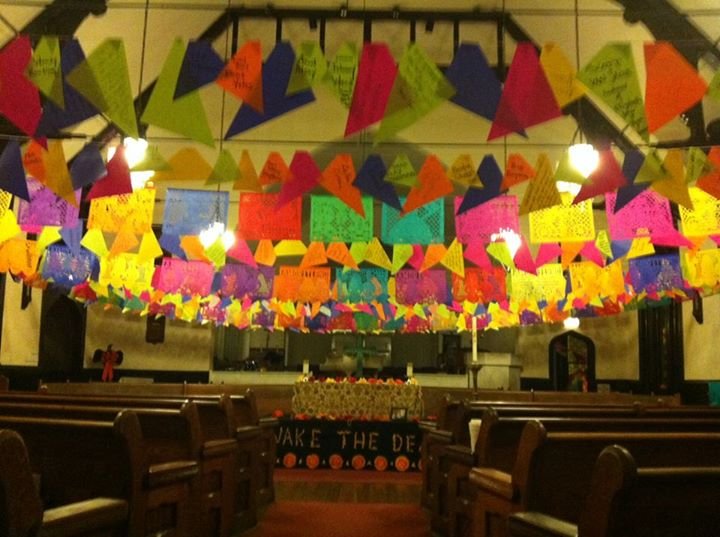
    All Saints Chicago

    In the midst of life we are in death.

    And vice versa.

10 responses to “Sermon for Christ the King 2014”

  1. Julie Mansfield Avatar
    Julie Mansfield

    Kelvin, I follow your blog and I often find your conversations on facebook a lot of fun. But often, too, I don’t really understand what you are saying – such as your last paragraph there; ‘Like love. Like compassion. Like truth. Like hope. Like justice. Like joy. Like peace. Like the Way. Like the very essence of life itself.’ It sounds wonderful but what does it actually mean? Are you saying that the word, ‘God’ is a synonym for other worthwhile words which already have meanings I do understand?

    1. Kelvin Avatar

      What a good question.

      No, I’m not saying that, or at least not quite. I would say that we can’t describe what God is like in language, but one of the closest ways we can come near to talking about God is to talk by analogy – to talk about what God is like.

      The bible is full of times when people use analogy and metaphor to describe the reality of God which we can never completely comprehend.

      In this sermon I’m saying that whilst God may be like a king, God is also like a lot of things that one doesn’t immediately associate with kingship and monarchy. That string of words that you picked out in the sermon are all ways that the bible uses to speak of God. I was using them to do the same.

      Does any metaphor contain or enclose or sum up what we can say or know of God. The answer is always no.

  2. Joy Jones Avatar
    Joy Jones

    I loved your sermon. And have subscribed to your blog.

    No, I have not met the Queen, but I have met the King! And continue to get to know Him more and more every day. His love, peace joy, truth, etc.

    Our priest in North Carolina, said on Sunday, that
    it was hard to tell the difference between sheep and goats.
    Since you live in Scotland, you see a lot of sheep and goats….why did Jesus picked those animals?

    1. Kelvin Avatar

      Thanks for your comments, Joy.

      Actually, I don’t see that many sheep and goats in Great Western Road in the middle of Glasgow. I do see sheep when I drive in the countryside but very rarely goats.

      I think that it is the case that in the Middle East, sheep and goats are pastured together and do sometimes need sorting out. Here in Scotland, sheep and goats (especially wild goats) look very different. However I think in the Middle East, that’s less true.

  3. Julie Mansfield Avatar
    Julie Mansfield

    Kelvin, I’ve only just found your reply! Thanks so much for bothering. I really mean it. I thought you must have just ignored it. Yes, I see what you are saying but… I would say that all those meaningful words in the Bible about what God is like only make sense in the context of understanding who God is. ( i.e. that He came into being as the personification of the worldview of the marginalised Hebrew people, later taken up by Jesus, just as all of the other communities of the ancient Near East had gods representing their worldviews. I study with this bloke here http://www.bibleincartoons.co.uk. ) What I am trying – !! – to say is that God obviously cannot be everyone’s ‘truth’, ‘joy’, ‘justice’ etc because in society there are contradictory ideas about what these things are.

    1. Kelvin Avatar

      Are there contradictory ideas about truth, joy and justice?

      I’m not so sure. Surely we can still speak of these things as though they had some commonly understood meanings.

      1. Julie Mansfield Avatar
        Julie Mansfield

        oh absolutely there are, Kelvin. Just one of many examples: these immigrants in the Mediterranean Sea. Their truth and joy and justice is to be allowed to come and live here. Many folk here get their truth, joy and justice in seeking to put in controls. Whose truth, joy and justice is right? As I see it, the god of the marginalised Hebrews would side with the immigrants but I’m not sure about the Church…

        1. Kelvin Avatar

          I was speaking about God, not ethics. That’s not to say that there isn’t a lot that is interesting to say about the two, but they are quite different I think.

          The fact that people disagree about how to show love. does not, to me at least, negate the assertion that God is love.

      2. Julie Mansfield Avatar
        Julie Mansfield

        Oh absolutely there are contradictory ideas, Kelvin. Just one of many examples; these immigrants in the Mediterranean Sea. Their truth and joy and justice is to be allowed a place to live and thrive. For many folk here, their truth and joy and justice depends on keeping out as many immigrants as possible because they affect housing, medical care, schools etc. As I see it, the Biblical god of the marginalised Hebrews is on the side of the immigrants…

        1. Julie Mansfield Avatar
          Julie Mansfield

          sorry I didn’t see your reply! My difficulty is that you use words as if they have a universal meaning. E.g. love is not a neutral word. there are many different types of love such as conservative paternalistic love or socialist love or non-marginalising love. They are all love. How can God be them all?

Leave a Reply

Your email address will not be published. Required fields are marked *

Previous Posts

  • More on animal blessings

    There has been some correspondence regarding the animal blessing service which takes place at 1030 on 1 October 2011. Firstly, Freda has been in touch on behalf of Misty who cannot be there on the day and asks what can be done. Well, actually the request is more specific than that. Freda says that Misty…

  • The happiest in the world?

    There is an interesting piece on Forbes Magazine’s website about a piece of research which has come up with the finding that, in the US at least, clergy appear to be those who have the greatest job satisfaction for amongst many other groups, they reported themselves to be the happiest of all. I think it…

  • Blessing of the Animals

    Could I just give quick notice that we will be having a Blessing of the Animals at St Mary’s Cathedral on 1 October 2011 at 1030. It is the Saturday nearest to St Francis’s Feast Day and a part of the committment we have to engage with thinking about creation. The service will last about…

  • Ten Years Ago Tonight

    I’ve waited before posting a “ten years ago” today kind of blog post to late evening because in my case I heard about the attacks in the US literally rather late in the day. On the morning of 11 September 2001 I woke up in Paris. I’d gone there to look for and look at…